 United States
“Scorsese's film is a dark, brooding, and often terrifying journey into the psyche.”
Claudia Puig
USA Today
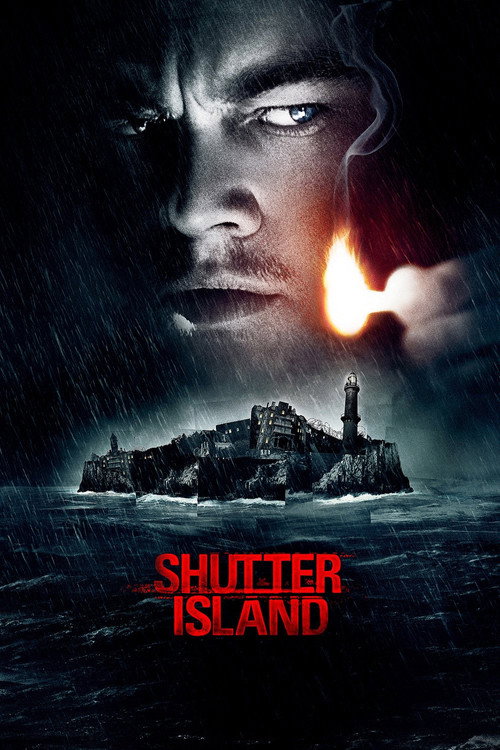
February 1954. U.S. Marshal Teddy Daniels arrives by ferry at the remote Ashecliffe Hospital for the criminally insane, a fortress-like institution on a windswept island off the coast of Boston. His assignment: investigate the disappearance of Rachel Solando, a patient who vanished from a locked cell. The hospital's chief psychiatrist, Dr. John Cawley, insists it's impossible. But Daniels isn't buying it. Haunted by the death of his wife and his memories of liberating Dachau, he senses a conspiracy. His new partner, Chuck Aule, is a talkative, easygoing deputy from Oregon. Together they step into a maze of lies, drugs, and psychological warfare.
Martin Scorsese directed this adaptation of Dennis Lehane's 2003 novel, spending $80 million to build a world that feels both historically precise and nightmarishly abstract. The film earned $294 million globally and became one of the most talked-about thrillers of the decade. Leonardo DiCaprio gives a raw, unhinged performance as Daniels, supported by Mark Ruffalo, Ben Kingsley, and Max von Sydow. Scorsese fills the frame with rain, fog, and the dissonant strings of Penderecki and Ligeti. The result is a film that feels less like a whodunit and more like a descent into madness.
Stream
Paramount+
Rent
Amazon Prime Video
$3.99
Availability and pricing can change. Confirm on the provider's site before purchasing.
In the summer of 1954, U.S. Marshal Teddy Daniels and his new partner Chuck Aule take a ferry to Shutter Island, home of Ashecliffe Hospital for the criminally insane. A Category 4 hurricane is brewing, and the island already feels off. The warden greets them with a warning: the staff knows how to handle their own. Teddy and Chuck are led to the hospital's main building, a grim stone structure with barred windows and locked wards. They meet Dr. John Cawley, the chief psychiatrist, who explains that patient Rachel Solando, a woman who drowned her three children, vanished from her room the night before. The door was locked from the outside. The window was barred. No one saw anything.
Teddy begins questioning the staff and patients, but every answer leads to more questions. A patient named Bridget Kearns whispers a cryptic phrase: "The Law of 4." Another patient, George Noyce, warns Teddy that the hospital is conducting mind-control experiments and that he should get off the island while he can. Teddy finds a note in Rachel's cell that reads "Who is 67?" The numbers and names start to feel like a code. He learns that the hospital has a lighthouse, but no one will tell him what happens there. Meanwhile, his headaches and nightmares grow worse. He sees his dead wife, Dolores, in his sleep, her back covered in ash, whispering that he must leave.
Chuck seems supportive, but Teddy notices that the deputy marshal sometimes hesitates, as if he knows more than he lets on. When Teddy tries to access Ward C, the most secure wing, Dr. Cawley blocks him, citing patient privacy. Teddy pushes harder, demanding to see the patient files. He discovers that an inmate named Andrew Laeddis set the fire that killed their landlord and that Laeddis is somehow connected to his wife's murder. The storm hits, cutting off all communication with the mainland. Power flickers. Patients roam the halls. Teddy and Chuck split up to search the island. Teddy ends up in a cave on the cliffs, where he finds a woman who claims to be the real Dr. Rachel Solando, a former psychiatrist who fled the hospital because of the unethical experiments being conducted there. She tells him that the entire facility is a front for a CIA program that uses drugs, electroshock, and psychological manipulation to control minds. She warns him that his partner, Chuck, is not who he appears to be.
Teddy returns to the hospital, more paranoid than ever. He confronts Dr. Cawley, demanding to see the lighthouse. Cawley refuses. Teddy steals a gun from the warden's office and breaks into Ward C. There he finds George Noyce, who tells him the truth: Teddy is not a marshal. He is a patient. The entire investigation is a role-playing therapy designed to break through his delusion. Noyce says that Teddy has been here for months, and that he has failed the test before. The storm rages. Teddy, shaken but still believing his own story, decides to storm the lighthouse. He believes that is where the experiments are happening, and that Laeddis is being held there. He leaves Chuck behind and heads into the rain.
Trailer
Critical Consensus
Martin Scorsese's Shutter Island is a stylish, atmospheric thriller bolstered by a strong performance from Leonardo DiCaprio. While its twists may be divisive, the film is a compelling and suspenseful watch.
“Scorsese's film is a dark, brooding, and often terrifying journey into the psyche.”
Claudia Puig
USA Today
“Shutter Island is a marvel of mood and mystery, a labyrinthine puzzle box that keeps you guessing until the very end.”
Peter Travers
Rolling Stone
“Leonardo DiCaprio gives a powerhouse performance as a man unraveling under immense psychological pressure.”
Roger Ebert
Chicago Sun-Times
“The film is a masterclass in suspense, expertly building tension and dread with every scene.”
Manohla Dargis
The New York Times
Leonardo DiCaprio
Teddy Daniels
Mark Ruffalo
Chuck Aule
Ben Kingsley
Dr. Cawley
Max von Sydow
Dr. Jeremiah Naehring
Michelle Williams
Dolores Chanal
Emily Mortimer
Rachel Solando
Patricia Clarkson
Dr. Rachel Solando
Jackie Earle Haley
George Noyce
Ted Levine
Warden
John Carroll Lynch
Deputy Warden McPherson
Director
Martin Scorsese
Writers
Dennis Lehane, Laeta Kalogridis
Cinematographer
Robert Richardson
Producers
Bradley J. Fischer, Mike Medavoy, Arnold Messer, Martin Scorsese
Golden Globe (2011)
Best Actor – Motion Picture Drama: Nominated
BAFTA Award (2011)
Best Film Music: Nominated
Saturn Award (2011)
Best Horror Film: Nominated
Saturn Award (2011)
Best Actor: Nominated
Critics' Choice Movie Award (2011)
Best Adapted Screenplay: Nominated
Join the community
fans discussing