“Short Peace is a solid anime compilation movie, arguably the best adaptation of Farewell to Weapons ever made.”
Ollie Barder
Forbes
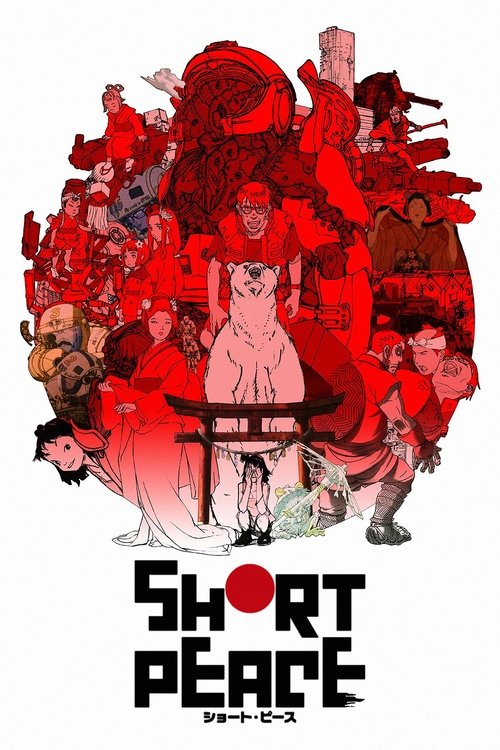
 Japan
Japan"Four visions of Japan, one unbroken spirit."
User Score
75 votes
Short Peace is a 2013 Japanese anthology film that strings together four distinct anime shorts, each exploring a different facet of Japanese culture and imagination. Directed by a quartet of filmmakers including Katsuhiro Otomo and Shuhei Morita, the collection spans genres from supernatural horror to sci-fi action. The voice cast features notable talents like Aoi Yuuki, Koichi Yamadera, and Saori Hayami, bringing life to characters across the segments. Produced by SUNRISE, the film had a modest theatrical run starting July 20, 2013, and grossed just over $22,000 at the box office, a figure that reflects its niche appeal rather than its ambition. With a runtime of 68 minutes, Short Peace offers a compact yet varied viewing experience, and its reception, marked by a 6.4 rating from 75 votes, suggests it resonated more with anime enthusiasts than mainstream audiences. The anthology format, reminiscent of earlier experiments like Neo Tokyo, showcases the range of contemporary Japanese animation, from hand-drawn elegance to digital spectacle.
The four segments are united by a loose thematic thread: the fragility of peace in the face of conflict, whether that conflict is supernatural, social, or technological. Shuhei Morita's "Tsukumo" (or "Possessions") earned an Academy Award nomination for Best Animated Short, putting the film on the international map even before its full release. Katsuhiro Otomo, known globally for Akira, contributes "Combustible," a period piece that adapts his own manga and showcases his signature attention to detail. Hiroaki Ando's "Gambo" is a brutal folklore tale, while Hajime Katoki's "Farewell to Weapons" closes the film with a dystopian robot battle. Each segment has its own visual identity, from the painterly textures of "Combustible" to the CG-heavy action of the finale.
The project was a collaborative effort overseen by the SHORT PEACE COMMITTEE, which included Sunrise and Otomo's production company Mash•Room. It was conceived as part of a larger multimedia push that also spawned a manga adaptation and a video game tie-in, though neither achieved the same cultural footprint as the film itself. Short Peace is the fourth anthology Otomo has been involved with, following Robot Carnival, Neo Tokyo, and Memories, and it fits neatly into that lineage while also pushing the format forward. For anime fans, it remains a hidden gem, a compact showcase of what the medium can do when given the freedom to experiment.
Availability and pricing can change. Confirm on the provider's site before purchasing.
Short Peace opens with "Tsukumo," directed by Shuhei Morita. A lone traveler, soaked from a sudden storm, stumbles upon an abandoned mountain shrine and seeks shelter. Inside, he finds a collection of household objects that have come to life as tsukumogami, spirits born from items discarded after a century of use. A broken umbrella, a cracked lantern, and other worn tools surround him, their movements both eerie and playful. The traveler, initially fearful, soon realizes these spirits are less interested in harming him than in being acknowledged. He begins to repair what he can, mending the umbrella's ribs and patching the lantern's paper, and in doing so, he earns their gratitude. By morning, he departs unharmed, leaving the shrine restored and the spirits at peace.
The second segment, "Combustible," is directed by Katsuhiro Otomo and set in Edo-period Japan. It follows Owaka, the daughter of a merchant, and Matsukichi, the son of a fireman. The two are childhood friends, but their paths diverge as they grow up. Owaka is bound by the expectations of her class, eventually entering an arranged marriage, while Matsukichi dedicates himself to the dangerous work of fighting fires in a city built from wood and paper. Their unspoken feelings for each other simmer beneath the surface, never quite breaking through. The segment is a visual tour de force, with Otomo's meticulous animation capturing the bustling streets and the constant threat of flame. As a fire breaks out and spreads rapidly, Owaka and Matsukichi are caught in the chaos, their personal drama playing out against a backdrop of destruction.
The third segment, "Gambo," directed by Hiroaki Ando, shifts to a feudal village terrorized by a monstrous red demon called Onibaba. The villagers live in fear, their crops and families at risk. A young girl, the only one brave enough to seek help, ventures into the forest and encounters a mysterious white bear named Gambo. Gambo is a supernatural guardian, and after some hesitation, he agrees to face the demon. The ensuing battle is brutal and prolonged, with the bear and the demon clashing across the landscape, uprooting trees and scarring the earth. The girl watches from a distance, her hope and fear intertwined. The fight tests both combatants, but Gambo's determination ultimately prevails, though not without a heavy cost to himself and the village.
The final segment, "Farewell to Weapons," is directed by Hajime Katoki and written by Otomo. Set in a post-apocalyptic near-future Tokyo, it follows a squad of soldiers assigned to neutralize rogue military robots that have gone haywire in the ruined city. The team, led by a battle-hardened veteran, navigates the urban battlefield, engaging in firefights with the machines. The action is intense, with explosions and gunfire echoing through the empty streets. Amid the chaos, the soldiers grapple with the pointlessness of their mission: even if they destroy these robots, new ones will be built, and the cycle of violence will continue. The segment blends CG and traditional animation, creating a stark contrast between the sleek, mechanical enemies and the gritty, human soldiers. As the mission reaches its climax, the protagonist is forced to confront the futility of his role in this endless war.
Throughout the anthology, the segments are bookended by brief interstitial scenes that hint at a larger narrative, but they remain abstract, leaving the viewer to draw connections. The film's title, Short Peace, plays on the idea of "short pieces" while also commenting on the fleeting nature of peace itself. Each segment offers a different lens on Japanese identity, from folklore and history to modern anxieties about technology and conflict, and together they form a cohesive meditation on the forces that disrupt harmony.
"Short Peace" Trailer (English Subbed)
Critical Consensus
Short Peace is a visually ambitious anthology that showcases the range of contemporary Japanese animation, from Morita's Oscar-nominated Tsukumo to Otomo's technically stunning Combustible. While the segments vary in narrative strength, the collection as a whole demonstrates the medium's capacity for both intimate storytelling and large-scale spectacle. Its limited box office reflects niche appeal, but among anime enthusiasts it's regarded as a worthy successor to Otomo's earlier anthology projects.
“Short Peace is a solid anime compilation movie, arguably the best adaptation of Farewell to Weapons ever made.”
Ollie Barder
Forbes
“A traveler is confronted by spirits in an abandoned shrine, a white bear defends the royal family from a red demon, and ragtag soldiers battle a robotic force...”
Rotten Tomatoes Editorial
Rotten Tomatoes
“A lone traveler is confronted by unusual spirits in Shuhei Morita's Academy Award nominee POSSESSIONS (TSUKUMO).”
Sentai Filmworks
Sentai Filmworks
Aoi Yuuki
Beauty (segment "Tsukumo") (voice)
Koichi Yamadera
Samurai (segment "Tsukumo") (voice)
Takeshi Kusao
Frog (segment "Tsukumo") (voice)
Saori Hayami
Owaka (segment "Combustible") (voice)
Yu Kobayashi
Oume (segment "Combustible") (voice)
Masakazu Morita
Matsukichi (segment "Combustible") (voice)
Directors
Hiroaki Ando, Shuhei Morita, Katsuhiro Otomo, Hajime Katoki
Writers
Shuhei Morita, Katsuhiro Otomo, Kishi Keisuke, Katsuhito Ishii, Kensuke Yamamoto
Academy Award for Best Animated Short Film (2014)
Best Animated Short Film: Nominated
Join the community
fans discussing