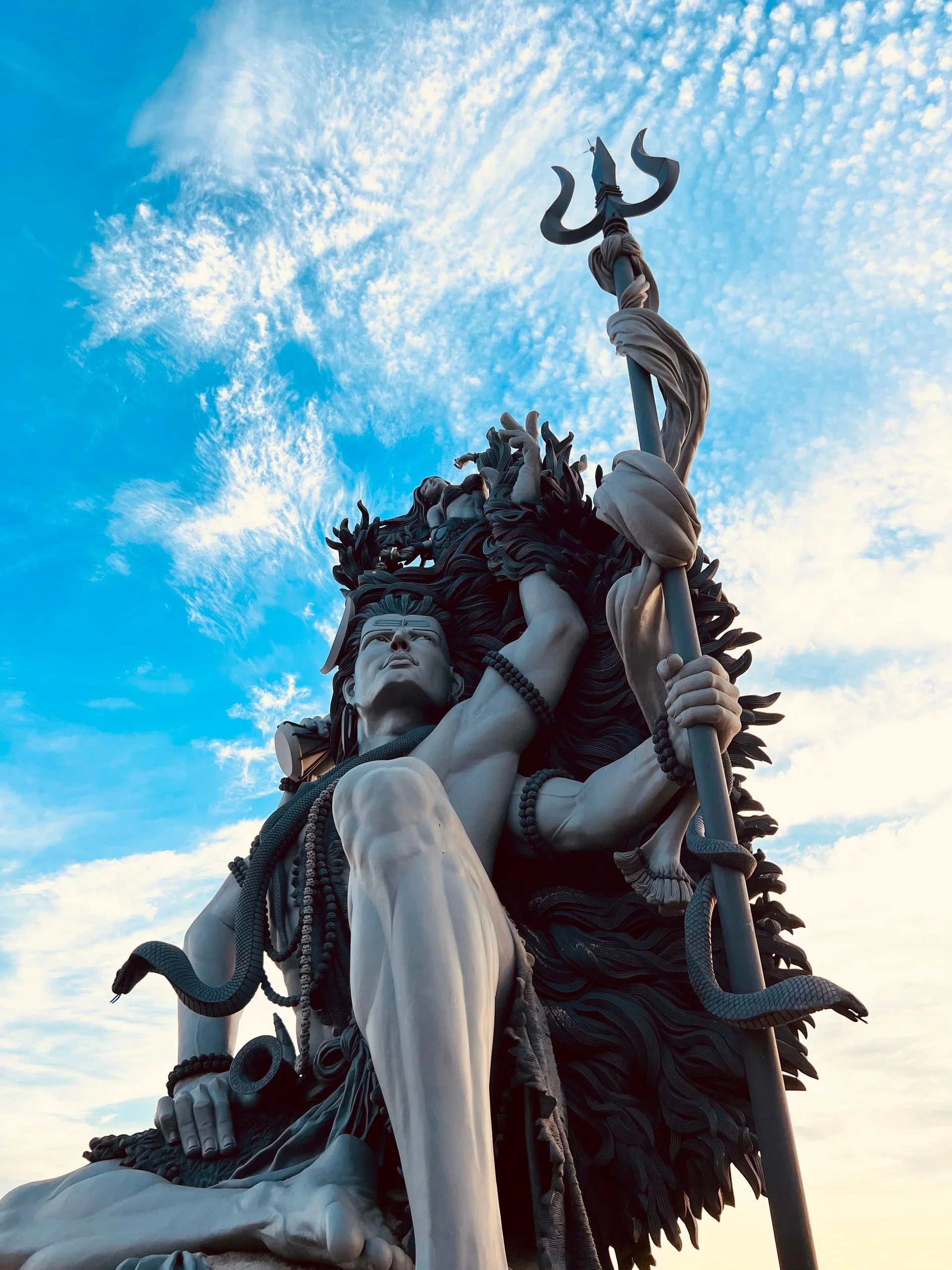
Shiva
Also known as: Mahadeva, Hara, Rudra, Nataraja, Adiyogi, Neelkantha
Birthday
Birth Sign
Birthplace
Age
0 years old
About
Shiva is one of the principal deities of Hinduism and the Supreme Being in the Shaivism tradition. Revered as the Destroyer within the Trimurti alongside Brahma and Vishnu, he embodies the cyclical nature of creation, preservation, and transformation. His name derives from the Sanskrit word meaning 'The Auspicious One', though he is also widely known by titles such as Mahadeva ('The Great God') and Hara ('The Remover').
In the Shakta tradition, Shiva stands as the equal complementary partner to the Supreme Goddess Devi, representing consciousness to her creative energy or Shakti. Devotees worship him in diverse forms ranging from the ascetic yogi meditating on Mount Kailasa to the fierce warrior slaying demons. He is particularly celebrated as Adiyogi, the first yogi who transmitted the knowledge of yoga to the seven sages.
Public Image & Style
The public image of Shiva is uniquely dualistic, encompassing both terrifying power and benevolent compassion. He is often depicted as an ascetic covered in ash, wearing tiger skins and adorned with a serpent around his neck. This appearance symbolizes renunciation and mastery over fear. Yet, he is equally revered as a joyful dancer and a loving husband. His third eye represents spiritual insight that can burn away ignorance and desire.
Fame & Fandom
iFANN has not yet collected fame data for this person. While Shiva does not appear in modern celebrity rankings, his influence spans centuries and continents. The global community of Hindus worships him with immense devotion, forming a vast network of devotees known as Shaivas or Saivites. There is no formal fandom name like those seen in pop culture, but the collective following is arguably larger than any human celebrity fanbase.
Fan culture revolves around deep ritualistic practices rather than social media trends. Devotees observe fasting on Mondays, chant mantras like Om Namah Shivaya, and offer milk and water to the Lingam. The festival of Maha Shivaratri draws millions of pilgrims to temples across India and Nepal for night-long vigils. Massive charitable drives organized by temple trusts further demonstrate the organized nature of this spiritual community.
Interesting Facts and Legends
One of the most enduring legends surrounding Shiva involves the churning of the ocean, known as Samudra Manthan. When a deadly poison called Halahala emerged during the process, threatening to destroy the universe, Shiva drank it to save creation. The poison remained in his throat for an eon, turning it blue, which earned him the epithet Neelkantha or 'The Blue-Throated One'. Another iconic image depicts him performing the Tandava, the cosmic dance of destruction and creation, often shown as Nataraja, the Lord of Dance, encircled by a ring of fire.
Notable Quotes
“I am the beginning, the end, and the middle of all things.”
“The only way to find peace is to let go of the past and embrace the present.”
Family & Personal Life
Shiva's family life is central to Hindu mythology and features complex divine relationships. His first wife was Sati, the daughter of King Daksha, whose self-immolation in protest of her father's disrespect led to her rebirth as Parvati. Parvati, the daughter of Himavan, the mountain king, eventually won Shiva back through intense austerities. Together with Parvati, Shiva is the father of Ganesha, the elephant-headed god of wisdom, and Kartikeya, the god of war. These figures are worshipped individually across South Asia and Southeast Asia.
Notable Connections
Relationships & Dating History
Shiva's romantic history is defined by divine myths rather than human timelines. His first marriage was to Sati, the daughter of King Daksha. This union ended tragically when Sati immolated herself after her father insulted Shiva. Following her death, she was reborn as Parvati, who performed severe penance to win Shiva's heart again. They married and established a household on Mount Kailasa, becoming the archetypal divine couple.
As an eternal deity, Shiva exists beyond temporal states of singlehood or widowhood. He maintains simultaneous existence in all aspects of life, including his role as a householder and a solitary ascetic. His relationship with Parvati is viewed as the union of masculine and feminine principles, essential for the balance of the universe.
- DivorcedSatiFirst wife; died by self-immolation after her father's insult.
- MarriedParvatiCurrentReincarnation of Sati; current consort and mother of Ganesha and Kartikeya.
Salary, Net Worth In 2026
$0
iFANN Editorial Team estimate
Awards & Accolades
View 3 records, honours and achievementsKnown For
The Destroyer
· Cosmic Function
Adiyogi
· Patron of Yoga
Nataraja
· Lord of Dance
Keywords
Sources
Quick Facts
- Gender
- Male
- Spouse
- Parvati, Sati
- Children
- Ganesha, Kartikeya
- Mountains
- Mount Kailasa
- Weapon
- Trishula (Trident)
Personal Details
- Spouse
- Parvati, Sati
- Children
- Ganesha, Kartikeya
Frequently Asked Questions
Who is Shiva in Hinduism?
What are Shiva's children named?
Why is Shiva called Neelkantha?
Is Shiva still worshipped today?
What is the significance of the third eye?
Similar People
Join the community
fans discussing