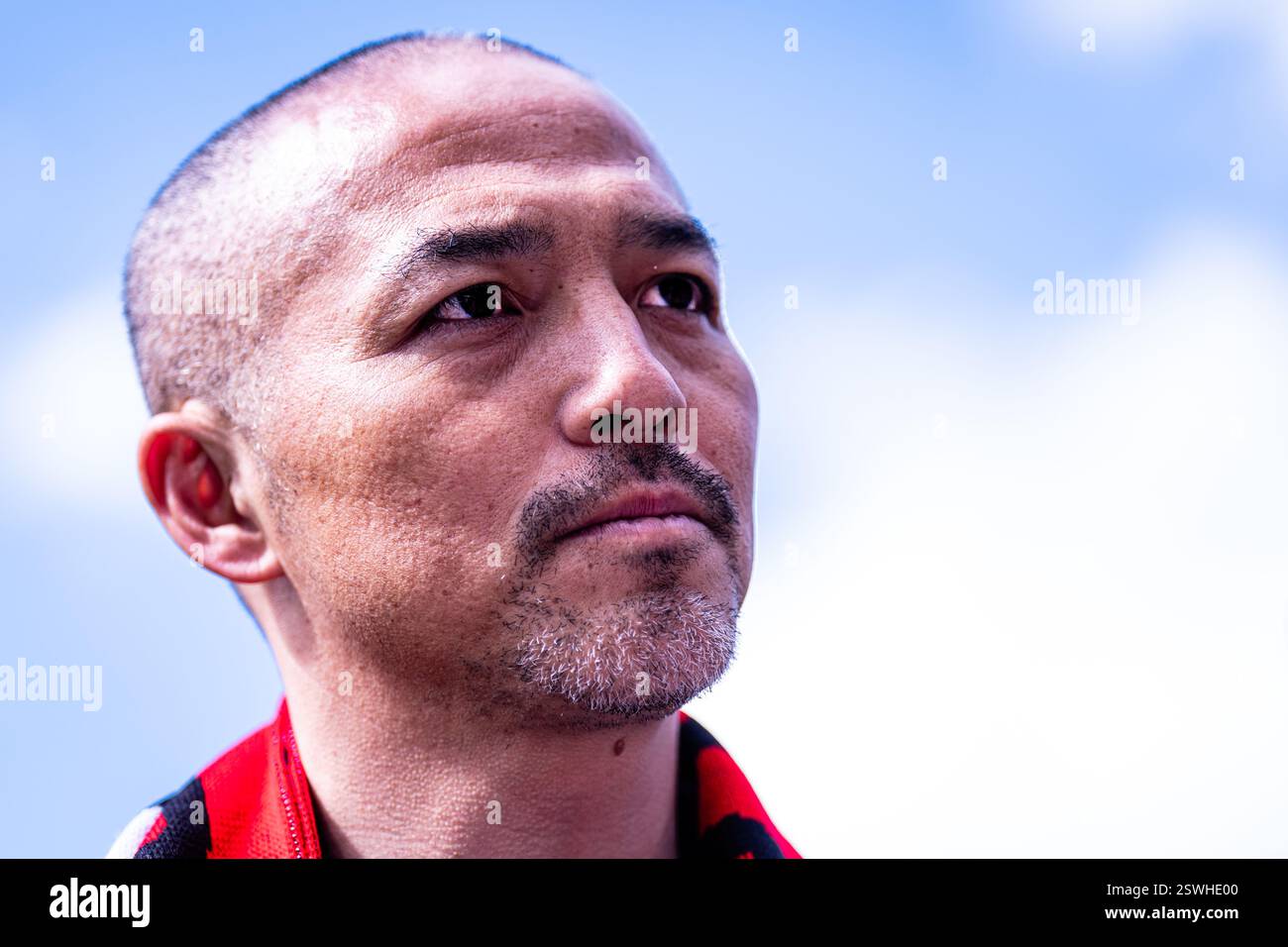
Shinji Ono
 Japan
JapanFormer professional footballer (midfielder)
Also known as: The Genius
Birthday
September 27, 1979
Birth Sign
Libra
Birthplace
Numazu, Shizuoka, Japan
Age
47 years old
Height
1.75 m (5 ft 9 in)
About
Shinji Ono is a distinguished Japanese former professional footballer who primarily operated as a midfielder. Born on September 27, 1979, in Numazu, Shizuoka, he achieved a landmark status as the first Japanese player to secure a major European trophy, triumphing in the UEFA Cup with Feyenoord in 2002. His illustrious career, spanning over two decades, saw him represent clubs across Japan, the Netherlands, Germany, and Australia. Ono also accumulated 56 caps for the Japan national team, participating in three FIFA World Cups. Standing at 1.75 meters (5 ft 9 in), he is recognized for his exceptional technical skill, astute vision on the field, and groundbreaking achievements in international football. As of 2023, Ono has retired from professional football after his final match in 2020, concluding a career that left an indelible mark on the sport.
Early Life & Background
Shinji Ono spent his formative years in Shizuoka Prefecture, attending Imazawa Junior High School and later Shimizu Shogyo High School, where his footballing prowess began to flourish. He joined the youth system of J1 League club Urawa Reds, making his senior debut in 1998 at the young age of 18. That same year, he earned a place in Japan's squad for the 1998 FIFA World Cup in France, becoming the youngest Japanese player ever to feature in the tournament. His leadership as captain of the Japanese Under-20 team, guiding them to the final of the 1999 FIFA World Youth Championship in Nigeria, garnered significant international attention. However, a serious knee injury sustained later that year led to him missing the remainder of the season and crucial Olympic qualifiers, a significant setback that profoundly influenced his early career trajectory.
Career Growth
Ono's transfer to Dutch club Feyenoord in 2001 marked a pivotal moment in his career. In 2002, he etched his name in history by becoming the first Japanese player to win a European trophy, as Feyenoord secured the UEFA Cup, defeating Borussia Dortmund 3-2 in a memorable final. He played for Feyenoord for four seasons, accumulating 112 appearances and scoring 19 goals. In 2006, Ono returned to Urawa Reds, where he was instrumental in leading the club to the J.League title in his inaugural season back and subsequently to the AFC Champions League title in 2007. A move to German Bundesliga side VfL Bochum in January 2008 was unfortunately hampered by injuries, restricting his appearances to just 29 games without scoring. He then joined Shimizu S-Pulse in January 2010, followed by a stint with the Western Sydney Wanderers in Australia from 2012 to 2014, where he played a crucial role in their early A-League campaigns. His career concluded with spells at Hokkaido Consadole Sapporo (2014-2019) and FC Ryukyu (2019-2020), before his official retirement from professional football in 2023. Throughout his senior career, Ono amassed 485 appearances and scored 57 goals across all clubs. He also earned 56 caps for Japan, representing his nation in the 1998, 2002, and 2006 FIFA World Cups, and was part of the squad that won the AFC Asian Cup in 2000. His career statistics include 79 appearances and 20 goals for Urawa Reds (1998–2001), 112 appearances and 19 goals for Feyenoord (2001–2005), 53 appearances and 8 goals for Urawa Reds (2006–2007), 29 appearances and 0 goals for VfL Bochum (2008–2009), 70 appearances and 8 goals for Shimizu S-Pulse (2010–2012), 47 appearances and 9 goals for Western Sydney Wanderers (2012–2014), 62 appearances and 2 goals for Hokkaido Consadole Sapporo (2014–2019), and 23 appearances and 0 goals for FC Ryukyu (2019–2020).
Career Timeline
Public Image & Style
Shinji Ono is widely celebrated in Japanese football circles as one of the most technically gifted midfielders of his generation, consistently lauded for his exceptional dribbling skills, precise passing, and insightful playmaking. His groundbreaking success in Europe, particularly winning the UEFA Cup, has cemented his legacy as a trailblazer, earning him a revered status in Japanese football history. He is admired not only for his on-field abilities but also for his enduring humility and professional demeanor throughout his career. Ono engages with his fanbase through social media platforms like Instagram (@shinjiono7) and X (@OnoSkcr), often sharing training insights and personal moments, though he generally maintains a discreet public profile. His pioneering achievements have inspired countless aspiring footballers and opened pathways for Japanese talent in top-tier European leagues.
Fame & Fandom (iFAMOUS Rankings)
Shinji Ono commands a decentralized following across Japan, Europe, and Australia, distinguished by an organic reverence rather than corporate orchestration. His supporters, generally identified as "Ono fans," coalesce around the moniker "Genius," a title reflecting his technical mastery rather than serving as a formal group name. Unlike modern idol cultures driven by aggressive marketing or viral chart pushes, Ono's audience grew through sustained performance over a twenty-six-year career, culminating in a quiet farewell that resonated deeply without pre-planned rituals. The narrative of his legacy is anchored in verified milestones, including his silver medal at the 2000 Sydney Olympics, which fostered a loyal base that celebrates his longevity and humility. While cross-media projects like the *Shoot! Goal to the Future* trailer have engaged third-party enthusiasts, the core identity remains tied to his on-field elegance. Despite this enduring global respect, Shinji Ono is currently the subject of an iFANN evaluation that places him outside the published Global Top 1,000 rankings. As of August 2026, he holds no placement in the Global Top 1,000 or any Top-100 scope list, a status confirmed by the iFANN Global Fame Engine. This absence of a numerical rank does not diminish his historical significance but reflects the current distribution of his fame within the broader celebrity ecosystem.
Interesting Facts and Legends
Shinji Ono holds the distinction of being the youngest Japanese player to ever participate in a FIFA World Cup, making his debut at the age of 18 years and 288 days in 1998. He is also the first Japanese footballer to achieve the feat of winning a major European trophy. During his playing days, he was affectionately nicknamed "The Genius" by fans, a reflection of his remarkable technical capabilities. Ono was known for his ambidexterity, demonstrating proficiency with both his left and right feet on the pitch. A notable moment in his international career was a memorable free-kick goal scored against Australia during a 2009 World Cup qualifier. Post-retirement, Ono has taken up golf as a recreational activity and has participated in various celebrity golf tournaments. He was also part of the Japanese squad that finished as runner-up in the 2001 FIFA Confederations Cup. A persistent story among enthusiasts notes his unique status as a living link between late 1990s video games and modern football, having been a playable character in *World Cup 98* while spanning nearly three decades of professional play. In 2024, his cultural impact was further cemented when a new variety of lily was named in his honor during a ceremony at the Dutch Embassy.
Notable Quotes
“I always tried to enjoy my football and give my best for the team.”
“Winning the UEFA Cup was a dream come true for me and for Japanese football.”
“I never thought about records, I just wanted to play well.”
Family & Personal Life
Information regarding Shinji Ono's immediate family is not widely publicized. He has kept details about his parents and any siblings largely private, choosing not to share extensive personal information. While he has mentioned in past interviews that his family was a source of support for his burgeoning football career from an early age, he maintains a strong preference for keeping his domestic life away from the public eye. As of the current year, there is no public record of him being married or having children.
Notable Connections
Shinji Ono is not commonly associated with other celebrities, but he played alongside notable Japanese internationals such as Hidetoshi Nakata and Shunsuke Nakamura. His name is sometimes confused with the fictional character Shinji Ikari from the anime Neon Genesis Evangelion, though the two are unrelated.
Relationships & Dating History
Shinji Ono has maintained a highly private personal life, with no publicly documented romantic relationships, marriages, or significant partnerships. His relationship status as of the present remains undisclosed, and he has not been publicly linked with any high-profile individuals. Ono has consistently prioritized his football career and has seldom discussed his personal romantic life in interviews, preferring to keep these aspects of his life out of the public spotlight.
Salary, Net Worth In 2026
$5 Million
iFANN Editorial Team estimate
Per iFANN's editorial analysis, Shinji Ono's estimated net worth stands at $5 Million. This financial standing has been primarily accumulated through his extensive professional football career, which included lucrative contracts with clubs in Japan, the Netherlands, Germany, and Australia. During his prime playing years, particularly with Feyenoord and Urawa Reds, he commanded substantial salaries and benefited from various endorsement opportunities. Post-retirement, his income streams likely extend to public appearances, coaching initiatives, and potential social media partnerships. His financial standing has seen consistent growth over the years, reflecting the success and longevity of his football career.
Awards Won (4)
Shinji Ono won several major team honors, including the UEFA Cup in 2002, the J.League title in 2006, and the AFC Champions League in 2007. With Japan, he won the AFC Asian Cup in 2000 and was a runner-up in the 2001 FIFA Confederations Cup. These achievements highlight his success both at club and international level.
2000 · Winner
Japan national team
2002 · Winner
Feyenoord
Known For
UEFA Cup winner with Feyenoord
2002 · Midfielder
J.League champion with Urawa Reds
2006 · Midfielder
AFC Champions League winner
2007 · Midfielder
Japan national team (56 caps, 3 World Cups)
1998-2006 · Midfielder
Keywords
Sources
Quick Facts
- Profession
- Former professional footballer
- Born
- September 27, 1979
- Birthplace
- Numazu, Shizuoka, Japan
- Gender
- Male
- Birth Sign
- Libra
- Height
- 1.75 m (5 ft 9 in)
- National Team Caps
- 56
Personal Details
- Height
- 1.75 m (5 ft 9 in)
- Children
- Education
- Shimizu Shogyo High School
Frequently Asked Questions
What is Shinji Ono's nationality and profession?
What are Shinji Ono's major career achievements?
When did Shinji Ono retire from football?
Which clubs did Shinji Ono play for?
Did Shinji Ono play in the World Cup?
Social Media
Similar People

Join the community
fans discussing