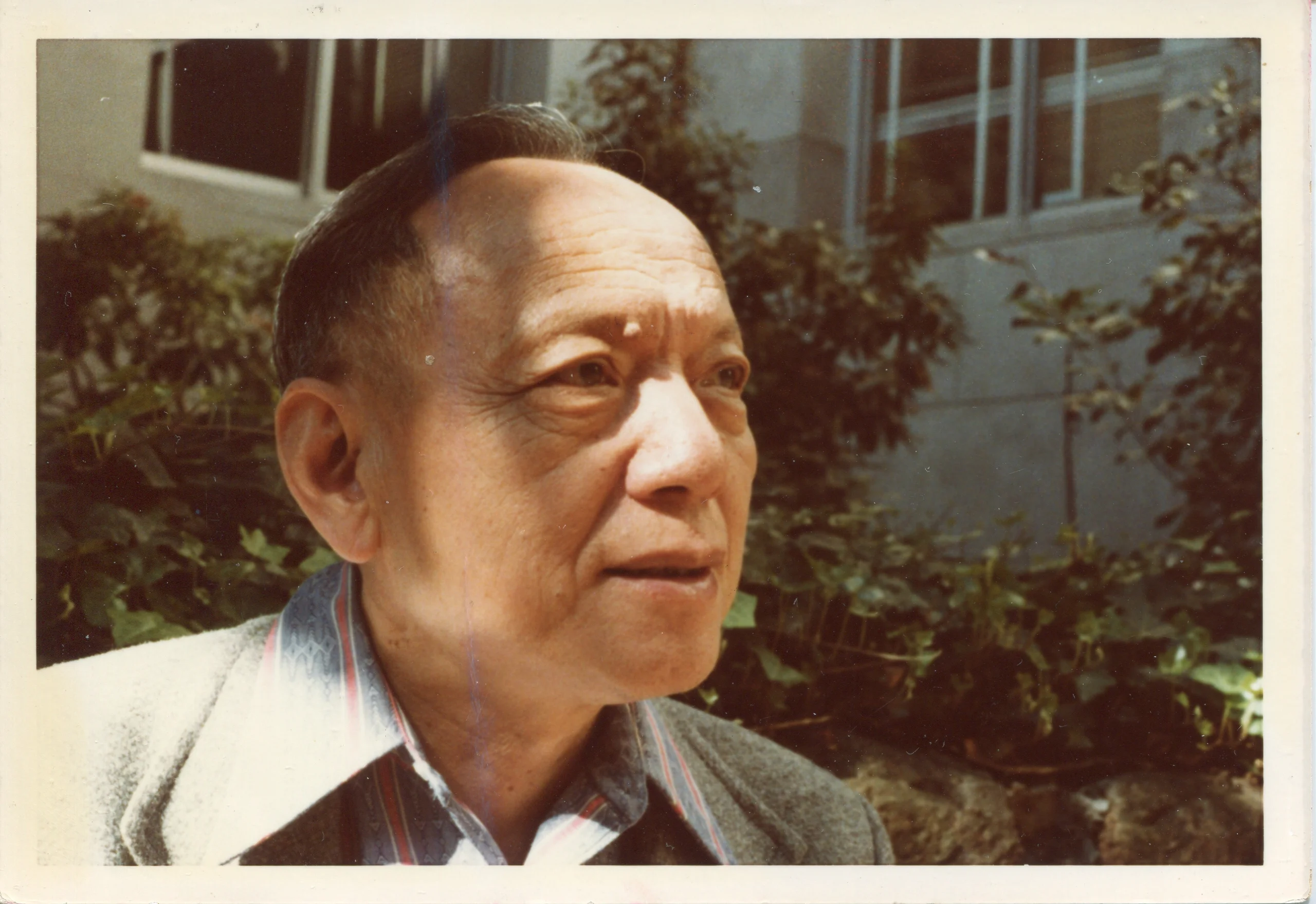
Shiing-Shen Chern
 China
Chinamathematician•university teacher
Also known as: S.S. Chern, 陈省身
Birthday
October 26, 1911
Birth Sign
Scorpio
Birthplace
Jiaxing, Zhejiang, China
Age
Died at 93
About
Shiing-Shen Chern was a Chinese-born American mathematician who reshaped modern differential geometry. He is widely regarded as the father of modern differential geometry, and his work on Chern classes and the Chern–Simons theory became foundational in both mathematics and theoretical physics. His contributions earned him the Wolf Prize, the National Medal of Science, and the inaugural Shaw Prize. He died on December 3, 2004, in Tianjin, China, at the age of 93.
Chern's career spanned top institutions: the Institute for Advanced Study in Princeton, the University of Chicago, and the University of California, Berkeley, where he co-founded the Mathematical Sciences Research Institute in 1982. His collaboration with Jim Simons produced the Chern–Simons theory, which later found applications in condensed matter physics and quantum field theory. The International Mathematical Union established the Chern Medal in 2010 to honor outstanding mathematical achievements. His legacy continues through the Chern Institute of Mathematics and regular commemorative conferences.
Early Life & Background
Shiing-Shen Chern was born on October 26, 1911, in Jiaxing, a city in Zhejiang Province, China. He showed an early aptitude for mathematics, graduating from Nankai University in 1930. He then spent four years at Tsinghua University, earning a master's degree. In 1934, he traveled to Germany to study at the University of Hamburg, where he completed his doctorate in 1936 under Wilhelm Blaschke.
Afterward, Chern spent a postdoctoral year in Paris, working closely with Élie Cartan. Cartan's methods of moving frames and exterior differential calculus deeply influenced Chern's approach, providing the technical foundation for his later breakthroughs. This period was pivotal in shaping his mathematical style, which combined geometric intuition with powerful analytic techniques.
Career Growth
Chern's most celebrated achievement came in 1944 while he was at the Institute for Advanced Study in Princeton. He proved the intrinsic Gauss–Bonnet theorem for general Riemannian manifolds, introducing the topological invariants now known as Chern classes. This work is considered his crowning achievement and opened new directions in geometry and topology.
After the war, Chern directed the Institute of Mathematics at Academia Sinica in Nanjing from 1946 to 1948. He then moved to the United States, serving as a professor at the University of Chicago from 1949 to 1960. In 1960, he joined the University of California, Berkeley, where he remained for the rest of his American career. In 1982, he co-founded the Mathematical Sciences Research Institute (MSRI) and served as its founding director.
In the early 1970s, Chern collaborated with Jim Simons on what became known as the Chern–Simons theory. This geometric invariant later found astonishing applications in physics, including in the fractional quantum Hall effect and topological quantum computing. In his final years, Chern returned to China, spending his last five years at Nankai University in Tianjin, where he helped establish the Chern Institute of Mathematics.
Career Timeline
Public Image & Style
Chern's public image is that of a serene, deeply intellectual figure, the archetypal pure mathematician whose work bridged disciplines. He is consistently described in obituaries and memorials as one of the greatest geometers of the 20th century and the foremost differential geometer of his time. His tone in the documentary "If Possible Do Nothing" is calm, philosophical, and self-effacing.
There is no formal fandom name or fan culture; his "fandom" consists of the global mathematics community, which holds regular commemorative conferences, including the 2021 Tsinghua event marking his 110th birth anniversary.
Fame & Fandom
The reverence for Shiing-Shen Chern exists not in the chaotic energy of pop culture, but in the quiet, enduring architecture of global mathematics. His admirers are not a fandom in the traditional sense of chart chasers or billboard fundraisers; they are the vast, interconnected network of mathematicians, topologists, and physicists whose work stands on the foundations he laid. This community does not gather under a specific banner name, nor do they organize fan campaigns, yet their devotion is measured by the 1,700+ academic descendants who trace their lineage back to his mentorship. The legend of his return to China to found the Nankai Institute remains the defining narrative of his later life, a story of patriotism and scientific dedication that resonates deeply within the scholarly world. While the global public may know him as the father of modern differential geometry, his true legacy lives in the classrooms and research centers where his theories continue to drive discovery decades after his passing. According to the August 2026 evaluation by iFANN's Global Fame Engine, Shiing-Shen Chern is currently evaluated but holds no placement in the published rankings. He does not appear in the Global Top 1,000 list, nor does he hold a position on any Top-100 scope list. The data confirms that while his intellectual impact is immeasurable, his current standing in the metrics of general fame has not secured a ranked spot among the world's most famous figures.
Interesting Facts and Legends
Chern's mathematical lineage is staggering, with over 1,700 descendants recorded in the Mathematics Genealogy Project, stemming from his 43 direct doctoral students. He was famously known for the aphorism "If possible do nothing," a piece of life advice that became the title of a documentary interview featuring Jean-Pierre Bourguignon. After arriving at Princeton in 1943, having been isolated in wartime China, he completed the full intrinsic proof of the Gauss–Bonnet theorem. Fluent in multiple languages, he was celebrated for an elegant and concise writing style that made complex ideas accessible. The Chern–Simons theory, developed alongside Jim Simons, began as a purely mathematical curiosity before its physics applications emerged decades later. A central legend of his life involves his decision to leave a prestigious career at UC Berkeley to return to China in his late eighties. There, he dedicated his final years to building the Nankai Institute of Mathematics in Tianjin, a move viewed as a heroic act of revitalizing Chinese science. Following his death in December 2004, the International Mathematical Union established the Chern Medal to honor lifetime achievement, cementing his status as a figure whose influence transcends generations.
Notable Quotes
“If possible do nothing.”
“A mathematician's work is mostly a solitary endeavor, but the results belong to everyone.”
Family & Personal Life
Chern married Zheng Shining, and the couple had two children, a son named Paul and a daughter. He became a naturalized American citizen in 1961. His wife predeceased him, and Chern died in 2004. His personal life was notably quiet and devoted to mathematics, with no public record of other romantic relationships.
Notable Connections
Chern's most famous collaborator was Jim Simons, who later became a billionaire hedge fund founder; Simons credited Chern as a profound influence. His postdoctoral mentor Élie Cartan deeply shaped his methods, and his doctoral advisor Wilhelm Blaschke guided his early work. Jean-Pierre Bourguignon interviewed Chern for the documentary "If Possible Do Nothing." Chern's 43 direct doctoral students included prominent geometers who propagated his school of thought.
Relationships & Dating History
Chern was married to Zheng Shining, and the couple had two children. His wife predeceased him. As of 2026, Chern is deceased, and his relationship status at the time of death was widowed. There is no documented dating history beyond his marriage in credible sources.
- MarriedZheng ShiningChern's wife, who predeceased him.
Death & Aftermath
Died
December 3, 2004 (aged 93)
Death Place
Tianjin, China
Cause of Death
Heart attack (myocardial infarction)
The global mathematical community mourned the loss of Shiing-Shen Chern with immediate tributes that hailed him as the foremost differential geometer of his time. The Institute for Advanced Study in Princeton and the University of California, Berkeley both issued statements recognizing his role in sparking a renaissance within their respective departments, while Chinese officials celebrated him as a pivotal figure who revitalized mathematics in his homeland. These accolades underscored his unique legacy as a bridge-builder between Eastern and Western traditions, a sentiment that echoed through the academic world long after his passing. Chern passed away on December 3, 2004, at Nankai University in Tianjin, China, where he had resided for the final five years to lead the institute he helped establish. He died of a heart attack at the age of 93, a natural cause confirmed by family and institutional statements.
His final days were spent quietly mentoring students and working at the university until his death. Following his death, he was buried in Tianjin, though the funeral arrangements remained private within the context of his academic institutions. His influence has been cemented posthumously through significant honors, most notably the International Mathematical Union launching the Chern Medal Award in 2009 to recognize outstanding lifelong achievement. Biographies such as Taking the Long View and compilations like How to Do Good Mathematics further preserved his wisdom, while commemorative conferences continue to mark his contributions. The Chern Institute of Mathematics at Nankai University remains a physical reflection of his work, attracting leading scholars today.
Net Worth (Estate Value)
No credible public source documents Chern's personal net worth during his lifetime, and no published estimates of his estate value exist. As an academic mathematician, his income came from professorial salaries and prize money. The Wolf Prize carried a modest cash award, and the 2004 Shaw Prize was US$1 million, awarded jointly.
His estate is not a commercially active entity; no posthumous revenue streams such as licensing or merchandise exist. His intellectual legacy is managed through the academic institutions he founded, particularly the Chern Institute of Mathematics and the Chern Medal, which are funded by the International Mathematical Union and donors, not by estate revenue. No estate value figures are available from any source.
Awards Won (5)
Chern received numerous prestigious awards, including the National Medal of Science in 1975, the Wolf Prize in Mathematics in 1983, the Steele Prize for Lifetime Achievement in 1983, the Lobachevsky Prize in 2002, and the inaugural Shaw Prize in Mathematical Sciences in 2004. These honors reflect his foundational contributions to mathematics.
2004 · Mathematical Sciences
Lifetime achievement in mathematics
2002 · Mathematics
Contributions to geometry
Known For
Chern classes
1944 · Introduced topological invariants
Gauss–Bonnet theorem
1944 · Proved intrinsic version
Chern–Simons theory
1974 · Co-developed with Jim Simons
Keywords
Sources
Quick Facts
- Profession
- mathematician, university teacher
- Born
- October 26, 1911
- Birthplace
- Jiaxing, Zhejiang, China
- Died
- December 3, 2004
- Death Place
- Tianjin, China
- Gender
- Male
- Spouse
- Zheng Shining
- Birth Sign
- Scorpio
Personal Details
- Full Name
- Shiing-Shen Chern
- Spouse
- Zheng Shining
- Children
- 2
- Education
- Nankai University (B.S., 1930); Tsinghua University (M.S.); University of Hamburg (Ph.D., 1936)
Frequently Asked Questions
What is Shiing-Shen Chern's net worth?
How old was Shiing-Shen Chern when he died?
What did Shiing-Shen Chern discover?
Was Shiing-Shen Chern married?
Where did Shiing-Shen Chern work?
Similar People
Join the community
fans discussing