“A brutal, beautiful, and deeply unsettling allegory for modern capitalist society.”
Daniel Fienberg
The Hollywood Reporter
 South Korea
"The final games begin."
User Score
17,505 votes
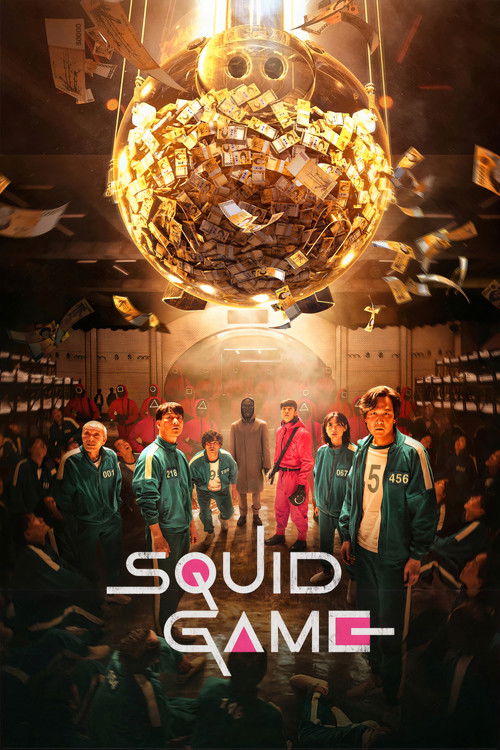
In September 2021, Netflix dropped a show that nobody saw coming. Squid Game, a South Korean survival drama from writer-director Hwang Dong-hyuk, exploded into the global conversation within days of its release. The premise was simple: 456 debt-ridden strangers compete in deadly versions of childhood games for a 45.6 billion won prize. What followed was a cultural wildfire that made the green tracksuit, the honeycomb dalgona candy, and the giant robot doll from Red Light, Green Light instantly recognizable worldwide.
The show became Netflix's most-watched series at the time, racking up 1.65 billion viewing hours in its first 28 days and hitting number one in 94 countries. Its success was no accident. Hwang had been sitting on the idea for over a decade, drawing from his own financial struggles and a deep frustration with economic inequality. The result was a brutal allegory wrapped in bright colors and playground nostalgia, a combination that proved irresistible.
Beyond the viewership numbers, Squid Game reshaped how the industry looked at non-English content. It won six Primetime Emmy Awards, including Outstanding Lead Actor for Lee Jung-jae, and a Golden Globe for Best Television Series – Drama. The show's imagery seeped into Halloween costumes, Halloween decorations, and even Halloween party games. It also sparked a real-world spin-off, Squid Game: The Challenge, a reality competition that aired in 2023.
Stream
Availability and pricing can change. Confirm on the provider's site before purchasing.
Squid Game introduces Seong Gi-hun, a divorced father and compulsive gambler who is drowning in debt. He lives with his elderly mother, can barely afford to buy his daughter a birthday present, and spends his days scraping by on bad bets and worse luck. When a mysterious man in a suit offers him a chance to win money through a game of ddakji, Gi-hun accepts. He wakes up in a vast, windowless dormitory with 455 other people, all wearing green tracksuits with numbers on their chests.
The players come from all walks of life, but they share one thing: they are desperate. Among them are Kang Sae-byeok, a North Korean defector trying to reunite her family; Cho Sang-woo, Gi-hun's childhood friend and a former investment banker who embezzled client funds; Oh Il-nam, an elderly man with a brain tumor who seems oddly cheerful; and Jang Deok-su, a gangster with a violent temper. They are told they will play six games over six days, and the winner takes home 45.6 billion won. The catch: losing means death.
The games themselves are twisted versions of children's activities. Red Light, Green Light ends with a firing squad for anyone who moves. Dalgona requires players to extract a shape from a brittle honeycomb candy without breaking it. Tug-of-War takes place on a platform high above the ground, with the losing team plunging to their deaths. The show uses these familiar, innocent games to create a stark contrast between the playful aesthetics and the vicious stakes. Masked guards in pink jumpsuits oversee everything, while a mysterious Front Man in a black mask watches from a control room.
As the competition narrows, alliances form and shatter. Gi-hun teams up with Sae-byeok, Ali, and Il-nam, but trust is fragile. Sang-woo, driven by desperation, makes increasingly ruthless choices. The show also follows Detective Hwang Jun-ho, who infiltrates the facility as a guard to find his missing brother. He uncovers the organization's brutal logistics and the silent complicity of the VIPs who watch the games for sport.
The first season builds toward a final showdown where the remaining players must confront not only the games but their own moral limits. The narrative raises questions about free will, economic desperation, and whether the players are truly victims or willing participants in their own destruction. Season 2, set for release in 2024, picks up with Gi-hun carrying the trauma of his victory and a new determination to expose the organization. Season 3, planned for 2025, will follow his deepening obsession and the personal cost of his mission.
Official Trailer [Subtitled]
Critical Consensus
Squid Game is a visually stunning and thematically rich descent into a brutal, allegorical world that, while occasionally uneven, is undeniably compelling and thought-provoking.
“A brutal, beautiful, and deeply unsettling allegory for modern capitalist society.”
Daniel Fienberg
The Hollywood Reporter
“It's a masterful piece of television, full of suspense, shock, and surprising emotional depth.”
Brian Lowry
CNN
“The show is a sharp, effective critique of class inequality and the desperation it breeds.”
Kristen Baldwin
Entertainment Weekly
“A thrilling, disturbing, and unforgettable viewing experience.”
Lucy Mangan
The Guardian
Lee Jung-jae
Seong Gi-hun / Player 456
Yim Si-wan
Lee Myung-gi / Player 333
Wi Ha-jun
Detective Hwang Jun-ho
Park Hae-soo
Cho Sang-woo / Player 218
HoYeon Jung
Kang Sae-byeok / Player 067
O Yeong-su
Oh Il-nam / Player 001
Heo Sung-tae
Jang Deok-su / Player 101
Anupam Tripathi
Abdul Ali / Player 199
Kim Joo-ryung
Han Mi-nyeo / Player 212
Lee Byung-hun
The Front Man / Hwang In-ho
Director
Hwang Dong-hyuk
Writer
Hwang Dong-hyuk
Composers
Jung Jae-il, Park Min-joo, Kim Sungsoo
Producers
Hwang Dong-hyuk, Kim Ji-yeon, Kim Min-young, Lee Jung-jae, Lee Taek-kyu, Sim Jae-myung
Primetime Emmy Awards (2022)
Outstanding Lead Actor in a Drama Series: Won
Primetime Emmy Awards (2022)
Outstanding Guest Actor in a Drama Series: Won
Primetime Emmy Awards (2022)
Outstanding Drama Series: Nominated
Golden Globe Awards (2022)
Best Television Series – Drama: Won
Golden Globe Awards (2022)
Best Actor – Television Series Drama: Won
Screen Actors Guild Awards (2022)
Outstanding Performance by a Male Actor in a Drama Series: Won
Screen Actors Guild Awards (2022)
Outstanding Performance by a Female Actor in a Drama Series: Won
Critics' Choice Television Awards (2022)
Best Foreign Language Series: Won
Baeksang Arts Awards (2022)
Best Drama: Won
Baeksang Arts Awards (2022)
Best Actor: Won
Baeksang Arts Awards (2022)
Best New Actress: Won
Join the community
fans discussing