“The images are so vivid and startling that they make most nature documentaries look like home movies. This is not just television; it's a revolution in how we see the planet.”
Alessandra Stanley
The New York Times
 United States
"Explore Earth as you've never seen it."
User Score
1,261 votes
In 2006, BBC One aired what many still consider the gold standard of nature documentaries. Planet Earth took four years to make, sending camera crews to 64 countries and 200 locations. The result was 11 hours of footage that showed the natural world with a clarity no one had seen before. David Attenborough's narration gives the series its heartbeat, turning scientific observation into something close to poetry. The show won four Emmys and four BAFTAs, and its influence on wildlife filmmaking is hard to overstate.
The series works as a guided tour of Earth's major biomes, from the poles to the deep ocean. Each episode focuses on a specific habitat, revealing the animals that live there and the strategies they use to survive. What made Planet Earth different was its ambition. The production team pioneered new camera systems, including a gyro-stabilized aerial rig called Cineflex that allowed them to film wolves hunting from a helicopter without any shake. They captured the first footage of a snow leopard in the wild, and the first aerial shots of a caribou migration. The series didn't just document nature; it redefined how we could see it.
Availability and pricing can change. Confirm on the provider's site before purchasing.
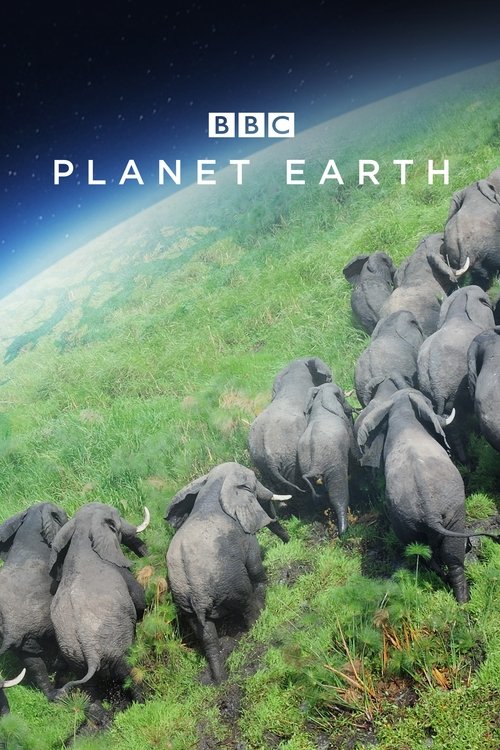
From the opening moments of the first episode, Planet Earth establishes a simple but powerful framework: follow the sun. The premiere, From Pole to Pole, traces how solar energy drives seasonal cycles and animal migrations across the globe. We see polar bears hunting on Arctic ice, caribou crossing tundra, and elephants trekking across African savanna. The message is clear: every living thing on Earth is connected by the same fundamental forces.
Each subsequent episode dives into a specific environment. Mountains climbs the Himalayas and the Andes, showing snow leopards stalking blue sheep and Andean condors riding thermals. Fresh Water follows rivers from source to sea, capturing the spectacle of salmon leaping upstream and the stealth of crocodiles hunting wildebeest at a river crossing. Caves descends into darkness, revealing blind cave fish and vast crystal chambers that few humans have ever entered. Deserts documents the harsh lives of camels, fennec foxes, and desert beetles that collect water from fog.
The middle episodes broaden the scope. Polar Regions contrasts the Arctic and Antarctic, showing emperor penguins huddling against the cold and polar bears waiting for sea ice to form. Great Plains captures the massive herds of wildebeest, bison, and elephants that roam open grasslands, and the predators that follow them. Jungles enters the rainforest canopy, where orangutans swing through trees and jaguars prowl the forest floor. Shallow Seas explores coral reefs and kelp forests, revealing the intricate dance of sea turtles, dolphins, and sharks. Seasonal Forests moves through temperate woodlands, from the deciduous forests of North America to the bamboo groves of China, featuring bears, deer, and snow monkeys bathing in hot springs.
The series does not follow a traditional narrative arc. Instead, it builds a cumulative portrait of life on Earth, emphasizing adaptation and resilience. Each episode presents the challenges animals face and the remarkable solutions evolution has produced. The tone is reverent but unsentimental: predators kill prey, scarcity forces migrations, and the environment is indifferent to individual suffering. Attenborough's narration provides context without anthropomorphizing, letting the images speak for themselves. The series culminates in Deep Ocean, which descends to hydrothermal vents where life thrives without sunlight, completing the journey from the highest peaks to the deepest trenches.
Planet Earth Trailer - The Complete Series
BBC - Planet Earth - Trailer
Critical Consensus
Planet Earth is a landmark achievement in nature filmmaking, combining breathtaking cinematography with David Attenborough's authoritative narration to create an awe-inspiring portrait of the natural world. Critics unanimously praised its technical innovation, emotional depth, and conservation message, calling it essential viewing that redefined the documentary genre and set a new standard for wildlife television.
“The images are so vivid and startling that they make most nature documentaries look like home movies. This is not just television; it's a revolution in how we see the planet.”
Alessandra Stanley
The New York Times
“A stunning achievement that captures the majesty and fragility of Earth with unprecedented clarity. Attenborough's narration is the perfect complement to the visual feast, turning science into poetry.”
Brian Lowry
Variety
“Planet Earth is a triumph of nature filmmaking, offering viewers a front-row seat to the most spectacular wildlife moments ever captured on camera. It is both educational and emotionally resonant.”
Tim Goodman
The Hollywood Reporter
“Attenborough's voice is the perfect guide, calm and authoritative, as we witness the most intimate and extraordinary moments of animal life. This is television at its most majestic.”
Sam Wollaston
The Guardian
“The footage is so breathtakingly beautiful that it feels almost illicit to watch. Planet Earth reminds us that we are part of something larger, more complex, and more miraculous than we can imagine.”
Heather Havrilesky
Salon
Writer
Gary Parker
Composer
George Fenton
Cinematographers
Doug Allan, Richard Burton, John Brown
Producers
Alastair Fothergill, Mike Gunton, Maureen Lemire, Tom Hugh-Jones
Emmy Award (2007)
Outstanding Nonfiction Series: Won
Emmy Award (2007)
Outstanding Cinematography for Nonfiction Programming: Won
Emmy Award (2007)
Outstanding Music Composition for a Series: Won
Emmy Award (2007)
Outstanding Picture Editing for Nonfiction Programming: Won
Emmy Award (2007)
Outstanding Sound Editing for Nonfiction Programming: Won
BAFTA TV Award (2007)
Best Factual Series: Won
BAFTA TV Award (2007)
Best Cinematography & Lighting (Factual): Won
BAFTA TV Award (2007)
Best Original Television Music: Won
BAFTA TV Award (2007)
Best Editing (Factual): Won
Peabody Award (2007)
Excellence in Electronic Media: Won
Royal Television Society Award (2007)
Best Documentary Series: Won
Royal Television Society Award (2007)
Best Cinematography: Won
Producers Guild of America Award (2008)
Outstanding Producer of Non-Fiction Television: Won
Television Critics Association Award (2007)
Outstanding Achievement in News and Information: Won
Join the community
fans discussing