“A psychological tour de force that redefines the mecha genre with its raw emotional depth and surreal imagery.”
Charles Solomon
Los Angeles Times
 Japan
Japan"Mankind's greatest fear is mankind itself."
User Score
2,093 votes
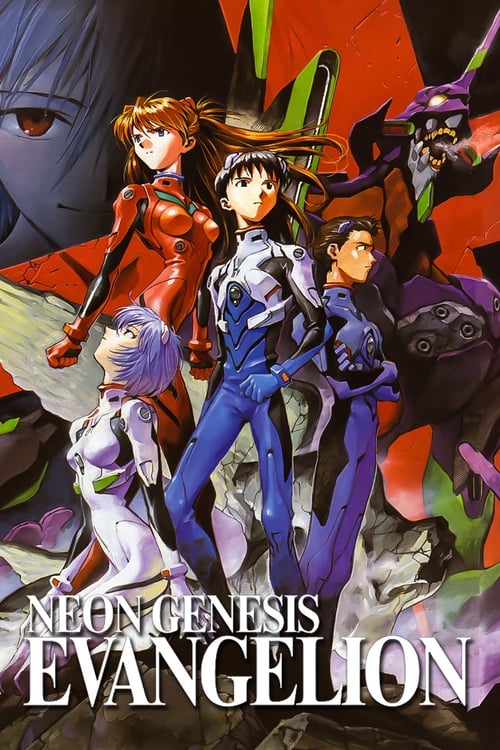
In 2015, fifteen years after a global cataclysm known as the Second Impact wiped out half of humanity, the survivors live in fortified cities. The Angels, colossal monsters of unknown origin, have returned to finish the job. To fight them, the secret organization NERV has developed the Evangelions, giant bio-mechanical mecha that only a handful of teenagers can pilot. This is the world of Neon Genesis Evangelion, a series that begins as a classic monster-of-the-week action show but quickly evolves into something far more unsettling.
Created by Hideaki Anno and produced by GAINAX, the series aired on TV Tokyo from October 1995 to March 1996, spanning 26 episodes. Its groundbreaking blend of psychological horror, religious symbolism, and deconstruction of the mecha genre set it apart from anything that came before. The show's visual style, character designs by Yoshiyuki Sadamoto, and Shiro Sagisu's haunting score became instantly iconic, influencing countless works that followed.
Stream
Availability and pricing can change. Confirm on the provider's site before purchasing.
Shinji Ikari, a shy and emotionally withdrawn 14-year-old boy, is summoned to the city of Tokyo-3 by his estranged father, Gendo Ikari, the commander of NERV. Upon arrival, Shinji is thrust into the cockpit of Evangelion Unit-01 and forced to battle an Angel with no training. He succeeds, but the victory brings him no relief. He is soon joined by Rei Ayanami, a mysterious and emotionless girl who pilots Unit-00, and Asuka Langley Soryu, a brash and confident German-Japanese prodigy who pilots Unit-02.
As the trio defends humanity from increasingly bizarre and powerful Angels, the cracks in their psyches begin to show. Shinji struggles with abandonment issues and a desperate need for validation. Asuka masks her deep insecurities with arrogance. Rei seems almost robotic, her true nature a mystery. Their guardian, Misato Katsuragi, is a NERV tactical officer haunted by her own trauma from the Second Impact. Meanwhile, Gendo Ikari pursues a hidden agenda involving the Human Instrumentality Project, a plan that would merge all human souls into a single, painless collective existence.
The series builds its tension through a cycle of battles and introspection. Early episodes follow a formula: an Angel attacks, the Evas deploy, and after a struggle, they win. But as the story progresses, the psychological toll on the pilots becomes the central conflict. The Angels themselves grow more abstract, attacking not just physically but mentally, forcing the pilots to confront their deepest fears. By the midpoint, the show has shifted from action to existential horror, questioning the very nature of identity, connection, and reality.
Across its single season, the narrative arc moves from external threats to internal collapse. The final stretch of episodes abandons traditional plot structure altogether, plunging into the fractured minds of the characters. The series does not resolve its mysteries in a conventional way; instead, it forces viewers to grapple with the same questions that torment Shinji: Is it better to be alone and safe, or to risk pain for the chance at genuine human connection?
Blu-ray Pre-order Trailer
Official Trailer [HD] | Netflix
Neon Genesis Evangelion Trailer
Critical Consensus
Neon Genesis Evangelion is a landmark anime that deconstructs the mecha genre with deep psychological themes. Its complex characters, abstract storytelling, and philosophical ambition have earned it a lasting legacy, though its unconventional ending remains polarizing.
“A psychological tour de force that redefines the mecha genre with its raw emotional depth and surreal imagery.”
Charles Solomon
Los Angeles Times
“Evangelion is not just an anime, it's an experience that challenges viewers to confront their own fears and desires.”
Chris Beveridge
The Fandom Post
“A series that dares to explore the depths of human psyche like no other, blending action with existential dread.”
Jacob Devlin
Anime News Network
“Hideaki Anno's masterpiece remains a touchstone for anime's potential to tackle mental health and trauma.”
Zachary Reeves
IGN
Megumi Ogata
Shinji Ikari (voice)
Kotono Mitsuishi
Misato Katsuragi (voice)
Megumi Hayashibara
Rei Ayanami (voice)
Yuko Miyamura
Asuka Langley Soryu (voice)
Yuriko Yamaguchi
Dr. Ritsuko Akagi (voice)
Fumihiko Tachiki
Gendo Ikari (voice)
Motomu Kiyokawa
Kozo Fuyutsuki (voice)
Miki Nagasawa
Maya Ibuki (voice)
Director
Hideaki Anno
Writer
Hideaki Anno
Composer
Shiro Sagisu
Cinematographer
Yoichi Kuroda
Producers
Noriko Kobayashi, Yutaka Sugiyama
Anime Grand Prix (1996)
Best Anime: Won
Anime Grand Prix (1997)
Best Anime: Won
Join the community
fans discussing