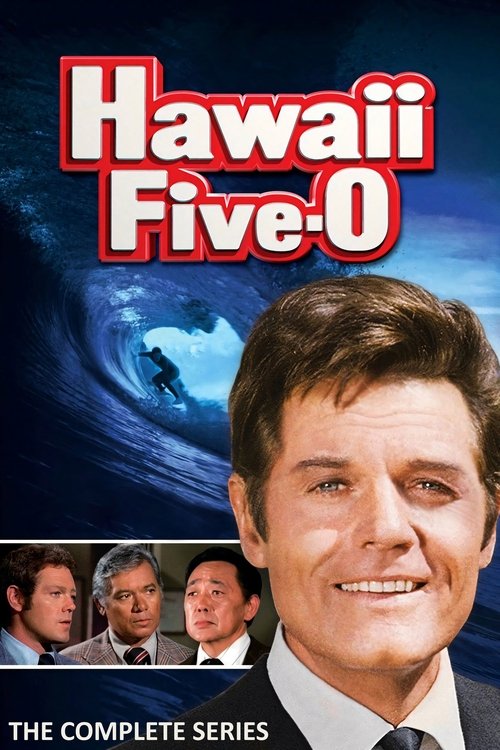
Hawaii Five-O
 United States
"Book 'Em, Danno!"
User Score
167 votes
Overview
Fifty years on, the theme still kicks in like a shot of adrenaline: those brass stabs, that surf-rock guitar. But Hawaii Five-O was never just a catchy intro. From September 20, 1968, to April 5, 1980, CBS aired 284 episodes across 12 seasons, and for much of that run it was the most-watched police drama on American television. Jack Lord played Steve McGarrett, head of an elite state police unit answering only to the governor. The setup was fiction, but it nodded to a real territorial-era task force that operated under martial law in the 1940s. That historical echo gave the show a seriousness that set it apart from the cop shows of its day.
The supporting cast rotated over the years, but a few faces stuck. Herman Wedemeyer brought local credibility as Duke, Richard Denning made Governor Paul Jameson a wily political foil, and William Smith joined late as Detective James "Kimo" Carew. Sharon Farrell arrived as Lori Wilson, a rare female presence in a squad otherwise made up of men. Episodes ran a full hour, which meant cases could breathe: multiple suspects, red herrings, and a final act that usually ended with McGarrett delivering his signature line. "Book 'em, Danno" entered the language, and it never really left.
What made the show last wasn't just the catchphrase. It was the way it used Hawaii as more than a postcard. The islands were beautiful, yes, but they were also a place where organized crime, political corruption, and international smuggling washed ashore. Morton Stevens's theme became a hit single, and the series helped establish the template for sun-drenched procedurals that later shows like Magnum, P.I. and Miami Vice would build on. It's a product of its time, but the formula, a righteous leader, a loyal team, and a setting that's both paradise and crime scene, still holds up.
Where to Watch
Stream
Availability and pricing can change. Confirm on the provider's site before purchasing.
PlotSpoiler-free
Steve McGarrett doesn't just work in Hawaii. He treats the islands as a personal trust. As head of Five-O, a special state police unit named for Hawaii's status as the fiftieth state, he answers directly to the governor and bypasses the usual departmental chain. That independence is the engine of the show. McGarrett can go after anyone, from a local syndicate boss to a foreign agent, without worrying about jurisdiction or politics. His team is small but loyal: Danny "Danno" Williams, the young detective who gets the famous instruction to book the suspect; Duke, the local cop who knows every corner of the islands; and later Kimo Carew, a transplant who brings a different kind of muscle. Governor Paul Jameson is McGarrett's boss and occasional adversary, a politician who sometimes wants a quiet solution when McGarrett wants a just one.
The cases lean serious. This isn't a show about petty theft. McGarrett and his team chase organized crime, extortion, murder for hire, political corruption, and international intrigue. The Cold War looms in the early seasons, with spies and defectors passing through Honolulu. Later years bring drug smuggling and homegrown conspiracies. Each episode stands alone, but recurring villains give the series a spine. The most important is Wo Fat, a Chinese criminal mastermind played by Khigh Dhiegh, who appears in the very first season and returns again and again. Wo Fat is McGarrett's opposite: patient, international, and utterly without scruples. Their rivalry runs through the entire series, and it's the closest thing the show has to a throughline.
Season by season, the show adjusts to the times without losing its core. The first three seasons (1968 to 1971) establish the unit and lean hard into Cold War paranoia and mob stories. By the mid-1970s, the roster deepens. William Smith joins as Kimo, and Sharon Farrell appears as Lori Wilson, giving the squad a female perspective. The crimes broaden to include drug trafficking and domestic terrorism. The later seasons (roughly 1977 to 1980) find the show competing with a changing television landscape, but McGarrett remains the fixed point. He is stoic, impeccably dressed, and absolutely incorruptible, a leader who takes every crime as an insult to the state. The show never abandons its procedural spine, and it never turns Hawaii into a generic backdrop. The tension between the tourist-brochure beauty and the violence that washes ashore is the engine of almost every episode.
What holds up best is the craft. Episodes run a full hour, which gives the writers room to build a case, introduce suspects, and let McGarrett's instincts play out. The theme music by Morton Stevens sets a tone that's half cop show, half surf party, and it became a hit single in its own right. The show also knew how to use its location. Waikiki, Diamond Head, the pineapple fields, and the working-class neighborhoods all appear, and the series treats them as real places with real problems. That's a big reason it lasted twelve seasons. The formula, a righteous leader, a loyal team, a beautiful but troubled setting, and a catchphrase for the ages, still works. Just don't expect a cliffhanger. The show was built to close cases, not leave them open.
Ending ExplainedSpoilers
Critical Reception
Critical Consensus
Critics and fans agree that Hawaii Five-O endures on the strength of Jack Lord's commanding performance, Morton Stevens's unforgettable theme, and its novel use of Hawaii as a setting that is both alluring and morally complicated. The show's period pacing and formulaic structure are acknowledged, but its seriousness and craft keep it watchable decades later.
Top Cast
Jack Lord
Det. Steve McGarrett
Herman Wedemeyer
Duke
William Smith
Det. James 'Kimo' Carew
Richard Denning
Governor
Sharon Farrell
Lori Wilson
Crew
Composer
Morton Stevens
Producer
Leonard Freeman
Seasons (3)
Keywords
Sources
Facts
- Status
- Ended
- Type
- Scripted
- Original Language
- EN
- Network
- CBS
- Created By
- Leonard Freeman
- Seasons
- 12
- Episodes
- 284
- Production
- Leonard Freeman Production, CBS Studios
Join the community
fans discussing