“The show's greatest strength lies in its ability to make the mundane feel extraordinary, turning everyday arguments into comedy gold.”
A.O. Scott
Vulture
 United States
"Share the love."
User Score
45000 votes
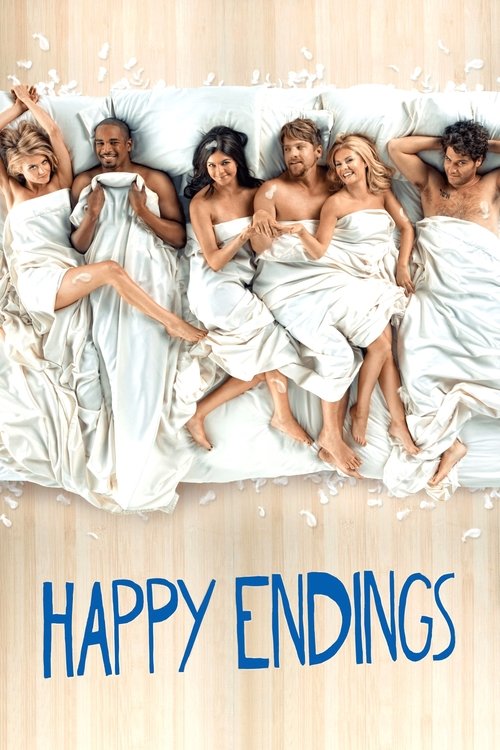
Created by David Caspe for ABC, Happy Endings launched in April 2011 as a sharp comedy about friendship tested by heartbreak. The series centers on six Chicagoans whose lives intertwine after the perfect couple, Alex and Dave, call off their wedding just hours before the ceremony. This disaster forces everyone to reevaluate their relationships and find new ways to stay together without the glue that held them all.
The show quickly distinguished itself from traditional sitcoms by rejecting linear storytelling in favor of rapid-fire dialogue, non-linear narratives, and frequent fourth-wall breaks. Instead of focusing solely on romantic pairings, the narrative prioritized the chaotic dynamics of a friend group navigating adulthood. Characters like Jane, Brad, Max, Penny, and Alex learned to survive life's messiness while trying to keep their social circle intact despite the breakup of the central couple.
Availability and pricing can change. Confirm on the provider's site before purchasing.
The story begins in Chicago with a catastrophic engagement party that never happens. Hours before Alex Kerkovich is set to marry Dave Rose, she calls off the wedding. This single event shatters the existing social order, transforming a group defined by one couple into six individuals struggling to define themselves outside that relationship. The series follows their immediate attempts to navigate this new reality, ranging from awkward hangouts where the former couple tries to remain friends to desperate dating schemes that often backfire spectacularly.
As the first season progresses, the audience meets the distinct personalities driving the chaos. Jane Kerkovich-Williams, the pragmatic but self-sabotaging sister of the bride, finds herself caught between her loyalty to her family and her growing feelings for Dave. Brad Williams, Dave's best friend and a notorious womanizer, hides his own commitment issues behind a facade of confidence. Meanwhile, Penny Hartz navigates her neurotic anxieties and career struggles, while Max Blum provides comic relief with his eccentric behavior and oblivious charm.
The show evolves beyond the initial breakup premise into a broader exploration of twenty-something life. Season two expands the scope to include deeper character backstories and more complex romantic entanglements involving people outside the core group. The writing style becomes increasingly meta, with characters acknowledging sitcom tropes and the artificial nature of their situation. Flash-forwards and time jumps become common tools to tease future outcomes or highlight the absurdity of current situations.
By the third season, the stakes feel higher as the characters face significant life transitions. Marriage proposals, job losses, and family dramas test the resilience of their bond. Despite ABC moving the show from Wednesdays to Tuesdays and finally to a Friday night death slot, the tone remains consistently energetic. The series maintains an optimistic philosophy that while relationships end and life gets messy, the community built by these friends endures. The narrative arc focuses less on finding a specific partner and more on personal growth within the safety of their shared history.
Throughout its run, the show avoided heavy melodrama in favor of lighthearted humor. Even when dealing with serious topics like financial instability or career failure, the characters approached problems with wit and resilience. The ensemble cast delivered performances that felt natural and spontaneous, driven by strong chemistry developed over three years of filming. The result was a unique blend of situational comedy and emotional truth that resonated with viewers looking for something different from standard network fare.
Happy Endings - Official Trailer
Critical Consensus
Happy Endings distinguishes itself from traditional sitcoms with its sharp, witty dialogue and innovative storytelling techniques. The ensemble cast delivers standout performances, creating a vibrant world where friendship takes center stage. While the show occasionally relies on slapstick, its emotional core and unique humor style have earned it a dedicated cult following.
“The show's greatest strength lies in its ability to make the mundane feel extraordinary, turning everyday arguments into comedy gold.”
A.O. Scott
Vulture
“David Caspe has crafted a show that feels fresh and modern, avoiding the clichés that plague so many ensemble comedies.”
A.O. Scott
The New York Times
“With its rapid-fire pacing and clever writing, Happy Endings is a breath of fresh air in the crowded sitcom landscape.”
Tim Goodman
Variety
“The chemistry between the cast members is palpable, making the show's emotional beats land with surprising impact.”
Robert Lloyd
The Hollywood Reporter
“Happy Endings proves that friendship can be just as compelling as romance, offering a refreshing take on the genre.”
Eric Kohn
IndieWire
Eliza Coupe
Jane Kerkovich-Williams
Elisha Cuthbert
Alex Kerkovich
Zachary Knighton
Dave Rose
Adam Pally
Max Blum
Damon Wayans Jr.
Brad Williams
Casey Wilson
Penny Hartz
Directors
Joe Russo, Anthony Russo, Ken Whittingham, Tristram Shapeero
Writers
David Caspe, Jen Statsky, Josh Sieidel, Dylan Morgan
Composer
Ludwig Göransson
Cinematographer
Michael E. Satrazemis
Producers
Joe Russo, Anthony Russo, David Caspe, Jen Statsky
Teen Choice Awards (2012)
Choice TV Comedy Actress: Nominated
People's Choice Awards (2012)
Favorite New TV Comedy: Nominated
Critics' Choice Television Award (2013)
Best Comedy Series: Nominated
Join the community
fans discussing