
“A masterpiece of television storytelling that captures the essence of the tech revolution with unparalleled depth and emotional resonance.”
David Bianculli
TV Worth Watching
 United States
"What are you searching for?"
User Score
584000 votes
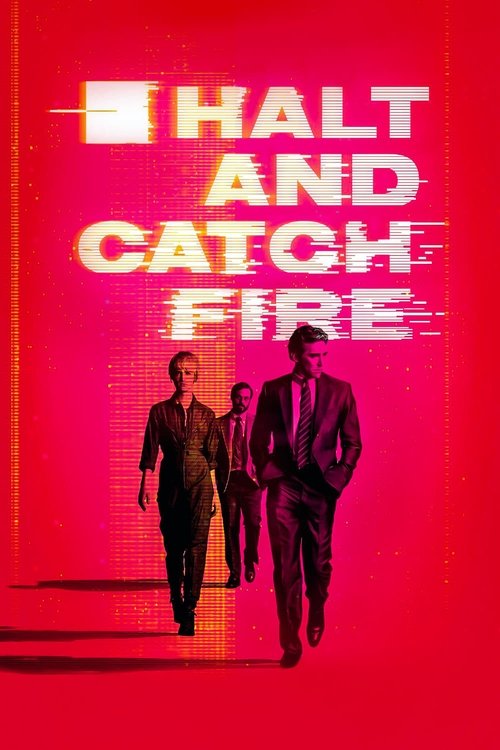
Set against the backdrop of early 1980s Texas, Halt and Catch Fire tracks the chaotic rise of the personal computer revolution. Created by Christopher C. Rogers and Christopher Cantwell for AMC, this four-season drama spans from 2014 to 2017. The series follows a volatile trio: Lee Pace plays the ambitious Joe MacMillan, Scoot McNairy portrays the brilliant but troubled engineer Gordon Clark, and Mackenzie Davis brings Cameron Howe to life as a young coding prodigy. Their journey unfolds across Dallas tech offices and suburban living rooms, driven by a mix of corporate ambition and genuine geek culture.
The narrative avoids standard biopic tropes by focusing on the human cost of innovation rather than just the hardware. It explores how genius often walks hand in hand with delusion and how the drive to build the future can fracture personal relationships. As the characters navigate the transition from hobbyist computing to the birth of the internet, the show examines the blurred lines between visionary leadership and toxic manipulation. Each season marks a distinct technological era, moving from the emulation of IBM architecture to the emergence of online communities and finally the World Wide Web.
Availability and pricing can change. Confirm on the provider's site before purchasing.
In 1983 Dallas, Joe MacMillan arrives at Compaq headquarters claiming he has a vision for a new product that will disrupt the market. He recruits Gordon Clark, an engineer fired from his family's company for being too unconventional, and convinces him to build a black box that can emulate the IBM PC architecture. They need software to make it work, so they recruit Cameron Howe, a teenage girl working at a local computer store who writes code faster than anyone else. Together they form a partnership to create the CTRL computer, a low-cost clone designed to undercut IBM's pricing. The first season chronicles their struggle to manufacture the device while dealing with skeptical investors, legal threats from IBM, and internal friction within their own group. Gordon struggles with the pressure of scaling production and his deteriorating mental health, while Joe becomes increasingly obsessed with the next big thing, pushing the boundaries of what is possible. The season ends with the successful launch of the CTRL, which generates significant revenue but leaves the team exhausted and questioning their future.
Season two shifts focus as the trio faces the aftermath of their success. Gordon struggles with the pressure of scaling production and his deteriorating mental health, while Joe becomes increasingly obsessed with the next big thing, pushing the boundaries of what is possible. The season explores the thin line separating true innovation from self-delusion as the characters attempt to heal old wounds and redefine their relationships. Meanwhile, Donna Clark, Gordon's wife, finds her own path, eventually becoming a key player in the tech industry herself. The central conflict evolves from simply building a computer to fighting for survival in a market dominated by giants like IBM and Microsoft. The season introduces the concept of online gaming and community, setting the stage for the next phase of digital evolution.
In Season three, the timeline jumps six months forward, moving the characters into new environments and challenges. Joe has reinvented himself and built a massive empire, but he finds himself disconnected from his past partners. Cameron and Donna launch Mutiny, a company focused on online gaming and community, while Gordon struggles to find his place within Donna's growing enterprise. The season delves deeper into the culture of the internet age, exploring the potential for connection and the dangers of isolation. The characters must navigate the shifting tides of the tech industry, where the rules of the game change rapidly, forcing them to constantly adapt or risk obsolescence. Joe returns to the fold, bringing his marketing prowess to the new venture, but tensions rise as the original partnership fractures under the weight of differing visions.
Season four brings the series to its conclusion, focusing on the birth of the World Wide Web in the late 1980s and early 1990s. As the internet begins to take shape, each character must confront their own identity and legacy. Joe continues to push the envelope of technology, often at the expense of his personal life, while Gordon seeks redemption and a sense of purpose beyond his past failures. Cameron and Donna work to establish Mutiny as a key player in the emerging digital landscape, facing intense competition and ethical dilemmas. The final season weaves together the personal and professional arcs of the main cast, culminating in a powerful exploration of how the technologies they helped create would fundamentally alter the world. Throughout all four seasons, the show maintains a consistent theme: the relentless pursuit of the future, even when it demands the sacrifice of the present.
Season 1 Trailer
Season 2 Trailer
Final Season Trailer
Critical Consensus
Critics widely praise Halt and Catch Fire as one of the most compelling dramas of the 2010s, blending historical accuracy with deep character study. Reviewers highlight its intelligent writing, stellar performances, and ability to capture the spirit of the tech revolution without relying on clichés. The show earns acclaim for its nuanced portrayal of ambition, failure, and the human element behind technological progress.
“A masterpiece of television storytelling that captures the essence of the tech revolution with unparalleled depth and emotional resonance.”
David Bianculli
TV Worth Watching
“Halt and Catch Fire is a rare gem that manages to be both intellectually stimulating and deeply moving, offering a fresh perspective on the history of computing.”
Alan Sepinwall
Rolling Stone
“The show's greatest strength lies in its characters, particularly Lee Pace's mesmerizing performance as Joe MacMillan, who drives the narrative with his relentless ambition.”
Jonah Krakow
Vulture
“A beautifully crafted drama that explores the human cost of innovation, making it a must-watch for anyone interested in the intersection of technology and society.”
Charlotte O'Sullivan
The Guardian
“Halt and Catch Fire is a triumph of period drama, bringing the 1980s tech boom to life with authenticity and heart, setting a new standard for the genre.”
Tim Goodman
Variety
Lee Pace
Joe MacMillan
Scoot McNairy
Gordon Clark
Mackenzie Davis
Cameron Howe
Kerry Bishé
Donna Clark
Toby Huss
John 'Bos' Bosworth
Scott Michael Campbell
Bob Galloway
Alison Wright
Claire MacMillan
Jack Huston
Billy Henderson
Wendy Moniz-Grillo
Barbara MacMillan
Jeffrey DeMunn
William Clark
Directors
Daniel Minahan, David Semel, Maggie Betts, Peter Lawson Jones
Writers
Christopher C. Rogers, Christopher Cantwell, Katie Edgerton, Sara Hess, Sarah Conover
Composer
Paul Haslinger
Cinematographers
Evans Brown, Michael Fimognari, Todd Banhazl
Producers
Christopher Cantwell, Christopher C. Rogers, Melissa Bernstein, Mark Johnson, Liz Glotzer, Scott Rosenbaum
Peabody Award (2015)
Entertainment: Won
Emmy Awards (2015)
Outstanding Cinematography for a Single-Camera Series: Nominated
Emmy Awards (2016)
Outstanding Cinematography for a Single-Camera Series: Nominated
Satellite Awards (2015)
Best Television Series – Drama: Nominated
Critics' Choice Television Awards (2015)
Best Supporting Actress in a Drama Series: Nominated
Writers Guild of America (2015)
Episodic Drama: Nominated
Writers Guild of America (2016)
Episodic Drama: Nominated
Join the community
fans discussing