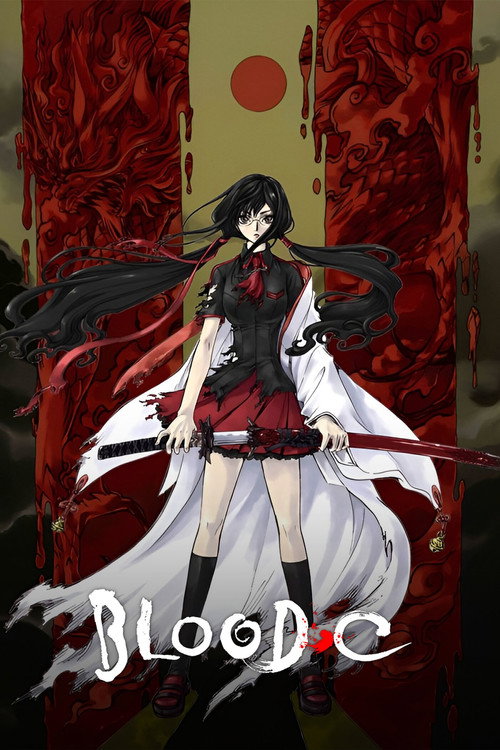
BLOOD-C aired on CBC from July 8 to September 30, 2011, twelve episodes produced by Production I.G from a concept by the manga group CLAMP. The series was built as a deliberate two-part structure: a slow, cheerful small-town drama in the first half and a graphic supernatural horror story in the second. It was conceived from the outset as a prologue to a theatrical film, Blood-C: The Last Dark, released in June 2012.
Saya Kisaragi lives in Kamuro, attends Sanbara Academy, helps her father tend the family shrine, and carries a ceremonial sword when the Elder Bairns come. The show spends its early episodes on café visits and classroom banter before the violence arrives, and the contrast is the point. CLAMP handled character design, Nanase Okawa wrote the scripts, and Takashi Otsuka directed. Naoki Sato composed the score.
The reception split sharply. MyAnimeList users settled on a 6.43 average, while IMDb voters were more generous at 7.9. Much of the disagreement centered on the finale, which recontextualizes the entire season in a single episode and was designed to hand the story off to the film.
Availability and pricing can change. Confirm on the provider's site before purchasing.
PlotSpoiler-free
Saya Kisaragi is clumsy in the mornings and cheerful the rest of the time. She lives in Kamuro, a coastal town small enough that she knows everyone, and she helps her father Tadayoshi run the local shrine when she is not at Sanbara Academy. Her friends are a familiar set: Nene and Nono Motoe, the twins; Yuka Amino; Itsuki Tomofusa; Kanako Tsutsutori; and Shinichiro Tokizane, who is quiet in a way that suggests he is paying closer attention than he lets on. A teacher named Fumito Nanahara keeps a table at the café where Saya and her friends spend their afternoons, and he teases her about her appetite.
At night, or when the town's calm breaks, creatures called Elder Bairns appear. They feed on human blood and they are not subtle about it. Saya's father gives her a katana and tells her to protect Kamuro. She does, and she is very good at it. The show stages these fights as abrupt, wet, and ugly, then returns Saya to school the next morning with no visible consequence except the blood she washes off. The town does not seem to notice what happens after dark, which is the first thing an attentive viewer should find strange.
The first several episodes play as a genre parody. Saya oversleeps, Saya eats too much, Saya's friends tease her, Saya kills something horrible in a shrine at midnight. The comedy is broad and the horror is brief, and the show holds that rhythm long enough that the shift, when it comes, lands like a trapdoor. Around the midpoint the Elder Bairns grow more numerous and more organized. Saya starts having visions she cannot place. Her friends begin to ask questions she cannot answer, and the town's routines start to feel staged rather than lived in.
What the season is building toward is a question about the town itself. Kamuro has an unusual number of people who seem to be watching Saya, and an unusual number of monsters who seem to be testing her rather than simply hunting. Fumito Nanahara's interest in her goes beyond a teacher's concern. Tadayoshi knows more than he says. The season's final stretch turns on the possibility that Saya's ordinary life and her secret one are not two halves of the same girl but two parts of the same experiment, and that the people she loves may be participants in it. The twelve episodes end on a revelation that resets the board and sends Saya out of Kamuro entirely, into the film that continues the story the following summer.
Audiences split on the finale, which was engineered as a handoff to a theatrical film and withholds a conventional resolution. The animation and CLAMP character designs drew consistent praise; the abrupt tonal turn and the graphic violence drew just as consistent criticism. MyAnimeList users averaged 6.43 across roughly the same period.
 Japan