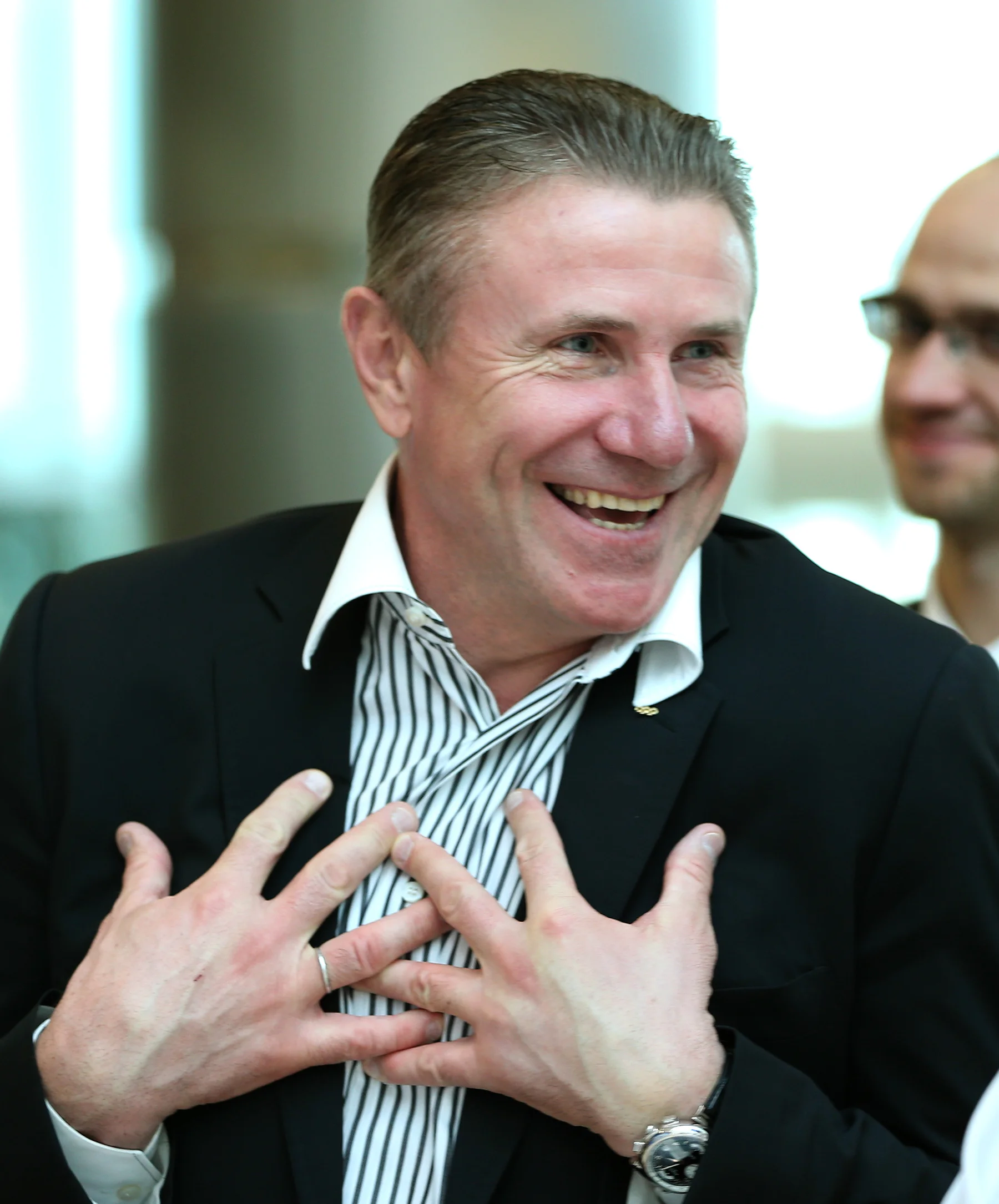
Sergey Bubka
 Ukraine
pole vaulter•sports administrator•politician
Also known as: Serhii Bubka, Sergey Nazarovych Bubka, The Golden Eagle
Birthday
December 4, 1963
Birth Sign
Sagittarius
Birthplace
Luhansk, Ukrainian SSR, Soviet Union
Age
62 years old
Height
6 ft 2 in (1.88 m)
About
Sergey Bubka, born Serhiy Nazarovych Bubka on December 4, 1963, in Luhansk, is widely regarded as the greatest pole vaulter in history. A former athlete who transitioned into sports administration and politics, Bubka dominated his sport for two decades, representing the Soviet Union until its dissolution in 1991 and then an independent Ukraine. His career is defined by an unprecedented 35 world record breaks—17 outdoors and 18 indoors—and a psychological dominance that made him the first man to clear both 6.0 meters and 6.10 meters. His outdoor record of 6.14 meters stood for 26 years until 2020, while his indoor mark of 6.15 meters lasted until 2014.
As of 2026, Bubka's legacy faces significant scrutiny following allegations of business ties with Russia and occupied territories during the ongoing war. In late 2025, Ukrainian President Volodymyr Zelenskyy stripped him of his state pension for failing to support the nation's war effort or reside in Ukraine for over three years. This political fallout has complicated his standing as a national hero, though his athletic achievements remain historically unmatched. He remains a polarizing figure, shifting from a universally celebrated hero to a subject of intense debate regarding his loyalty during wartime.
Early Life & Background
Serhiy Nazarovych Bubka entered the world in Luhansk, an industrial city in eastern Ukraine, on December 4, 1963. He grew up in a working-class family where his father Nikolai worked at a local factory and his mother Valentina managed the household. From a young age, Sergey displayed exceptional athletic potential, particularly in track and field events. His older brother Vasiliy also pursued pole vaulting, creating a competitive environment within the family that fostered early development. The city of Luhansk, known for its heavy industrial base, provided the backdrop for his formative years before he achieved global recognition.
Bubka began his formal training in pole vaulting at the age of nine after a local coach identified his unique physical attributes. The sport required a blend of speed, strength, and technical precision that suited his developing physique perfectly. He attended the Luhansk State Pedagogical Institute, now known as Luhansk National University, where he studied physical education. This academic path allowed him to balance elite-level training with his studies, preparing him for a life in sports administration later on. His rigorous training under the Soviet system laid the groundwork for his future dominance.
His breakthrough came in 1983 when he was just 19 years old. At the inaugural World Athletics Championships in Helsinki, Bubka claimed the gold medal, becoming the youngest world champion in pole vault history at the time. This victory marked the beginning of a reign that would see him dominate the event for nearly two decades. Before this global recognition, he had already set his first world record in Dnipropetrovsk in 1984, signaling the start of a relentless assault on the limits of human performance. His height of approximately 1.88 meters (6 ft 2 in) became a key asset in his technique.
Career Growth
Bubka's professional career was a chronicle of relentless records and championships that redefined the sport of pole vaulting. He secured his first world record of 5.80 meters in 1984, followed by a second consecutive World Championship title in Rome in 1985. By 1987, he had become the first man to clear 6.0 meters, shattering a psychological barrier that had confined the sport for decades. That same year, he won his third consecutive World Championship title. The 1988 Seoul Olympics saw Bubka win the gold medal while setting a new world record of 5.90 meters.
He continued his dominance through the dissolution of the Soviet Union, representing independent Ukraine. In 1991, he won his fourth consecutive World Championship title in Tokyo. In 1992, he set the iconic outdoor world record of 6.14 meters in Paris, a mark that stood for 26 years until 2020. His indoor prowess was equally impressive; he set the indoor world record of 6.15 meters in Budapest in 1993, which lasted until 2014. He added further titles in 1994 and 1995, winning five consecutive World Championship titles between 1983 and 1997, alongside a European Indoor Championship in 1996 and an IAAF Grand Prix Final win in 1997 before retiring in 1998.
Off the track, Bubka transitioned into high-level sports administration. He served as President of the National Olympic Committee of Ukraine from 2005 to 2022 and became a Senior Vice President of the International Association of Athletics Federations (IAAF) in 2007. An honorary member of the IOC since 1996, he was among the 24 inaugural inductees into the IAAF Hall of Fame in 2012. He was also appointed a UNESCO Champion for Sport in 2005 and inducted into the Laureus World Sports Academy. Despite recent controversies regarding his political stance and business activities, his athletic contributions remain the benchmark for the sport.
Career Timeline
Public Image & Style
Sergey Bubka cultivated a public image of calm precision and technical mastery. Known for his signature yellow and blue tracksuit colors representing Ukraine, he maintained a composed demeanor even under the intense pressure of world record attempts. His technique, characterized by a lightning-fast run-up and a powerful plant, revolutionized the sport and earned him the respect of peers and critics alike. Off the track, he projected an air of statesmanship, transitioning smoothly into roles as a diplomat for sports and an administrator. However, his public image has fractured in recent years due to allegations of business ties with Russia.
While some Ukrainians still revere him as a national icon, others view him with suspicion, questioning his loyalty during wartime. This duality has made him a polarizing figure, shifting from a universally celebrated hero to a subject of intense debate. The contrast between his athletic immortality and his political controversy highlights the challenges faced by public figures in times of conflict. Recent video evidence showing business operations in Russian-controlled areas further damaged his reputation, turning what was once a story of pure triumph into a complex narrative of glory and alleged betrayal.
Fame & Fandom (iFAMOUS Rankings)
Sergey Bubka's place in the cultural consciousness is defined by a unique duality: he remains an untouchable icon of athletic perfection for historians while navigating a fractured public perception in his homeland. Unlike modern athletes who cultivate distinct, organized tribes with specific names and rituals, Bubka's following has always been broader and less formalized. He is revered not as a pop star with a dedicated army, but as a national symbol whose status is now the subject of intense debate. While athletics enthusiasts still celebrate his unparalleled dominance, the general public in Ukraine has recently shifted from adoration to scrutiny, driven by investigations into business ties with Russia that have sparked calls to strip him of his national honors.
This tension marks a rare departure for a figure once considered beyond reproach, turning his legacy into a complex narrative of glory and controversy rather than simple celebration. Despite this shift in sentiment, there is no documented formal name for any fanbase associated with him, reflecting a history where reverence was implicit rather than mobilized through campaigns or subcultures. His standing in the global hierarchy reflects this complexity. According to the October 2026 evaluation by iFANN, Sergey Bubka has been evaluated but does not currently hold a placement in the published Global Top 1,000 rankings or any Top-100 scope list. This absence from the ranked lists signifies that while his historical impact is immense, his current active fame metrics do not align with the threshold required for a specific numerical ranking in the engine's latest assessment.
Interesting Facts and Legends
Bubka holds the distinction of being the first athlete to be featured on the cover of Sports Illustrated more than once for his pole vaulting achievements. He was named Athlete of the Century by the Ukrainian Olympic Committee in 1999, recognizing his unparalleled impact on the nation's sporting history. His nickname "The Golden Eagle" reflects his soaring style and dominance in the sport, a moniker that stuck throughout his career. Fans often recount the collective awe of watching him approach the bar with such casual confidence that failure seemed impossible, creating a unique mythology around his performances.
Reports from early 2026 revealed business connections in occupied territories, leading to a dramatic fall from grace where prominent figures called for the revocation of his title as Hero of Ukraine. This narrative shift has transformed him from a mythical hero into a controversial figure, adding a layer of political tragedy to his sporting immortality. He was also recognized by Guinness World Records for the most world records broken in a single sport. Additionally, he received the Order of Prince Yaroslav the Wise multiple times and was named Track & Field News Athlete of the Year for fourteen consecutive years from 1984 to 1997. His influence extends to current stars like Armand Duplantis, who frequently cites Bubka as a primary inspiration.
Notable Quotes
“I always believed that if you want something badly enough, you can achieve it.”
“The bar is the only opponent that never moves.”
“I am a Ukrainian, and my heart is with my country.”
Family & Personal Life
Bubka comes from a family with a strong athletic pedigree. His father, Nikolai, worked at a local factory in Luhansk, and his mother, Valentina, was a homemaker. His older brother, Vasiliy Bubka, also became a successful pole vaulter, though Sergey's achievements far surpassed his sibling's. The family dynamic was competitive yet supportive, fostering the environment that led to Sergey's early success. Beyond athletics, the family unit remained close despite the pressures of international fame.
Sergey was married to Olena Bubka (née Kovalenko), a former Ukrainian gymnast, from 1987 until their divorce in the early 2000s. The couple had one son, Nikita Bubka, who followed in his father's footsteps as a pole vaulter but did not reach the same level of international success. Nikita trained in the same discipline but faced different competitive landscapes than his father. There are no publicly confirmed romantic relationships or marriages following his divorce from Olena. As of 2026, Bubka is reported to be single and living primarily in Kyiv, though recent controversies have complicated his public standing.
Notable Connections
Relationships & Dating History
Sergey Bubka has maintained a notably private personal life compared to many modern celebrities. He was married to Olena Bubka, a former Ukrainian gymnast, from 1987 until their divorce in the early 2000s. The couple had one son, Nikita Bubka, who followed in his father's footsteps as a pole vaulter but did not reach the same level of international success. There are no publicly confirmed romantic relationships or marriages following his divorce from Olena. As of 2026, Bubka is reported to be single and living primarily in Kyiv, though recent controversies have complicated his public standing. His relationship with his brother Vasiliy remained a key part of his early life, while his connection to current pole vaulters like Armand Duplantis is primarily professional and inspirational.
- MarriedOlena Bubka1987 - 2000Former Ukrainian gymnast; divorced in early 2000s; one son together.
Salary, Net Worth In 2026
$18 Million
iFANN Editorial Team estimate
iFANN Editorial Team estimates Sergey Bubka's net worth at approximately $18 million as of 2026. This valuation reflects his extensive earnings from a long career as a professional athlete, lucrative endorsement deals, and subsequent roles in sports administration. His wealth stems largely from long-term contracts with major athletic companies like Nike and Adidas, which capitalized on his global stature. Additionally, he commanded high fees for motivational speaking engagements and corporate appearances worldwide. Reports from the Times of India in 2025 suggested a slightly lower estimate of $15 million, while other sources place his range between $10 million and $20 million.
Following his retirement, Bubka's income streams expanded through investments in real estate and sports-related businesses in Ukraine and abroad. His tenure as President of the National Olympic Committee of Ukraine provided a steady salary and further solidified his financial position. However, recent reports suggest financial scrutiny due to alleged ties with Russian entities, which may impact future earnings and asset valuation. The economic landscape surrounding his assets remains dynamic given the geopolitical tensions involving Ukraine. The loss of his state pension in late 2025 represents a significant reduction in his guaranteed income, though his accumulated wealth remains substantial.
Awards Won (10)
Sergey Bubka won the Olympic Gold Medal in 1988 and six consecutive World Championship titles from 1983 to 1997. He also secured one European Championship title in 1990 and won the IAAF Grand Prix Final seven times consecutively between 1992 and 1998. His most notable accolades include induction into the IAAF Hall of Fame in 2012 and receiving the Laureus World Sports Academy membership. He was honored with the title of Hero of Ukraine in 1994, though this honor is currently under review.
1988 · Athletics
Seoul Olympics
1997 · Athletics
Athens
1995 · Athletics
Gothenburg
1993 · Athletics
Stuttgart
1991 · Athletics
Tokyo
1987 · Athletics
Rome
1985 · Athletics
Rome
1983 · Athletics
Helsinki
Known For
Pole Vault
1988 · Gold Medalist
World Records
1992 · Record Holder
Keywords
Sources
Quick Facts
- Profession
- pole vaulter, athletics competitor, politician
- Born
- December 4, 1963
- Birthplace
- Luhansk
- Gender
- Male
- Birth Sign
- Sagittarius
Personal Details
- Full Name
- Serhiy Nazarovych Bubka
- Height
- 6 ft 2 in (1.88 m)
- Children
- Nikita Bubka
- Education
- Luhansk State Pedagogical Institute
Frequently Asked Questions
How many world records did Sergey Bubka break?
Is Sergey Bubka still alive?
Why was Sergey Bubka stripped of his pension?
What is Sergey Bubka's highest world record?
Does Sergey Bubka have children?
Similar People
Join the community
fans discussing