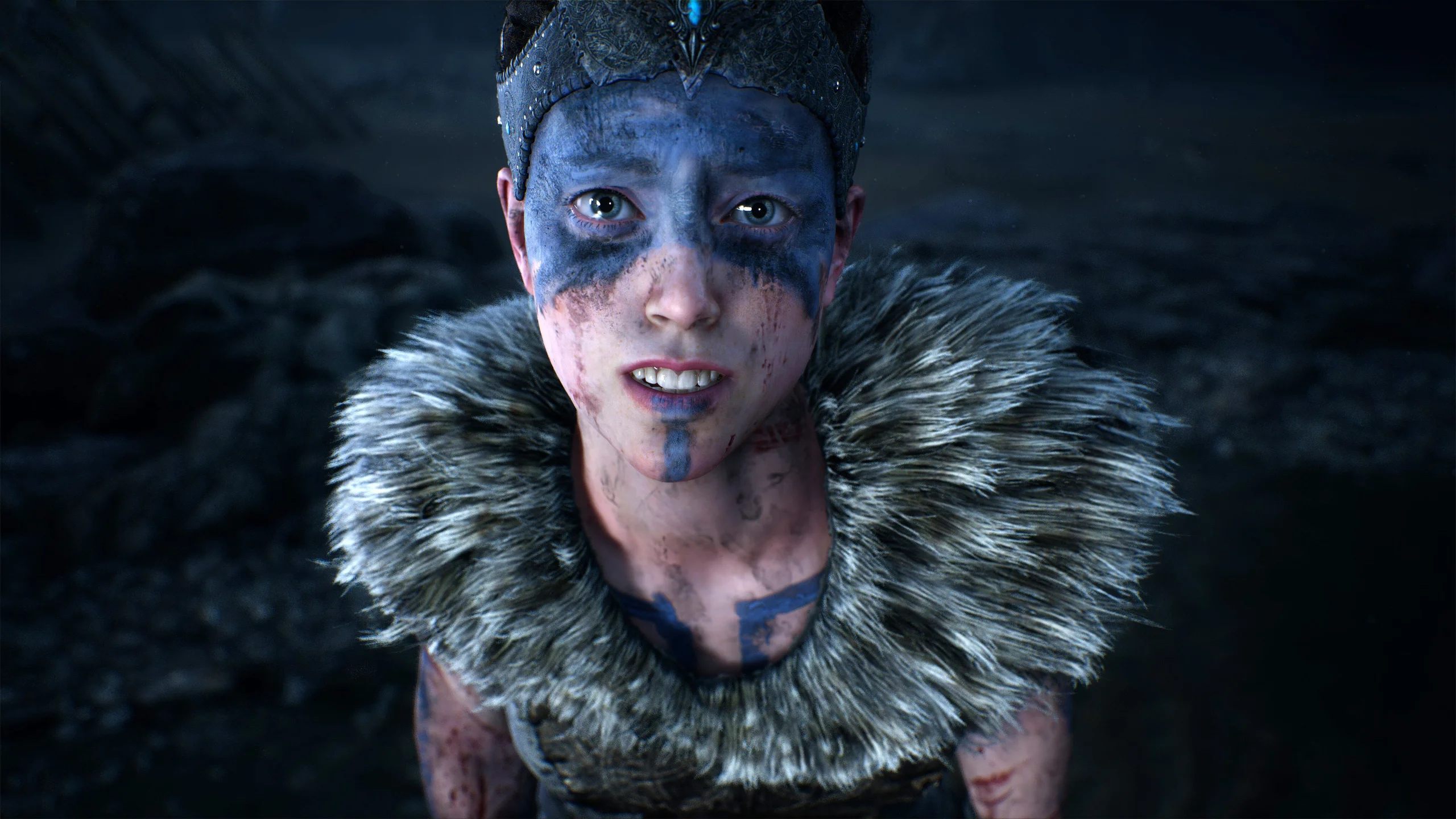
Senua
Appears In
Hellblade
Species
Human (Pict)
First Appearance
2017-08-08
Occupation
Warrior
Creator
Ninja Theory
Overview
Origin Story
Senua hails from a Pictish tribe in Scotland during the late 8th century, a time when Viking raids were tearing apart the local communities. She lives with her lover Dillion until a brutal attack by Norse invaders kills him and captures the rest of her people. The trauma of this event triggers severe psychosis, manifesting as auditory hallucinations where voices constantly speak to her about her perceived failures and impending doom. Driven by grief and a desperate need to save Dillion's soul, she travels across the ocean to Iceland, believing he has been taken to Helheim by the goddess Hela.
Her journey into the underworld forces her to confront the fractured nature of her own mind while navigating a landscape that shifts between reality and nightmare. The game treats her condition with clinical accuracy, showing how her hallucinations are not just random noise but rooted in her specific cultural fears and past traumas. She arrives in Helheim armed only with a sword and her determination, facing monsters that represent her deepest insecurities.
Personality
Senua is defined by an intense resilience masked by deep vulnerability. She speaks little, often communicating through action rather than words, yet her internal monologue reveals a constant struggle for control. Her psychosis makes her hyper-aware of her surroundings, causing her to see patterns and threats where others see none. This heightened perception serves as both a curse and a survival tool throughout her quest.
Despite the chaos in her head, she possesses a fierce protective instinct. She refuses to let go of hope even when logic suggests she should accept defeat. Her character arc involves learning to trust the voices in her head rather than fighting them, realizing they are often trying to protect her from further harm. She evolves from a woman consumed by guilt into someone capable of accepting her identity and moving forward.
Story Arc
In Hellblade: Senua's Sacrifice, Senua begins as a broken woman haunted by the loss of Dillion. She enters Helheim expecting to fight her way out, but quickly learns that the enemies she faces are manifestations of her own mental state. The narrative reaches its climax when she realizes that saving Dillion requires her to accept her illness rather than conquer it. She successfully rescues his soul but must leave him behind to return to the living world, marking a shift from seeking revenge to finding peace.
The sequel Senua's Saga: Hellblade II picks up years later in Iceland, where Senua has become a leader among those suffering from similar conditions. She no longer fights alone but leads a group of survivors against a new threat tied to the concept of 'The Dark'. Her journey here focuses on expanding her understanding of trauma beyond personal loss to include collective suffering. By the end of the story, she has found a community that validates her experiences, allowing her to face the future with greater stability.
Powers & Abilities
Expert swordsmanship
Axe combat proficiency
Stealth tactics
Heightened sensory perception
Psychological endurance
Fractured vision navigation
Equipment & Signature Items
Iron Sword
Viking Axe
Tribal Armor
Bifrost Stone
Relationships
Dillion
Love InterestSenua's deceased lover whose soul drives her journey into Helheim.
Hela
EnemyThe Norse goddess of death who rules Helheim and blocks Senua's path.
The Voices
OtherAuditory hallucinations that guide, taunt, and warn Senua throughout her journey.
Fenrir
RivalA wolf spirit representing primal fear and the destructive force of depression.
Survivors
AllyA group of people with psychosis whom Senua helps lead in the second game.
Memorable Quotes
“I am not alone.”
“I will find you.”
“It is just noise.”
“Do not let the darkness win.”
“We are all broken.”
Portrayed By
Key Appearances
Hellblade: Senua's Sacrifice
Senua's Saga: Hellblade II
Reception & Legacy
Senua became one of the most discussed characters in gaming history due to the sensitive portrayal of mental illness. Critics praised the game for treating psychosis with empathy rather than sensationalism, earning endorsements from mental health organizations. The performance by Melina Juergens received widespread acclaim for its raw emotional depth and technical precision. Fans have created numerous documentaries and academic papers analyzing the intersection of the game's mechanics and real-world psychological experiences.
The character's impact extends beyond entertainment, influencing how developers approach complex themes in interactive media. Her story resonated globally, making her a symbol of resilience for many players dealing with their own struggles. The franchise demonstrated that indie titles could tackle mature subjects with production values rivaling major studio releases.
Interesting Facts and Legends
Melina Juergens was originally hired as a motion capture stand-in before being cast as the lead after director Tameem Antoniades saw her natural ability to convey emotion.
The game uses binaural audio to simulate hearing voices directly inside the player's head, requiring headphones for full effect.
Ninja Theory consulted with the Royal College of Psychiatrists and individuals with schizophrenia to ensure the depiction of psychosis was accurate.
Senua's design incorporates elements of Celtic knotwork to reflect her Pictish heritage.
The development team spent over a year researching the history of the Picts and Viking Age Scandinavia.
The game was released simultaneously on PC and Xbox One without a traditional marketing budget.
Frequently Asked Questions
Who is Senua?
Does Senua die in the games?
Who plays Senua?
Is Senua a villain?
What happens to Dillion?
Keywords
Sources
Character Info
- Creator
- Ninja Theory
- Portrayed By
- Melina Juergens
- First Appearance Date
- August 8, 2017
- Species
- Human
- Status
- Alive
Join the community
fans discussing