 Turkey
About
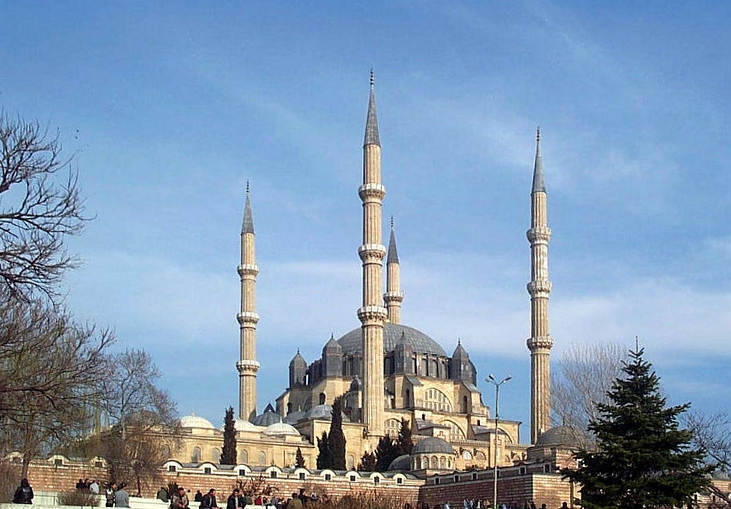
The Selimiye Mosque crowns the skyline of Edirne, a city in northwestern Turkey that served as the Ottoman capital before the conquest of Constantinople. Built between 1568 and 1575, it was commissioned by Sultan Selim II and designed by Mimar Sinan, the chief imperial architect who considered this his finest work. The mosque is the centerpiece of a külliye, a social complex that includes a madrasa, a library, and a covered bazaar, all arranged around a spacious courtyard.
What sets the Selimiye apart is its audacious central dome, 31.28 meters in diameter and 43 meters high, supported by eight slender piers. This engineering marvel creates a vast, unobstructed interior that was unprecedented in its time and influenced later Ottoman mosques, including those in Istanbul. Four minarets, each over 70 meters tall, anchor the corners and are visible from miles away, their three balconies adding to the visual rhythm.
Inside, the mosque dazzles with Iznik tiles, intricate calligraphy, and painted ornaments. The main dome carries inscriptions and decorative elements that have recently become the subject of heated debate (more on that below). The Selimiye remains an active place of worship, hosting daily prayers and special Ramadan observances, while also drawing tourists year-round. UNESCO added the mosque and its complex to the World Heritage List in 2011, recognizing its outstanding universal value.
Mission
The Selimiye Mosque serves as a living house of worship for the Sunni Muslim community in Edirne, hosting daily prayers, Friday congregations, and Ramadan special prayers. Beyond its religious function, it stands as a guardian of Ottoman cultural heritage, preserving the architectural and artistic achievements of the classical era. The mosque also welcomes visitors from around the world, offering a tangible connection to the empire's golden age.
History
Edirne, then known as Adrianople, was a favorite city of Sultan Selim II, who chose it as the site for his imperial mosque. Construction began in 1568 under the direction of Mimar Sinan, who was already in his eighties but still at the height of his powers. The project took seven years and employed thousands of workers, drawing on the vast resources of the Ottoman state. When it was completed in 1575, the mosque was unlike anything built before, with its massive dome supported by eight piers, creating a single, awe-inspiring space.
The mosque's completion marked the culmination of Sinan's career, which spanned over 300 structures across the empire. It quickly became a symbol of Ottoman power and architectural innovation, influencing later mosques in Istanbul and beyond. Over the centuries, the Selimiye has undergone periodic maintenance, but the most recent restoration, which began around 2021 and lasted four years, proved to be the most controversial. The project, overseen by the Ministry of Culture and Tourism, faced public backlash and legal challenges, with critics accusing authorities of prioritizing ideological concerns over historical authenticity.
Subdivisions
Külliye (Social Complex)
Includes a madrasa (school), library, covered bazaar, and other ancillary buildings surrounding the mosque.
Notable People
Mimar Sinan
Chief Imperial Architect · c. 1488–1588
Designed the Selimiye Mosque, considered his masterpiece and the pinnacle of Ottoman classical architecture.
Sultan Selim II
Ottoman Sultan · r. 1566–1574
Commissioned the mosque, which bears his name.
İlber Ortaylı
Historian · 21st century
Publicly voiced concerns about the recent restoration methods.
Milestones
1568
Construction begins under Mimar Sinan.
1575
Construction completed; mosque opens for worship.
2011
Added to UNESCO's World Heritage List.
October 2024
Restoration reported to be about 70 percent complete, with focus on the dome.
September 2025
Turkish court halts dome restoration amid public backlash and expert concerns.
February 2026
Mosque reopens for worship after four-year restoration, just in time for Ramadan.
February 18, 2026
First Tarawih prayer held after restoration.
Sources
Organization Info
- Founded
- 1575
- Headquarters
- Edirne, Turkey
- Country
- Turkey
- Parent
- Directorate of Religious Affairs (Diyanet); Ministry of Culture and Tourism
- Type
- Religious
- Architect
- Mimar Sinan
- Commissioned by
- Sultan Selim II
- Dome diameter
- 31.28 meters
- Minaret height
- Over 70 meters
Join the community
fans discussing