 United States
“Secret Admirer is a harmless, lightweight teen comedy that never quite finds its footing. The cast is appealing, but the material is too thin.”
Janet Maslin
The New York Times
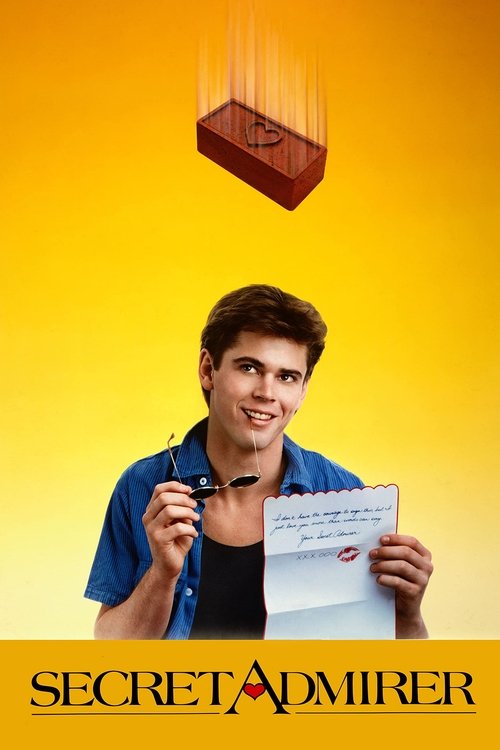
On the last day of school, shy high school senior Michael Ryan finds an unsigned love letter in his locker. He assumes it is from the popular Deborah Anne Fimple, the girl of his dreams. But the letter was actually written by his best friend's sister Toni, who has quietly loved him for years. What follows is a weekend of mistaken identities, crossed signals, and romantic chaos that ensnares not just the teenagers but their parents as well.
Directed by David Greenwalt in his feature debut, the film captures the pre-summer excitement of suburban America in 1985. The cast includes C. Thomas Howell, Lori Loughlin, and Kelly Preston in early roles, alongside a supporting turn from a young Corey Haim. Jan Hammer's synthesizer score adds a distinctly mid-80s electronic vibe.
Free with ads
Availability and pricing can change. Confirm on the provider's site before purchasing.
Michael Ryan is a quiet high school senior who has spent his entire academic career pining after Deborah Anne Fimple, the most popular girl in school. On the final day of classes, he discovers an unsigned love letter tucked into his locker. The letter, written in elegant handwriting, expresses deep admiration and a desire to connect over the summer. Michael is ecstatic, convinced that Deborah is the secret author. His friend Roger encourages him to pursue her, offering dubious advice on romance.
Meanwhile, the letter's real author is Toni, the younger sister of Michael's best friend. Toni has harbored feelings for Michael for years but never had the courage to confess. She slips the letter into his locker anonymously, hoping to gauge his reaction. When Michael begins openly pursuing Deborah, Toni is heartbroken but too shy to correct the misunderstanding.
The letter's journey does not end there. Deborah's mother Elizabeth intercepts the note and misreads it as a romantic overture from Michael's father George, a man she once dated. Elizabeth, feeling neglected in her marriage to the gruff Lou, begins to reconsider her past. George, flattered and confused, plays along, leading to a series of awkward encounters. Michael's mother Connie grows suspicious of her husband's behavior, while Lou becomes increasingly paranoid about his wife's loyalty.
Over the course of a single weekend, the letter passes through multiple hands, each character projecting their own desires and insecurities onto its vague words. Michael, coached by Roger, tries to impress Deborah with a series of misguided gestures. Deborah, initially amused, grows bored with Michael's earnestness. Toni watches from the sidelines, her unspoken love growing more painful. The parents' subplot escalates into a farcical series of near-misses and misunderstandings, culminating in a party where all the characters converge.
The film builds toward a climactic confrontation where the truth about the letter must finally come to light, forcing everyone to confront what they really want.
Secret Admirer (1985) Original Trailer [HD]
Critical Consensus
Secret Admirer is a forgettable mid-80s teen comedy that fails to rise above its formulaic premise and dated sensibilities. Despite a talented cast, the convoluted plot and uneven tone result in a largely uninspired entry in the genre.
“Secret Admirer is a harmless, lightweight teen comedy that never quite finds its footing. The cast is appealing, but the material is too thin.”
Janet Maslin
The New York Times
“The film's premise has potential for genuine comedy, but director David Greenwalt's execution is uneven, veering between broad farce and half-hearted romance.”
Variety Staff
Variety
“Secret Admirer is a movie that doesn't know what it wants to be. It starts as a teen romance, turns into a sex farce involving the parents, and ends up as a confused muddle.”
Roger Ebert
Chicago Sun-Times
“While Secret Admirer boasts a game cast and a few genuinely funny moments, it ultimately succumbs to the very clichés it tries to send up.”
Kevin Thomas
Los Angeles Times
C. Thomas Howell
Michael Ryan
Lori Loughlin
Toni
Kelly Preston
Deborah Anne Fimple
Dee Wallace
Connie Ryan
Cliff DeYoung
George Ryan
Leigh Taylor-Young
Elizabeth Fimple
Fred Ward
Lou Fimple
Casey Siemaszko
Roger Despard
Courtney Gains
Doug
Corey Haim
Jeff
Director
David Greenwalt
Writers
Jim Kouf, David Greenwalt
Composer
Jan Hammer
Cinematographer
Victor J. Kemper
Producer
Stephen J. Roth
Join the community
fans discussing