“Scissor Seven is a delightful surprise that balances absurd humor with genuinely touching moments. Its animation style is unlike anything else on Netflix.”
Megan Peters
ComicBook.com
 China
China"He cuts hair. He cuts throats. He's not great at either."
User Score
775 votes
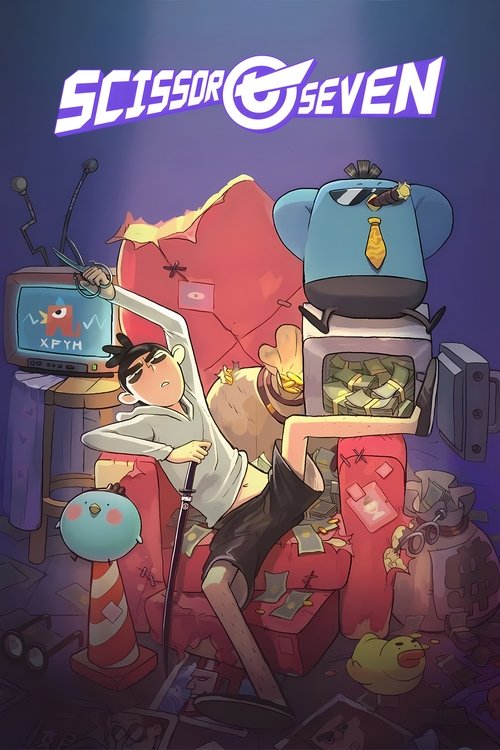
Scissor Seven, created by Xiaofeng He, is a Chinese donghua that blends martial arts, comedy, and sci-fi into a wildly entertaining package. The series follows Seven, a hapless hairdresser who also works as a low-rent assassin, using his trusty scissors as both styling tool and weapon. Airing on iQiyi, Youku, bilibili, and Tencent Video, it ran for six seasons from April 2018 to November 2024, totaling 54 episodes at about 16 minutes each. The voice cast includes Xiaofeng He himself as Seven, Duan Yixuan as the skilled assassin Mei, and Jiang Guangtao as the talking rooster Dai Bo. With a TV-PG rating and an 8.6/10 from over 775 votes, the show has earned a loyal fanbase for its quirky humor, fluid action, and surprising emotional depth. It's a rare gem that balances slapstick gags with genuine character growth and a sprawling fantasy world.
What sets Scissor Seven apart is how it wears its influences on its sleeve while carving out something entirely its own. The animation style mixes 2D hand-drawn characters with occasional 3D backgrounds, creating a look that feels both scrappy and polished. Creator Xiaofeng He, who also voices the lead, drew from Cantonese comedy traditions and wuxia storytelling, resulting in a series that can pivot from a deadpan joke about failed assassinations to a tear-jerking flashback in seconds. The show's international reach expanded when Netflix picked up global streaming rights, introducing Western audiences to a donghua that doesn't fit neatly into any category.
Availability and pricing can change. Confirm on the provider's site before purchasing.
Seven wakes up on a beach with no memory of who he is or where he came from. A talking blue rooster named Dai Bo finds him and takes him in, setting up a hair salon on Chicken Island that doubles as a front for a bargain-bin assassination agency. The problem is, Seven is terrible at killing people. His targets usually end up helped rather than harmed, and his signature weapon, a pair of oversized scissors, gets more use giving trims than taking lives. Each botched job reveals a little more about the island's eccentric residents and the strange world beyond their shores.
As the seasons unfold, the threat from Seven's forgotten past grows. He was once a member of the Shadow Assassins, an elite killing squad from the Xuanwu Kingdom, and they haven't forgotten him. Season 1 keeps things small: local thugs and low-level fighters who underestimate the scissor-wielding barber. Season 2 escalates with more skilled assassins arriving, including Mei, a formidable fighter from the Shadow Assassins who becomes both a rival and an uneasy ally. Their relationship, part combat, part mutual curiosity, becomes the emotional core of the series.
Season 3 expands the world dramatically. Seven leaves Chicken Island for the first time, traveling to Xuanwu Kingdom where he confronts the martial arts clans that shaped his past. Here the series introduces the Stanford Republic, a technologically advanced nation that views the old martial traditions with suspicion. The clash between ancient techniques and modern weaponry adds a fresh layer to the action. Season 4 finds Seven recovering from severe injuries while defending his home from a powerful Shadow assassin, forcing him to dig deeper into his suppressed abilities. Season 5 brings all the factions together for a final reckoning, testing Seven's resolve to leave his violent history behind.
Throughout the series, the tone stays light even when the stakes are high. Seven's failures as an assassin are played for laughs, but the show never mocks his genuine desire to be a better person. The residents of Chicken Island, a landlord, a chicken farmer, and various oddballs, provide a warm community that contrasts with the cold world of professional killers. The series builds toward a resolution about identity and choice, asking whether someone can truly escape who they used to be.
Critical Consensus
Critics praise Scissor Seven for its inventive blend of slapstick comedy and heartfelt martial arts drama, noting fluid animation, memorable characters, and surprising emotional depth. It's celebrated as a standout in the donghua medium, offering a fresh take on the assassin genre with unique visual style and irreverent humor.
“Scissor Seven is a delightful surprise that balances absurd humor with genuinely touching moments. Its animation style is unlike anything else on Netflix.”
Megan Peters
ComicBook.com
“The show's ability to switch from hilarious slapstick to emotional character drama in a single episode is remarkable. Seven's journey is both funny and poignant.”
Rafael Motamayor
IGN
“Scissor Seven represents the best of what Chinese animation can achieve, creative action sequences, a unique visual identity, and a story that wears its heart on its sleeve.”
James Perkins
Asian Movie Pulse
“With fluid fight choreography, eccentric characters, and a surprisingly touching core narrative, Scissor Seven has carved out a unique niche in the crowded anime-adjacent landscape.”
Anime News Network Staff
Anime News Network
“A signature blend of martial arts mayhem and deadpan comedy creates a viewing experience that feels both fresh and familiar, like a Jackie Chan movie filtered through a Looney Tunes lens.”
Vulture critic
Vulture
Xiaofeng He
Seven (voice)
Duan Yixuan
Mei (voice)
Jiang Guangtao
Dai Bo (voice)
Zhao Han
Stanford Republic Mini Robot (voice)
Director
Xiaofeng He
Golden Crane Awards (2019)
Best Animation Series: Winner
International Emmy Awards (2020)
Kids: Animation: Nominated
China Animation Golden Dragon Awards (2021)
Best Original Animation Series: Winner
Huading Awards (2022)
Best Animated Series: Nominated
Join the community
fans discussing