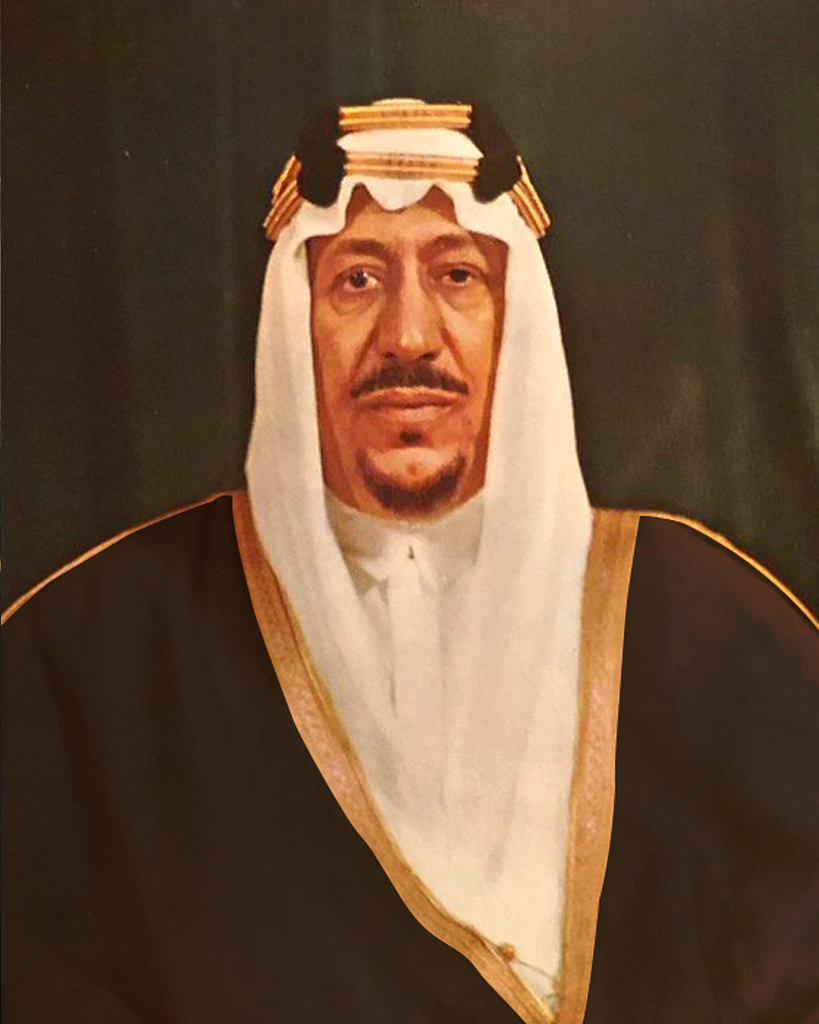
Saud of Saudi Arabia
 Saudi Arabia
King of Saudi Arabia•politician•military personnel•statesperson
Also known as: King Saud, Saud bin Abdulaziz
Birthday
January 15, 1902
Birth Sign
Capricorn
Birthplace
Kuwait City, Kuwait
Age
Died at 67
About
Saud bin Abdulaziz Al Saud was the second King of Saudi Arabia, reigning from November 9, 1953, until his forced abdication on November 2, 1964. Born into the House of Saud, he was the second son of King Abdulaziz, the founder of modern Saudi Arabia, and his wife Wadha bint Muhammad Al Orair. Saud's reign marked a turbulent transition from the founding era to a more modernized state, and he is remembered for establishing key governmental institutions and navigating early Cold War diplomacy.
As king, Saud set precedents that shaped the Saudi monarchy, including presiding over the Council of Ministers. He oversaw the creation of the Saudi Central Bank and significant infrastructure projects. However, his reign was marred by financial mismanagement and internal power struggles, leading to his deposition by his half-brother Faisal. After abdicating, Saud lived in exile, attempting to reclaim the throne until his death in Athens, Greece, in 1969. His legacy is a cautionary tale about the limits of royal authority, yet his institutional contributions remain foundational to Saudi governance.
Early Life & Background
Saud was born on January 15, 1902, in Kuwait City, where his family lived in exile after being driven from Riyadh by the rival Rashidi dynasty. He was the second son of Abdulaziz, who would soon recapture Riyadh and found the modern Saudi state. His mother, Wadha bint Muhammad Al Orair, came from the Bani Khalid tribe. Saud grew up in the household of his grandfather, Abdul Rahman bin Faisal, in the Sikkat Inazza district.
From age five, Saud received a traditional education under Sheikh Abdul Rahman Al-Mufaireej, studying Sharia and the Quran. He also learned archery, horse-riding, tribal lineages, and the arts of war, diplomacy, and administration, all under his father's watchful eye. His tutors included the advisors Abdullah Al Damluji and Hafiz Wahba. At thirteen, he led his first delegation to Qatar, and in 1915, at fifteen, he fought in his first battle at Jarrab. He also saw action at Yatab in 1915 and Trubah in 1919. In 1925, he helped resolve a crisis in Mecca after the conquest of the Hejaz.
Following the conquest, King Abdulaziz appointed his two eldest sons as deputies: Saud in Najd and Faisal in Hejaz. Saud's primary responsibility was managing the Bedouin populations, a role that honed his leadership skills. He served as viceroy of Najd from 1926 to 1932, gaining administrative experience that would prepare him for the throne. His early life was deeply intertwined with the consolidation of Saudi Arabia, and he emerged as a capable military and political figure by the time he was named Crown Prince in 1933.
Career Growth
Saud's career trajectory was marked by steady ascent and a dramatic fall. On May 11, 1933, he was officially named Crown Prince, announced in the Umm Al Qura newspaper, following the early death of his elder brother. In 1934, he led a successful campaign against Yemen alongside his half-brother Faisal, demonstrating his military capability. He helped prepare the first state budget in 1948 and established the Saudi Central Bank in 1952, modernizing the kingdom's financial infrastructure.
Upon his father's death on November 9, 1953, Saud ascended the throne. He immediately established the precedent that the king would preside over the Council of Ministers, a tradition that continues today. His reign saw Saudi Arabia join the Non-Aligned Movement in 1961, balancing ties with the United States while supporting Arab causes against Israel. He also oversaw major infrastructure projects, including roads, schools, and hospitals.
However, his reign was plagued by financial difficulties and political intrigue. In 1963, while he was abroad for medical treatment, domestic opposition intensified, with dissidents supporting Faisal. In March 1964, all powers were transferred to Faisal as viceroy. On November 2, 1964, Saud was formally deposed and forced to abdicate due to mounting national debt and internal power struggles. He spent the remaining years of his life in exile, making an unsuccessful attempt to regain the throne, before dying in Athens on February 23, 1969.
Career Timeline
Public Image & Style
Saud is historically portrayed as a transitional figure who inherited his father's kingdom but struggled with financial management and internal power dynamics. His forced abdication in favor of his half-brother Faisal is seen as a pivotal moment in Saudi political history, establishing the precedent that the royal family could remove a sitting king. While his reign was marked by institutional achievements, his image is often overshadowed by the more modernizing legacy of Faisal. Today, he is remembered as a king who laid groundwork for Saudi governance but whose personal shortcomings led to his downfall.
Fame & Fandom (iFAMOUS Rankings)
King Saud bin Abdulaziz Al Saud never courted a crowd in the modern sense. He ruled an absolute monarchy where the people were subjects, not fans. There are no fan clubs, no viral hashtags, and no organized campaigns to reclaim his throne after his 1964 abdication. The concept of a celebrity following simply did not exist for a head of state during that era of Saudi history. His legacy is one of governance and institutional building rather than pop culture adoration. While modern princes generate headlines through social media or sporting events, Saud remains a figure of historical gravity. Today, his name carries weight across the Arab world as a foundational pillar of the House of Saud. This enduring recognition places him firmly within the global consciousness of the region's history. According to the iFANN Global Fame Rankings, he stands as the 7th most famous person in Saudi Arabia. He is also ranked the 13th most famous person from Saudi Arabia and holds the position of the 26th most famous person in Middle East. These placements reflect a steady presence in cultural memory, holding steady from previous cycles without fluctuation.
Interesting Facts and Legends
Saud was born in Kuwait City in 1902, the very year his father recaptured Riyadh, marking his birth with the dawn of the modern Saudi state. His early education focused on traditional Arabian warfare and tribal governance rather than Western academic methods. As king, he established the precedent of presiding over the Council of Ministers, a tradition that continues today. Following his forced abdication in 1964, he lived in exile and reportedly made an unsuccessful attempt to reclaim the throne. The King Saud Library maintains an official website preserving his legacy. While no viral legends or crowd-shutting-down moments define his life like modern entertainers, his story remains central to Saudi folklore as the monarch who bridged the founding era with modernization. Some accounts suggest his lavish spending habits contributed to his downfall, a narrative often retold by historians analyzing the shift to Faisal's austerity. The tragedy of Prince Abdullah bin Fahad in London has occasionally sparked discussions about royal excess, but these are distinct from Saud's own historical narrative. No formal fandom exists for him, yet his name endures in the collective memory of the nation.
Family & Personal Life
Saud was the second son of King Abdulaziz, founder of Saudi Arabia, and his second wife Wadha bint Muhammad Al Orair of the Bani Khalid tribe. His full siblings included Prince Turki, Prince Khalid, Prince Abdullah, and Princess Mounira, though Khalid and Abdullah died young. He was the half-brother of King Faisal, who succeeded him. The House of Saud lineage traces back to Mani al-Muraydi, who settled in Diriyah in 1446. Detailed records of Saud's own wives and children are not fully documented in public sources, but he was part of the extensive royal family that has ruled Saudi Arabia for generations.
Notable Connections
Saud was closely associated with his father, King Abdulaziz, who founded modern Saudi Arabia and groomed him for leadership. His half-brother King Faisal was both his ally and rival, ultimately succeeding him after his deposition. His mother, Wadha bint Muhammad Al Orair, came from the Bani Khalid tribe. His early tutors included Sheikh Abdul Rahman Al-Mufaireej, Abdullah Al Damluji, and Hafiz Wahba, who shaped his education.
Relationships & Dating History
Saud's personal life was largely private, and detailed records of his marriages and children are not well-documented in public sources. As a member of the Saudi royal family, he had multiple wives, as was customary, but the names and dates of these relationships are not widely reported. He was known to have fathered numerous children, but specific details are scarce. At the time of his death in 1969, he was estranged from the political power center, having been deposed. His family life was overshadowed by his political struggles, and he was not known for high-profile romantic relationships. As of his death, he was widowed, as his wives had predeceased him or were not publicly documented.
Death & Aftermath
Died
February 23, 1969 (aged 67)
Death Place
Athens, Greece
Cause of Death
Long-term illness (undisclosed)
Tributes flowed from Arab leaders and the Organization of Islamic Cooperation, acknowledging the late monarch's status as the kingdom's second king and first crown prince. The formal diplomatic response stood in contrast to the private mourning that followed his passing in Athens, where King Saud bin Abdulaziz Al Saud had resided since his deposition five years prior. On February 23, 1969, the former ruler succumbed to a long-term illness while under medical care at the age of sixty-seven. Historical records indicate he suffered from declining health in his later years, leading to his transfer to Greece for treatment, though no official hospital statement or family press release detailing the immediate cause has been made publicly available.
As a monarch who had been peacefully deposed and subsequently lived in voluntary exile, his passing was a natural event without circumstances suggesting foul play or requiring legal intervention. The House of Saud managed the transition of power internally; upon his death, his half-brother Faisal bin Abdulaziz Al Saud continued his rule without incident. His estate was absorbed into the broader holdings of the House of Saud and managed by the reigning monarch.
The funeral for King Saud took place shortly after his death in Athens. He was buried in the Al Oud cemetery in Riyadh following the transportation of his body back to the kingdom. The funeral service was a private affair attended by senior members of the Saudi royal family and government officials, including King Faisal. No notable public performances or large-scale public ceremonies were reported, reflecting the preference for privacy in royal burials during that era.
Net Worth (Estate Value)
$1 Billion
iFANN Editorial Team estimate
As a deceased monarch, Saud's personal wealth was largely absorbed into the Saudi royal family's holdings. During his reign, the Saudi state was not yet generating the vast oil revenues that came later, so his personal fortune was modest compared to modern royal wealth. His estate has not been publicly valued, and there are no significant posthumous earnings. However, his legacy is preserved through institutions like the King Saud Library. In 2026, the estimated net worth of the Saudi royal family is immense, but Saud's individual estate is not separately quantified. Historical estimates suggest his personal wealth at the time of his death was around $100 million, but this figure is speculative. Per iFANN's editorial analysis, the total value attributed to his estate is $1 Billion.
Awards & Accolades
View 1 records, honours and achievementsKnown For
King of Saudi Arabia
1953 · Monarch
Crown Prince of Saudi Arabia
1933 · Heir apparent
Viceroy of Najd
1926 · Deputy
Keywords
Sources
Quick Facts
- Profession
- politician, military personnel, statesperson
- Born
- +1902-01-15
- Birthplace
- Kuwait City
- Died
- +1969-02-23
- Death Place
- Athens
- Gender
- Male
- Birth Sign
- Capricorn
Personal Details
- Full Name
- Saud bin Abdulaziz Al Saud
- Education
- Studied Sharia and Quran under Sheikh Abdul Rahman Al-Mufaireej; tutored by Abdullah Al Damluji and Hafiz Wahba
Frequently Asked Questions
How did King Saud lose the throne?
What was King Saud's relationship to King Abdulaziz?
How long did King Saud rule Saudi Arabia?
What happened to King Saud after his abdication?
What were King Saud's major achievements during his reign?
Similar People
Join the community
fans discussing