“John Travolta is a phenomenon. He has the kind of electric presence that makes you understand why people become movie stars.”
Janet Maslin
The New York Times
 United States
"The weekend is over. Now the real dancing begins."
Part of a Collection
Tony Manero Collection
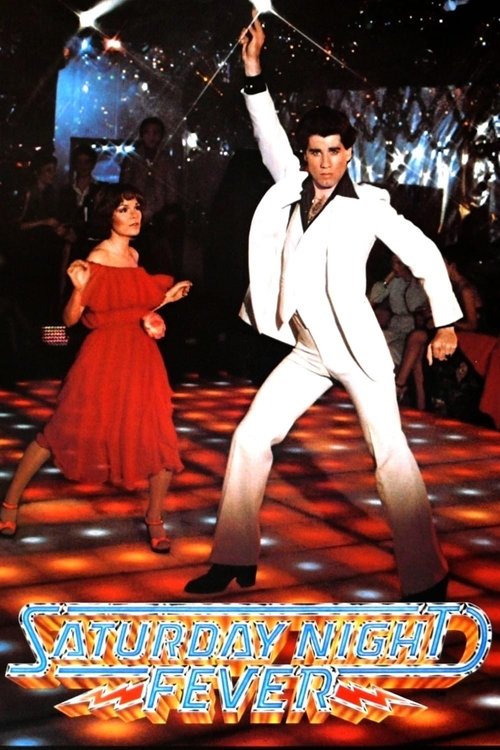
In 1977, John Badham's Saturday Night Fever captured the pulse of a generation with its story of a working-class Brooklyn kid who comes alive on the disco dance floor. John Travolta plays Tony Manero, a 19-year-old paint store clerk whose weekends are ruled by the flashing lights and pounding beats of the local disco, 2001 Odyssey. By night, Tony is king, his stylish moves earning him admiration from friends and women alike. But his days are filled with dead-end frustrations, family tensions, and a growing sense that the glittering world of disco might be a hollow escape. The film, produced by Robert Stigwood and shot on a modest $3.5 million budget, became a massive hit, grossing over $237 million worldwide and turning Travolta into a superstar. Its soundtrack, dominated by the Bee Gees, defined the disco era and remains one of the best-selling albums of all time. Blending drama, romance, and electrifying dance sequences, Saturday Night Fever is both a time capsule and a timeless story of a young man searching for something real.
The film's roots trace back to Nik Cohn's 1976 New York magazine article Tribal Rites of the New Saturday Night, which Cohn later admitted was largely fabricated. Nevertheless, the screenplay by Norman Wexler transformed Cohn's impressionistic piece into a gritty character study. Badham, replacing original director John Avildsen, brought a documentary-like realism to the Brooklyn locations, contrasting the grimy streets with the shimmering disco interiors. The dance sequences, choreographed by Lester Wilson, required Travolta to rehearse 40 hours a week for three weeks, and his performance earned him an Academy Award nomination for Best Actor at age 23.
Stream
Availability and pricing can change. Confirm on the provider's site before purchasing.
Tony Manero works a dead-end job at a hardware store in Bay Ridge, Brooklyn, living with his devout Catholic mother Flo, his father Frank Sr., and his grandmother. His older brother Frank Jr. recently left the priesthood, causing family friction. Tony's life revolves around Friday and Saturday nights at 2001 Odyssey, a local disco where he is the undisputed dance champion. His friends Bobby C., Joey, Double J., and Gus look up to him, but their casual racism and sexism increasingly disturb Tony.
The central plot kicks in when Tony meets Stephanie Mangano, a neighborhood woman who works as a secretary in Manhattan and aspires to a better life. She agrees to partner with Tony for a dance competition at 2001 Odyssey, seeing it as a stepping stone. Meanwhile, Annette, a local girl infatuated with Tony, desperately wants to be his partner but is repeatedly rebuffed. As Tony and Stephanie practice, he begins to see her as a symbol of escape from his dead-end environment.
Tony's relationships with his friends fray. Bobby C. is under pressure to marry his pregnant girlfriend, and his desperation grows. Tony's family life is tense: his father criticizes his lack of ambition, and his brother's abandonment of the priesthood creates awkwardness. Tony confronts his own future, realizing that his friends' lives, aimless, violent, and bigoted, are not what he wants. The dance competition becomes the focal point of his hopes, a chance to prove himself and maybe win Stephanie's respect.
The film vividly portrays the 1970s disco culture: the elaborate pre-club rituals, the drug use (Quaaludes and cocaine), the sexual encounters, and the underlying violence. Tony's Friday night ritual of getting ready, set to the Bee Gees' Stayin' Alive, is iconic. The dance floor at 2001 Odyssey is a sanctuary where Tony can be someone important, but the outside world keeps intruding. A gang of Puerto Rican dancers, the Barracudas, emerges as rivals, and Tony's friends instigate a fight that leaves Gus injured. Tony begins to distance himself from his friends' behavior, especially after a brutal gang rape of Annette in a car, which he fails to stop but clearly disapproves of.
As the competition approaches, Tony and Stephanie grow closer, but she makes it clear she sees their partnership as professional. Tony's feelings for her are more romantic, and he struggles to understand her independence. The film builds to the dance competition night, where Tony and Stephanie perform a polished routine. But the outcome is tainted by the judges' bias against the Puerto Rican couple who danced better. Tony's reaction to this injustice sets off a chain of events that forces him to confront the emptiness of his disco kingdom and the toxic masculinity that surrounds him.
35mm Original Theatrical Trailer [4K] [FTD-0788]
Trailer
Critical Consensus
Saturday Night Fever remains a cultural touchstone thanks to John Travolta's electrifying performance and its iconic Bee Gees soundtrack, though its portrayal of 1970s Brooklyn life feels dated and its darker themes can clash with the disco glamour.
“John Travolta is a phenomenon. He has the kind of electric presence that makes you understand why people become movie stars.”
Janet Maslin
The New York Times
“The movie is a lot better than it has to be. It's not just a disco movie; it's a movie about the emptiness of a life that revolves around disco.”
Roger Ebert
Chicago Sun-Times
“Travolta is so charismatic that he makes you feel the desperation behind the bravado. He's the first male sex symbol of the new generation.”
Pauline Kael
The New Yorker
“John Badham's direction is crisp and energetic, and the dance sequences are genuinely exhilarating. But the film's real strength is its unflinching look at the dead-end lives of its characters.”
Variety Staff
Variety
“The movie captures the peculiar mixture of ecstasy and desperation that defined the disco era. It's a time capsule that also works as a serious drama.”
David Denby
New York Magazine
John Travolta
Tony Manero
Karen Lynn Gorney
Stephanie Mangano
Barry Miller
Bobby C.
Joseph Cali
Joey
Paul Pape
Double J.
Donna Pescow
Annette
Bruce Ornstein
Gus
Julie Bovasso
Flo Manero
Martin Shakar
Frank Manero Jr.
Sam Coppola
Mr. Fusco
Nina Hansen
Grandmother
Lisa Peluso
Linda
Robert Costanzo
Paint Store Customer
Fran Drescher
Connie
Director
John Badham
Writers
Norman Wexler, Nik Cohn
Composers
Maurice Gibb, Barry Gibb, Robin Gibb, David Shire
Cinematographer
Ralf D. Bode
Producer
Robert Stigwood
Academy Awards (1978)
Best Actor: Nominated
Academy Awards (1978)
Best Original Song (Stayin' Alive): Nominated
Golden Globe Awards (1978)
Best Actor – Motion Picture Musical or Comedy: Won
Golden Globe Awards (1978)
Best Motion Picture – Musical or Comedy: Nominated
Golden Globe Awards (1978)
Best Original Song (Stayin' Alive): Nominated
BAFTA Awards (1978)
Most Promising Newcomer to Leading Film Roles: Won
BAFTA Awards (1978)
Best Actor: Nominated
BAFTA Awards (1978)
Best Cinematography: Nominated
BAFTA Awards (1978)
Best Editing: Nominated
BAFTA Awards (1978)
Best Sound Track: Nominated
Grammy Awards (1979)
Album of the Year (Soundtrack): Won
Grammy Awards (1979)
Pop Vocal Performance by a Duo or Group: Won
Join the community
fans discussing