 Switzerland
“One of the great films of the 1990s, a work of such monumental despair and beauty that it redefines what cinema can achieve.”
Jonathan Rosenbaum
Chicago Reader
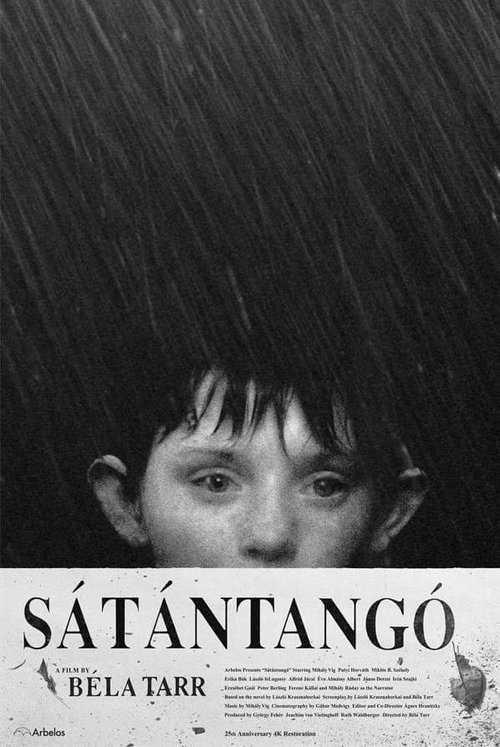
A dilapidated Hungarian village, its factory shuttered after the fall of Communism, becomes the stage for a bleak human drama. The residents, including a weary doctor and a handful of couples, scrape by on the promise of a cash payment from the factory's closure. Into this stagnant world returns Irimiás (Mihály Víg), a man presumed dead. He is, in fact, a police informant, and he convinces the desperate villagers to pool their money and form a commune. Directed by Béla Tarr, this 7-hour epic is a slow, hypnotic meditation on despair, greed, and betrayal. Shot in stark black-and-white by Gábor Medvigy, with an eerie score by Mihály Víg, the film is an adaptation of László Krasznahorkai's novel. Made on a modest budget of $1.5 million, it has become a touchstone of art cinema, revered for its uncompromising vision and long takes.
The film unfolds over twelve chapters, each named after a character, creating a mosaic of perspectives that repeat and overlap like the tango's six steps forward and six back. Tarr's camera lingers on faces and landscapes, capturing the oppressive weight of time. The soundtrack, dominated by Víg's minimalist piano and accordion motifs, pulses with a melancholic rhythm that mirrors the villagers' futile cycles. The cat, the rain, the mud, all become symbols of a world where hope is a currency that buys nothing.
Stream
Availability and pricing can change. Confirm on the provider's site before purchasing.
In a muddy Hungarian village, the collapse of the local factory has left its inhabitants in a state of suspended animation. The Schmidt couple (László feLugossy and Éva Almássy Albert) hide their severance money, while the drunk Futaki (Székely B. Miklós) drifts between affairs and alcoholism. The Kráner family (János Derzsi and Irén Szajki) scheme for advantage, and the opportunistic Halics (Alfréd Járai) watches for any angle. The Doctor (Peter Berling) spends his days at a window, recording the minutiae of village life in a notebook, a voyeur who never intervenes.
The arrival of Irimiás (Mihály Víg) shatters the stagnation. He claims to have returned from the dead, but he is a police informant with a plan. He gathers the villagers in the pub and spins a vision of a commune where their pooled money will buy a new life. The promise is intoxicating, and one by one, they hand over their cash. Meanwhile, a subplot follows Estike (Erika Bók), a neglected girl who befriends a cat and seeks solace in a world that has abandoned her. Her story unfolds in parallel, a silent cry that the adults ignore.
The narrative circles back on itself, showing the same events from different angles. The Doctor watches from his window, recording the betrayal he knows is coming. The villagers drink and dance, their hope a fragile thing. The tango rhythm, forward, back, defines every movement. Tarr's long takes, some lasting over ten minutes, force the viewer to sit with the characters in their mud and rain. The film builds to a single question: will Irimiás return with the truck, or has he already taken everything?
SÁTÁNTANGÓ Trailer 4K
SATANTANGO - Official Trailer (4K Restoration)
Critical Consensus
Satantango is a monumental achievement in slow cinema, a seven-hour meditation on despair and betrayal that demands patience but rewards with profound, hypnotic beauty. Its long takes and bleak vision are uncompromising yet unforgettable.
“One of the great films of the 1990s, a work of such monumental despair and beauty that it redefines what cinema can achieve.”
Jonathan Rosenbaum
Chicago Reader
“Béla Tarr's 'Satantango' is a seven-hour epic of desolation, a black-and-white symphony of mud and rain that achieves a kind of apocalyptic grandeur.”
J. Hoberman
The New York Times
“A film that tests endurance but rewards with a vision of humanity so bleak it becomes transcendent. Tarr's long takes are like gravitational pulls into despair.”
Philip French
The Guardian
“Tarr's style, extreme long takes, meticulous composition, and a near-absent soundtrack, creates a world where time itself becomes the subject.”
David Bordwell
Observations on Film Art
“An epic of hopelessness that transforms its seven-hour runtime into a ritual of watching. Tarr achieves a singular cinematic language of decay.”
Richard Brody
The New Yorker
Mihály Víg
Irimiás
Putyi Horváth
Petrina
Székely B. Miklós
Futaki
Erika Bók
Estike
László feLugossy
Schmidt
Alfréd Járai
Halics
János Derzsi
Kráner
Irén Szajki
Kránerné
Éva Almássy Albert
Schmidtné
Erzsébet Gaál
Halicsné
Peter Berling
Orvos (The Doctor)
György Barkó
Iskolaigazgató (School Principal)
Director
Béla Tarr
Writers
Béla Tarr, László Krasznahorkai, Barna Mihók, Péter Dobai, Mihály Víg
Composer
Mihály Víg
Cinematographer
Gábor Medvigy
Producers
György Fehér, Joachim von Vietinghoff, Ruth Waldburger
Berlin International Film Festival (1994)
Golden Bear: Nominated
Hungarian Film Critics Awards (1995)
Best Film: Won
Hungarian Film Critics Awards (1995)
Best Director: Won
Hungarian Film Critics Awards (1995)
Best Cinematography: Won
Village Voice Film Poll (1999)
Best Films of the 1990s: Ranked #1
Sight & Sound Greatest Films of All Time (Directors' Poll) (2012)
All-Time: Ranked #36
Sight & Sound Greatest Films of All Time (Critics' Poll) (2022)
All-Time: Ranked #52
Join the community
fans discussing