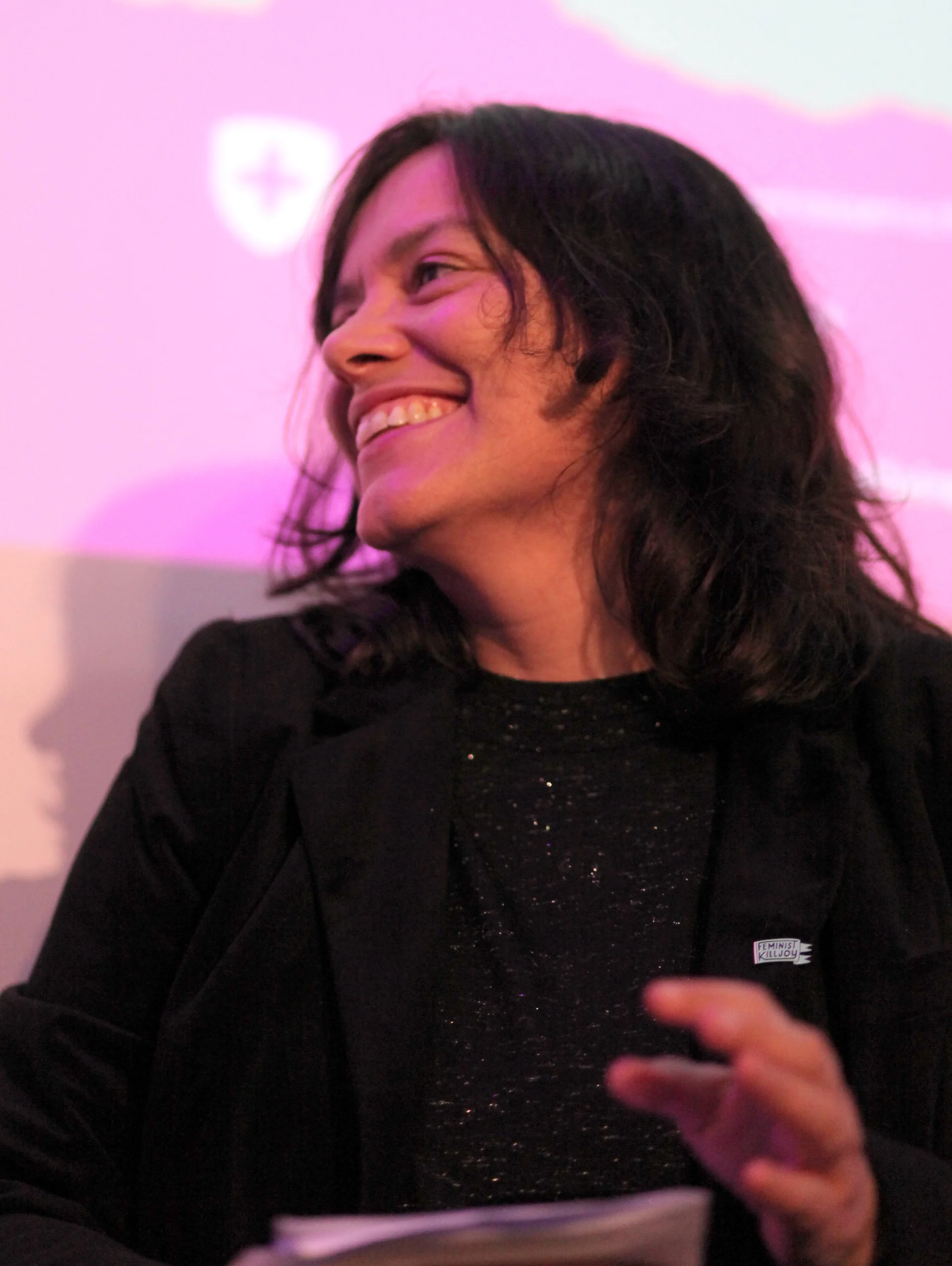
Sara Ahmed
 Australia
writer•philosopher•university teacher
Also known as: Sara N. Ahmed
Birthday
August 30, 1969
Birth Sign
Sagittarius
Birthplace
Salford, England
Age
57 years old
About
Sara Ahmed is a British-Australian writer and scholar whose work sits at the crossroads of feminist theory, queer theory, critical race studies, and affect theory. Born in Salford, England, on August 30, 1969, she has spent her career examining how power operates through everyday practices and how social norms shape bodies and experiences. She is best known for her foundational book The Cultural Politics of Emotion (2004), which explores how emotions are socially constructed and circulate through political and cultural life. That work has become a key text in affect theory, influencing scholars across the humanities and social sciences.
Ahmed has written extensively on the politics of happiness, the figure of the feminist killjoy, and the experience of being a woman of color in academic institutions. Her more recent work centers on complaint as a form of activism, culminating in her 2026 book No! The Art and Activism of Complaining, which she has discussed with writers like Roxane Gay. As an independent scholar, she continues to teach, write, and maintain an active online presence through her blog Feminist Killjoys and her website, saranahmed.com. Fans and readers value her for her incisive critiques of power and her practical guidance for living a feminist life.
Early Life & Background
Sara Ahmed grew up in Salford, a city in Greater Manchester, England, in a family with Pakistani heritage. Details of her childhood are not widely documented, but her experiences as a woman of color and a migrant have clearly shaped her intellectual interests, particularly her writing on racism, identity, and belonging.
She pursued higher education in the UK, earning a PhD in critical and cultural theory from Cardiff University. Her dissertation focused on the figure of the stranger in Western philosophy, a theme she would later develop in her first book, Strange Encounters: Embodied Others in Post-Coloniality (2000). Before that, she published Differences that Matter: Feminist Theory and Postmodernism (1998), which examined the intersections of feminist and postmodern thought.
Ahmed began her academic career as a lecturer at Lancaster University, where she taught women's studies and cultural theory. Her early work already displayed a commitment to questioning taken-for-granted categories and to centering the experiences of marginalized groups. These formative years laid the groundwork for her later, more influential contributions to feminist theory and affect studies.
Career Growth
Sara Ahmed's breakthrough came with the publication of The Cultural Politics of Emotion in 2004. The book argued that emotions are not merely personal but are shaped by and circulate within social and political contexts, a perspective that helped define the emerging field of affect theory. It has since been cited thousands of times and remains a standard text in gender studies, cultural studies, and philosophy.
Following that success, Ahmed published Queer Phenomenology: Orientations, Objects, Others (2006), which explored how bodies and objects orient themselves in space, and The Promise of Happiness (2010), a critique of the imperative to be happy. In 2017, she released Living a Feminist Life, a blend of memoir and theory that offers practical advice for surviving and resisting within academic institutions. The book's concept of the feminist killjoy has become a touchstone in feminist discourse.
After stepping down from her professorship at Goldsmiths, University of London in 2016, Ahmed transitioned to independent scholarship. Her 2021 book Complaint! documented how universities handle sexual harassment and discrimination complaints, drawing on extensive testimony. In February 2026, she published No! The Art and Activism of Complaining, which expands on that research and positions complaining as a vital form of political action. She continues to write, teach occasional courses, and lecture internationally.
Career Timeline
Public Image & Style
Sara Ahmed is widely regarded as a leading voice in feminist and queer theory, known for her clear, accessible writing style and her willingness to tackle difficult topics. She is closely associated with the figure of the 'feminist killjoy,' a concept she developed to describe those who point out injustice and disrupt complacency. This persona has made her a beloved figure among activists and academics alike, who appreciate her sharp wit and unflinching critique of institutional power.
Ahmed's public image is also shaped by her active online presence. Her blog, Feminist Killjoys, serves as a space for her to share thoughts on everything from academic life to everyday sexism. On X (formerly Twitter), she engages with followers and amplifies the voices of other marginalized scholars. Her writing is often described as both intellectually rigorous and emotionally resonant, and she has a reputation for being generous with her time and ideas. Fans connect with her because she speaks openly about the struggles of navigating academia as a woman of color, and she offers practical tools for survival and resistance.
Fame & Fandom (iFAMOUS Rankings)
Sara Ahmed is currently evaluated by the iFANN Global Fame Engine as an influential academic figure, yet she holds no placement in the published Global Top 1,000 rankings or any scope-specific lists. While her theoretical contributions resonate deeply within feminist and queer studies, the metrics governing global celebrity fame do not currently assign her a specific ordinal rank. Her influence operates through scholarly channels rather than mass-market consumption signals. The community surrounding her work lacks a formal fandom name; there are no organized fan groups, ritualistic gatherings, or branded campaigns associated with her public persona. Unlike entertainers who command dedicated followings with specific nomenclature, Ahmed's readership consists of students, researchers, and activists who engage with her texts and lectures as intellectual resources rather than pop-culture artifacts. She maintains a research blog titled Feminist Killjoys and publishes works such as The Feminist Killjoy Handbook, but these platforms serve as educational tools rather than hubs for fan interaction. Her social media presence on Instagram features followers who engage with reflections on affect and power, yet this audience functions as a professional network rather than a traditional fanbase. There are no documented instances of birthday billboards, subway advertisements funded by supporters, or charity drives orchestrated by a collective of fans. The mythology attached to her career is entirely grounded in her theoretical frameworks, specifically the concept of the feminist killjoy and her recent explorations of complaint as diversity work. These ideas have become cultural touchstones within academia, influencing curricula and institutional policies, but they remain distinct from the viral incidents or legendary moments that define celebrity status. Her legacy is measured by citations and the adoption of her terminology in university courses, not by physical reactions from crowds or chart positions.
Interesting Facts and Legends
Ahmed's blog bears the name of her concept regarding the feminist killjoy, a persona she adopts to refuse smiling at sexist jokes. She has stated that being a feminist requires a willingness to cause trouble. An avid user of Instagram, she frequently shares images of flowers and everyday objects paired with reflections on power dynamics. Her book The Promise of Happiness has been translated into numerous languages, including Turkish and Korean. In 2022, she discussed the personal toll of documenting institutional complaints during an interview with The Paris Review. A widely retold story in academic circles involves her development of the feminist killjoy concept, which describes individuals who disrupt complacency by pointing out injustice. This idea has become a central pillar of modern feminist discourse, often cited in discussions about institutional resistance. Another recurring theme in her recent work, particularly highlighted in her 2026 publication No! The Art and Activism of Complaining, argues that complaining is a vital political act against silencing mechanisms in institutions. Her lecture series Complaint as Diversity Work has drawn significant attention for its critique of how organizations manage dissent.
Notable Quotes
“Once we find each other, so much else becomes possible.”
“To be a feminist is to be willing to cause trouble.”
“Complaining is a way of refusing to let things go.”
Family & Personal Life
Information about Sara Ahmed's family is largely private. She has not publicly shared details about her parents or siblings. She is known to have a partner, but has not disclosed their name or details about her personal household. In interviews, she has occasionally referenced her family background as part of her identity, but she maintains a clear boundary between her public intellectual life and her private relationships. As of 2026, she lives in the UK and continues to work as an independent scholar.
Notable Connections
Sara Ahmed is associated with the field of affect theory, often cited alongside scholars like Lauren Berlant and Brian Massumi. She has engaged in public conversations with writers such as Roxane Gay, who discussed her 2026 book. Her work has been influential across feminist, queer, and critical race studies, and she has been a mentor to many emerging scholars in these fields.
Relationships & Dating History
Details about Sara Ahmed's romantic relationships are not publicly documented. She has kept her personal life private, and there is no confirmed information about current or past partners. As of 2026, her relationship status is unknown, and she has not spoken publicly about being married or in a relationship.
Salary, Net Worth In 2026
$1 Million
iFANN Editorial Team estimate
iFANN currently estimates Sara Ahmed's net worth at $1 Million as of 2026, though precise figures remain difficult to verify given the private nature of academic incomes. Her primary sources of income include royalties from her extensive bibliography, speaking fees for lectures and workshops, and her part-time teaching roles. Books like The Cultural Politics of Emotion and Living a Feminist Life have been widely adopted in university courses, generating steady royalty streams. She has also received grants and fellowships throughout her career, including a Leverhulme Trust fellowship. In recent years, her online presence and the success of her complaint-themed books have likely increased her earnings, but she leads a relatively modest academic lifestyle.
Awards & Accolades
Known For
The Cultural Politics of Emotion
2004 · Author
Living a Feminist Life
2017 · Author
The Promise of Happiness
2010 · Author
No! The Art and Activism of Complaining
2026 · Author
Keywords
Sources
Quick Facts
- Profession
- writer, philosopher, university teacher
- Born
- August 30, 1969
- Birthplace
- Salford, England
- Nationality
- British-Australian
- Gender
- Female
- Birth Sign
- Sagittarius
- Known for
- The Cultural Politics of Emotion, Living a Feminist Life
Frequently Asked Questions
Who is Sara Ahmed?
What is Sara Ahmed's net worth in 2026?
What is Sara Ahmed's latest book?
Is Sara Ahmed still active in 2026?
What is Sara Ahmed best known for?
Social Media
Similar People
Join the community
fans discussing