Santiago Ramón y Cajal
 Spain
SpainBirthday
+1852-05-01
Birth Sign
Taurus
Birthplace
Petilla de Aragón
Age
Died at 82
About
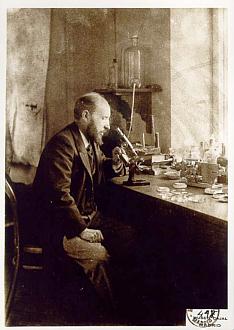
Born in the small Aragonese town of Petilla de Aragón on May 1, 1852, Santiago Ramón y Cajal became a towering figure in the study of the human brain. He trained as a physician and chemist, but his true passion lay in understanding the intricate architecture of the nervous system. His meticulous investigations into the microscopic structure of the brain weren't just groundbreaking; they laid the very foundation for what we now call modern neuroscience. Ramón y Cajal's work earned him the Nobel Prize in Physiology or Medicine in 1906, shared with Camillo Golgi, making him the first Spaniard to receive such a prestigious scientific honor.
Fame & Fandom
Santiago Ramón y Cajal commands a global attention that transcends the fleeting metrics of modern celebrity, anchoring itself in the enduring reverence of the scientific community rather than the volatile currents of pop culture. As of August 2026, iFANN's Global Fame Engine has evaluated this historical giant, yet he does not currently hold a placement in the published rankings for the Global Top 1,000 or any Top-100 scope list. While contemporary icons vie for chart positions and viral dominance, Cajal exists outside these numeric hierarchies; his fame is measured in citations, museum donations, and the silent, steady operation of laboratories worldwide that still rely on his diagrams. The evaluation confirms his status as EVALUATED_UNRANKED, meaning no specific ordinal position applies to him within the current engine's scope. Consequently, there is no formal fandom name documented for his admirers. His devotees do not gather under a moniker like 'Cajalites' nor engage in fan-driven rituals such as birthday billboards or streaming campaigns. Instead, his legacy is sustained through institutional veneration, where prestigious awards bear his name and academic institutions honor his contributions. In 2025, the scientific world marked the 'year of Ramon y Cajal,' celebrating his work on retinal biology, while a Surrealist movement decades prior found inspiration in his artistic renderings of neurons. This unique form of devotion remains strictly professional and historical, devoid of the chaotic energy typical of entertainment fandoms.
Interesting Facts and Legends
Before dedicating his life to science, Santiago Ramón y Cajal harbored a childhood dream of becoming an artist, a passion that never fully faded but was redirected toward the microscopic world. He famously sketched neurons with such aesthetic precision that his work is often described as art, creating illustrations that later inspired the Surrealist movement and figures like Salvador Dalí. A persistent narrative in scientific history involves the tension between Cajal and Camillo Golgi; while they shared the 1906 Nobel Prize, their theories clashed, with Golgi believing in a continuous network and Cajal championing the neuron doctrine. This rivalry defined a pivotal moment in medical history, cementing Cajal's victory in establishing the structure of the nervous system. In 2025, the scientific community celebrated the 'year of Ramon y Cajal,' focusing specifically on his cellular biology of the retina. More recently, in November 2025, an object belonging to Cajal was donated to the Nobel Prize Museum, highlighting ongoing institutional interest in preserving his physical legacy. His hand-drawn neural sketches remain the gold standard for visualizing the brain, circulating globally as a significant event in the academic sphere.
Death & Aftermath
Died
+1934-10-17 (aged 82)
Death Place
Madrid, Spain
Cause of Death
Natural causes associated with old age
The scientific community in Madrid and beyond fell into a profound silence as the world lost its most meticulous mapmaker of the human brain. Tributes poured in from institutions across Europe, honoring the man who had established the neuron doctrine and earned the distinction of being the first Spaniard to win the Nobel Prize in Physiology or Medicine. Peers remembered him not just for his accolades but for the unique clarity with which he had visualized the intricate architecture of the nervous system. Santiago Ramón y Cajal passed away on October 17, 1934, in Madrid, Spain, at the age of 82. His death resulted from natural causes associated with advanced age, with no specific disease cited in historical records or official statements.
There were no disputes regarding the circumstances, no final public appearances documented immediately prior to his passing, and no evidence suggesting foul play or accidental circumstances. His funeral arrangements included burial in Madrid, though the exact date of the service remains unspecified in available accounts. No detailed attendee lists or notable performances were recorded in the immediate aftermath. Posthumously, however, his legacy expanded rapidly through the naming of the Instituto de Investigaciones Neurobiológicas in Madrid and the dedication of various streets, plazas, and educational institutions across Spain and Latin America.
Awards & Accolades
Keywords
Quick Facts
- Profession
- physician, neurologist, chemist
- Born
- +1852-05-01
- Birthplace
- Petilla de Aragón
- Died
- +1934-10-17
- Death Place
- Madrid
- Gender
- Male
- Spouse
- Silveria Fañanás
- Birth Sign
- Taurus
Personal Details
- Spouse
- Silveria Fañanás
Join the community
fans discussing