 Italy
ItalyAbout
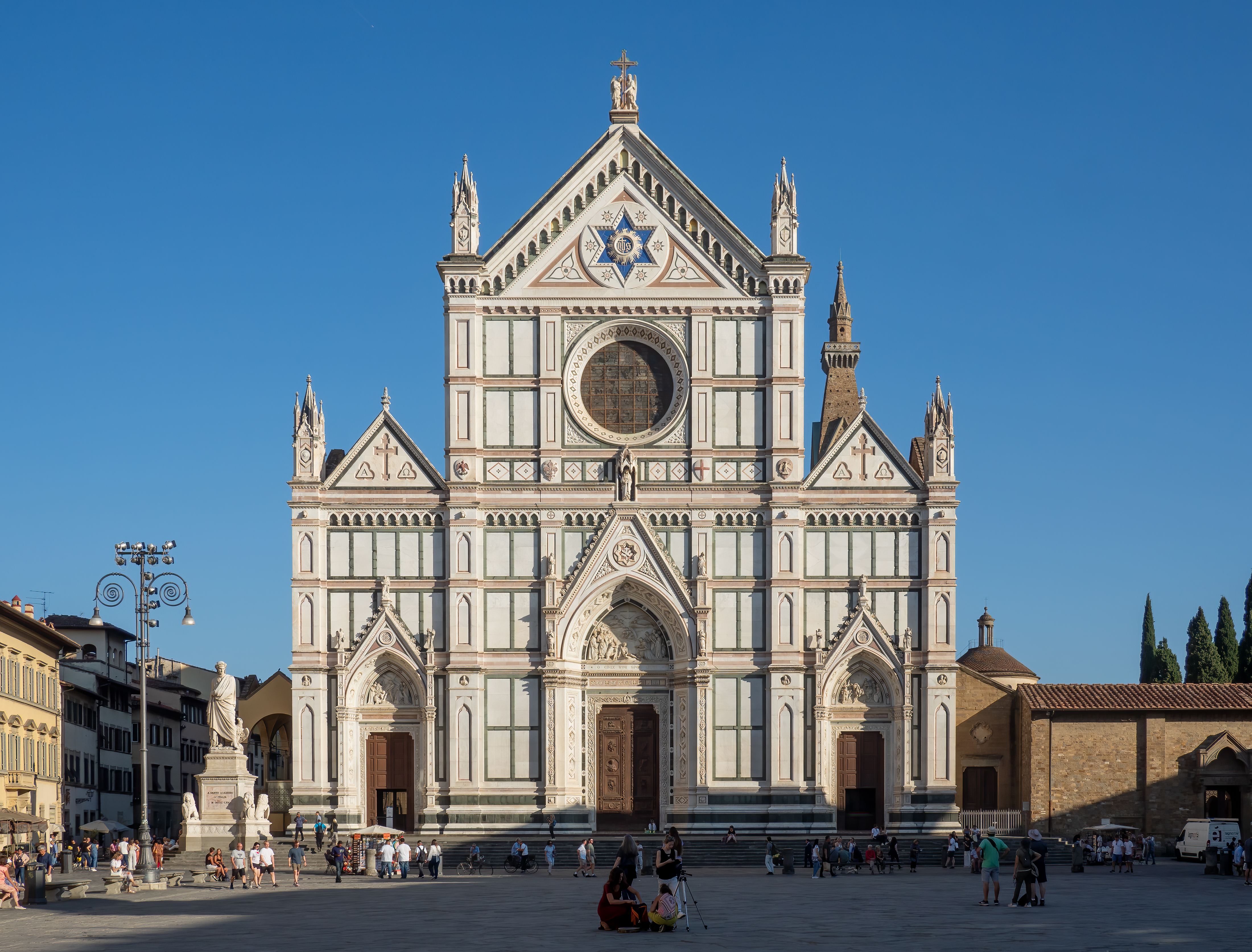
The Basilica di Santa Croce, known in English as the Basilica of the Holy Cross, is the principal Franciscan church of Florence and one of the city's most significant landmarks. It stands on the Piazza di Santa Croce, about 800 meters southeast of the Duomo, on land that was once marshland outside the medieval city walls. The church serves a dual role: it remains an active place of worship under the Order of Friars Minor, and it functions as a national memorial, housing the tombs of some of Italy's most celebrated figures, including Michelangelo, Galileo, and Machiavelli. This combination has earned it the nickname "Temple of the Italian Glories."
Founded in the late thirteenth century, Santa Croce is a masterpiece of Gothic architecture, traditionally attributed to Arnolfo di Cambio. Its interior is adorned with frescoes by Giotto and his school, a chapel designed by Brunelleschi, and a series of monumental tombs commissioned over the centuries. The complex also includes the Museo dell'Opera di Santa Croce, which preserves artworks removed from the church for conservation, and a convent with a historic library. Each year, over a million visitors pass through its doors, drawn by its artistic treasures and its role as a shrine to Italian history.
Santa Croce is more than a museum; it is a living institution. The friars still celebrate mass and hold community events, while the Opera di Santa Croce, the body that manages the site, runs educational programs and themed tours. The surrounding piazza is famous for the Calcio Storico Fiorentino, a historic football match played every June, connecting the basilica to Florence's vibrant civic traditions. As a minor basilica of the Catholic Church and a cornerstone of the city's UNESCO-listed historic center, Santa Croce holds a unique place in both religious and cultural life.
Mission
Santa Croce has always occupied a central place in the religious and civic life of Florence. Its mission is twofold: to serve as a living Franciscan church, offering worship and pastoral care, and to act as a custodian of Italian cultural heritage. The church's artistic and architectural treasures are preserved not merely as relics of the past but as a living expression of faith and community. The Opera di Santa Croce, the institution responsible for the complex, works to maintain the basilica's spiritual and historical significance, ensuring that it remains accessible to pilgrims, art lovers, and scholars alike. This dual commitment to faith and culture defines Santa Croce's purpose in the modern world.
History
The story of Santa Croce begins around 1210, when the first Franciscan friars arrived in Florence and established a small oratory on the site, following the visit of Saint Francis himself. The present basilica was begun in 1294, traditionally attributed to Arnolfo di Cambio, on the spot of that earlier oratory. The church was consecrated in 1442, though construction and embellishment continued for centuries. The Santa Croce area was originally an island formed by two branches of the Arno, and the Franciscans deliberately chose this marshy, isolated location outside the city walls, a choice that would shape the church's development.
Over the centuries, Santa Croce evolved from a simple Franciscan church into a grand memorial. The 16th and 19th centuries were particularly transformative, with significant modifications to the church's interior and exterior, reflecting changing liturgical tastes and the growing desire to honor Italy's great minds. The tombs of Michelangelo, Galileo, and Machiavelli were installed during these periods, cementing the church's role as a national pantheon. Wealthy foreign families, including French, English, Polish, and Russian patrons, also commissioned chapels and monuments, adding to the complex's artistic richness. Despite these changes, the church has retained its Gothic character, and its frescoes by Giotto remain among the most important works of Western art.
Subdivisions
Museo dell'Opera di Santa Croce
Museum housing artworks removed from the church for conservation, including Giotto's Baroncelli Polyptych.
Convent
Historic convent adjacent to the basilica, part of the original Franciscan complex.
Library
Library established alongside the original church, containing valuable manuscripts and texts.
Notable People
Arnolfo di Cambio
Architect (attributed) · 1294–1310
Traditional designer of the basilica
Giotto
Painter · c. 1320s
Created frescoes in the Peruzzi and Bardi chapels
Michelangelo Buonarroti
Buried at Santa Croce · d. 1564
Renaissance sculptor and painter, tomb in the church
Galileo Galilei
Buried at Santa Croce · d. 1642
Astronomer and physicist, tomb in the church
Niccolò Machiavelli
Buried at Santa Croce · d. 1527
Political philosopher, tomb in the church
Filippo Brunelleschi
Designer of the Pazzi Chapel · c. 1440s
Renaissance architect, designed the Pazzi Chapel in the complex
Milestones
1210
First Franciscan friars establish a small oratory on the site.
1294
Construction of the present basilica begins, traditionally attributed to Arnolfo di Cambio.
1442
The church is consecrated.
1564
Michelangelo is buried in Santa Croce.
1642
Galileo is buried in Santa Croce.
1865
The church becomes a national monument and undergoes significant restoration.
Sources
Organization Info
- Founded
- 1294
- Headquarters
- Piazza di Santa Croce 16, 50122 Florence, Italy
- Country
- Italy
- Parent
- Order of Friars Minor
- Type
- Religious
- Denomination
- Roman Catholic
- Architectural style
- Gothic
- Annual visitors
- Over 1 million
Official Website
www.santacroceopera.it
Join the community
fans discussing