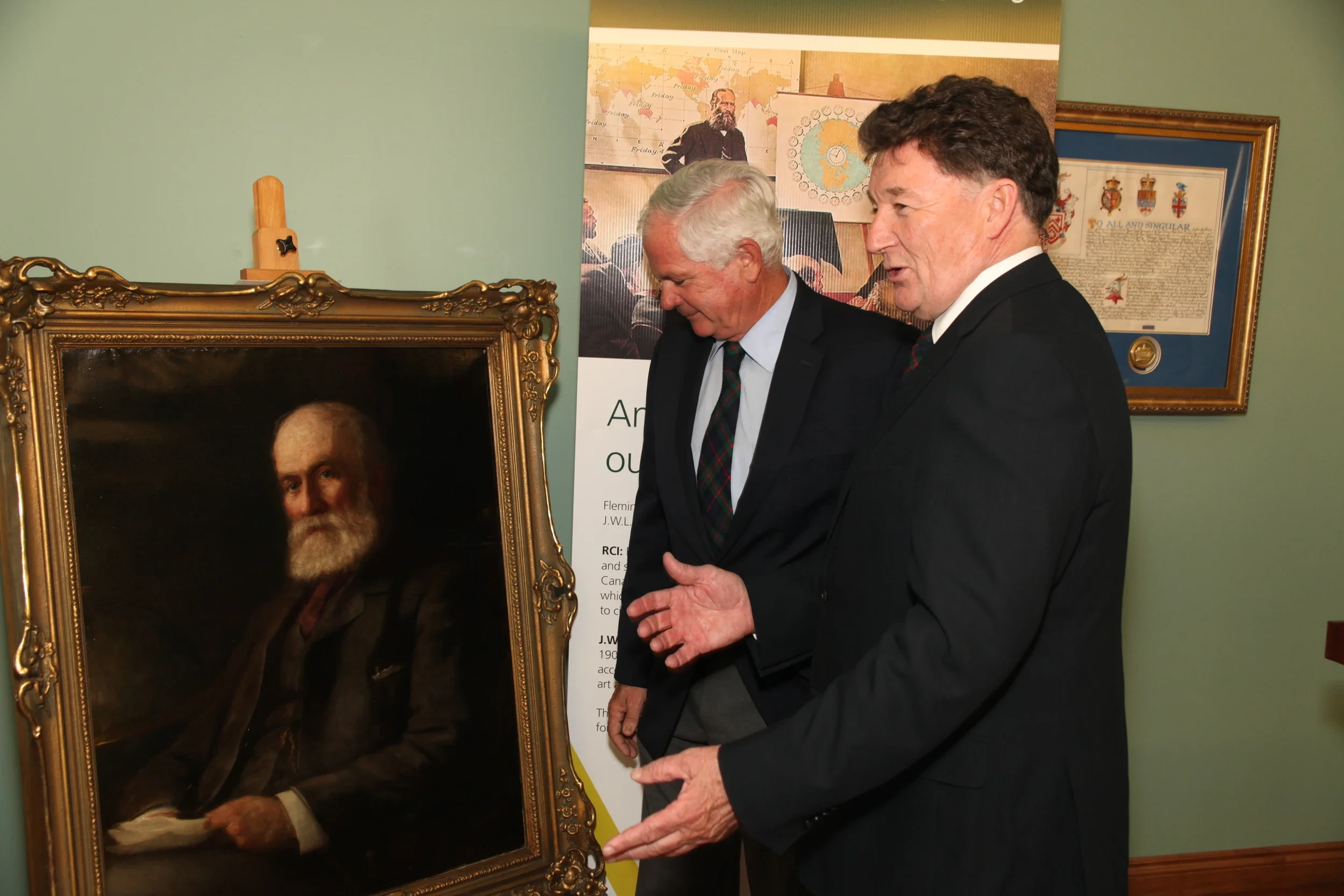
Sandford Fleming
 Canada
postage stamp designer•inventor•engineer
Birthday
+1827-01-07
Birth Sign
Capricorn
Birthplace
Kirkcaldy
Age
Died at 88
About
Sir Sandford Fleming (January 7, 1827 – July 22, 1915) was a Scottish Canadian engineer and inventor. Born and raised in Scotland, he immigrated to colonial Canada at the age of 18. He promoted worldwide standard time zones, a prime meridian, and use of the 24-hour clock as key elements to communicating the accurate time, all of which influenced the creation of Coordinated Universal Time. He designed Canada's first postage stamp, produced a great deal of work in the fields of land surveying and map making, engineered much of the Intercolonial Railway and the first several hundred kilometers of the Canadian Pacific Railway, and was a founding member of the Royal Society of Canada and founder of the Canadian Institute (a science organization in Toronto).
Fame & Fandom (iFAMOUS Rankings)
Sir Sandford Fleming commands a global attention that spans over a century, his influence etched into the very infrastructure of modern life rather than the fleeting currents of pop culture. He does not currently hold a placement in the published rankings for the Global Top 1,000 or any Top-100 scope list as of August 2026. The evaluation confirms that while his historical footprint is massive, he remains an EVALUATED_UNRANKED figure within the current competitive landscape. Consequently, there is no formal fandom name documented for Sir Sandford Fleming; his audience consists of historians, engineers, and students who study his work rather than fans engaging in organized rituals or social media campaigns. His legacy is maintained through institutional reverence, such as the Sandford Fleming Medal awarded by the University of Toronto, where recent recipients like Geoffrey Hinton have carried the torch of scientific excellence. Unlike contemporary icons who rely on viral moments or chart-topping hits, Fleming's fame rests on verified achievements: the creation of standard time zones and the engineering of the Canadian Pacific Railway. These contributions shaped the world he never saw, turning him into a foundational figure whose name appears on colleges and stamps rather than in fan clubs.
Interesting Facts and Legends
The story of how Sir Sandford Fleming championed standard time began with a missed train connection in Nova Scotia caused by inconsistent local schedules. This specific logistical failure sparked his lifelong advocacy for dividing the world into 24 time zones, a proposal adopted at the International Meridian Conference in 1884. He also designed Canada's first postage stamp, the Three-Penny Beaver, which helped forge a distinct national identity during the colonial era. For thirty-five years, from 1882 until his death, he served as Chancellor of Queen's University, a tenure often cited as a reflection of his dedication to science and education. In June 2026, computer scientist Geoffrey Hinton received the Sandford Fleming Medal, continuing the tradition of recognizing high-level academic achievement under Fleming's name. While some attribute the concept of daylight saving time to him, the reality is more nuanced; he did propose adjusting clocks for seasonal light changes, though the terminology evolved later. His work on the Intercolonial Railway and the first several hundred kilometers of the Canadian Pacific Railway physically united Canada from coast to coast, creating a legend of infrastructure that outlasts his own lifetime.
Death & Aftermath
Died
+1915-07-22 (aged 88)
Death Place
Kingston, Ontario
Cause of Death
Unknown
In 1950, the Government of Canada formally designated Sir Sandford Fleming as a Person of National Historic Significance, cementing a legacy that had endured for three decades after his passing. This honor recognized the man who gave the world standard time zones and engineered much of Canada's early railway infrastructure. The tribute arrived long after the immediate aftermath of his death in 1915, when he was widely celebrated by peers as the nation's foremost engineer. Fleming passed away on July 22, 1915, in Kingston, Ontario, at the age of 88. Historical records document the date and location clearly but offer no specific details regarding the medical cause or the circumstances of his final days.
His death appears recorded simply as the end of a long life following a career that spanned decades of invention and surveying. Tributes from institutions and fellow engineers highlighted his 35-year tenure as Chancellor of Queen's University and his role as a founding member of the Royal Canadian Institute. While specific details of the funeral service remain unrecorded, it is historically consistent that his burial took place in Kingston where he lived and worked for much of his later life. Posthumously, his name has remained prominent in Canadian history through institutions like Sandford Fleming College and the University of Waterloo's Sandford Fleming Building.
Awards & Accolades
Keywords
Quick Facts
- Profession
- postage stamp designer, inventor, engineer
- Born
- +1827-01-07
- Birthplace
- Kirkcaldy
- Died
- +1915-07-22
- Death Place
- Halifax
- Gender
- Male
- Spouse
- Annie Jane Fleming
- Birth Sign
- Capricorn
Personal Details
- Spouse
- Annie Jane Fleming
Join the community
fans discussing