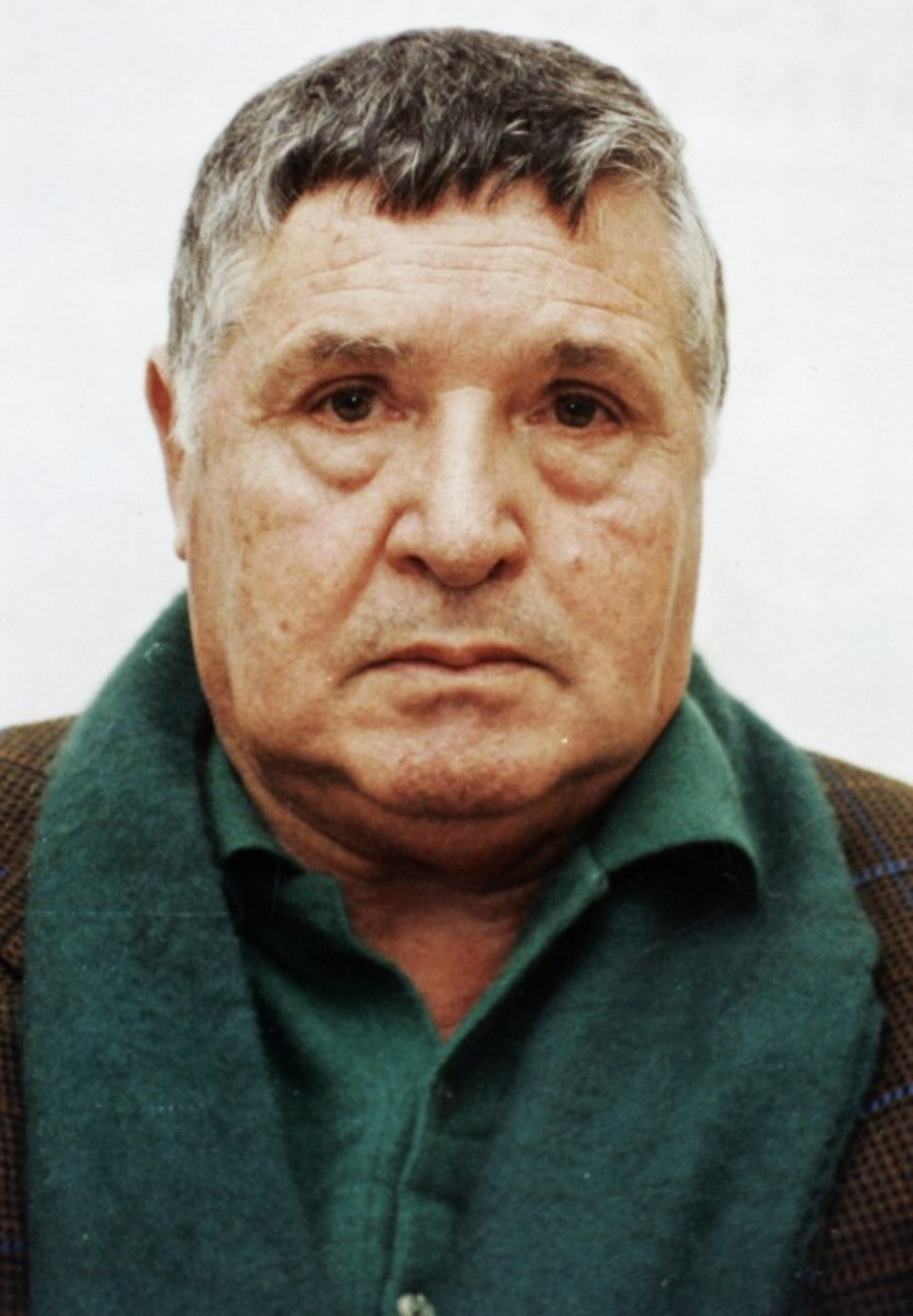
Salvatore Riina
 Italy
ItalyAlso known as: Totò Riina, la Belva, il Capo dei Capi
Birthday
November 16, 1930
Birth Sign
Scorpio
Birthplace
Corleone, Sicily, Italy
Age
Died at 87
Height
5 ft 2 in (157 cm)
About
Salvatore Riina was an Italian mobster who became the boss of the Sicilian Mafia, known as Cosa Nostra. Born in Corleone, Sicily, he rose to become one of the most feared figures in organized crime history. His extreme brutality earned him the chilling nicknames "la Belva," meaning 'the beast,' and "il Capo dei Capi," or 'the boss of bosses.' Riina's leadership was characterized by a ruthless strategy of eliminating rivals and anyone who stood in his way, extending his reign through widespread violence.
During his time at the head of the Corleonesi clan, Riina orchestrated a campaign of terror that brought the Mafia into direct conflict with the Italian state. He was responsible for ordering the murders of many individuals, including high-profile anti-Mafia prosecutors, which ignited significant public outrage and led to intensified government crackdowns. Riina spent 23 years as a fugitive before his capture in 1993. He remained imprisoned under strict conditions until his death, leaving behind a dark legacy that profoundly impacted Italy's fight against organized crime.
Early Life & Background
Growing up in Corleone, Sicily, in the 1930s and 1940s, Salvatore Riina experienced a childhood shaped by the poverty and harsh realities of post-war rural Italy. This environment was also deeply intertwined with the long-standing presence of the Mafia, which had woven itself into the social fabric of the region. Riina's early life offered few opportunities for formal education or legitimate advancement, pushing many young men toward the illicit structures that promised power and wealth.
He became involved with the local Corleonesi Mafia clan at a young age, starting his criminal career on the lower rungs of the organization. His initial activities likely involved petty crimes and acts of violence that demonstrated his willingness to follow orders and assert dominance. Riina quickly gained a reputation for his fierce loyalty and a readiness to use extreme force, qualities that caught the attention of the clan's leadership. These early experiences within the Corleonesi prepared him for a brutal ascent through the ranks, laying the foundation for the ruthless figure he would become.
By the mid-1970s, Riina had established himself as a key player within the Corleonesi, working closely with Luciano Leggio, the then-head of the clan. His strategic thinking and unwavering aggression allowed him to survive and prosper in a world where betrayal was common. This period before his full consolidation of power was crucial, as he learned the intricacies of Mafia politics and perfected the art of intimidation, setting the stage for his eventual takeover and the violent reign that would follow.
Career Growth
Salvatore Riina’s true ascent began in the mid-1970s when he took control of the Corleonesi clan, following the arrest of its previous leader, Luciano Leggio. This move marked the start of his ruthless campaign to dominate the Sicilian Mafia, a period often referred to as the Second Mafia War. He systematically eliminated rival factions and their leaders, consolidating power through a wave of unprecedented violence across Sicily. Riina's orders led to the deaths of over 150 people, including women, children, and innocent bystanders, a tactic he used to instill fear and divert law enforcement attention.
The early 1990s saw Riina authorize some of the most infamous acts of violence in modern Italian history. In 1992, he ordered the assassinations of anti-Mafia magistrates Giovanni Falcone and Paolo Borsellino. Falcone was killed in May by a roadside bomb on the highway to Palermo, and Borsellino died two months later in a car bombing in front of his mother's apartment. These high-profile murders shocked Italy and triggered widespread public outrage, prompting the government to launch a significant crackdown on the Mafia.
Riina had been sentenced to life imprisonment in absentia during the Maxi Trial of 1986, facing charges for Mafia association and multiple murders. Despite his conviction, he evaded capture for 23 years, continuing to direct Cosa Nostra from hiding. His long run as a fugitive ended in January 1993 when he was finally arrested in Palermo. Even after his capture, Riina's influence was felt; his organization retaliated with a series of bombings in mainland Italy targeting cultural sites and churches. He remained under the strict 41-bis prison regime until his death in 2017, never repenting for his actions.
Career Timeline
Public Image & Style
Salvatore Riina cultivated an image of absolute ruthlessness, earning him the moniker "la Belva" or 'the beast.' This public perception was not accidental; it was carefully built through a campaign of extreme violence that instilled fear and obedience throughout the Sicilian underworld and beyond. He was seen as a cold, calculating figure who would stop at nothing to achieve his goals, even ordering the deaths of women, children, and prominent public figures.
His other notorious nickname, "il Capo dei Capi" or 'the boss of bosses,' underscored his unchallenged authority within Cosa Nostra. The media and public often portrayed him as the embodiment of Mafia evil, particularly after the shocking assassinations of magistrates Falcone and Borsellino. This image, while terrifying, also galvanized public opinion against the Mafia, contributing to a national anti-Mafia movement. Riina's persona became synonymous with the darkest aspects of organized crime, a symbol of state defiance and unyielding brutality.
Fame & Fandom (iFAMOUS Rankings)
Salvatore Riina commands no fandom in the conventional sense. There are no fan clubs, no tribute campaigns, no birthday billboards. His audience is not one of admiration but of grim fascination, true-crime enthusiasts and historians who study the mechanics of his terror. The closest thing to a community is the collective revulsion that followed his death in 2017, when Italians reacted with defiance rather than sympathy, and the town of Corleone has since sought to distance itself from his legacy, even attempting to expel his son in 2023. His name is a stigma, not a brand.
Yet within the broader landscape of public attention, Riina's infamy has secured him a peculiar kind of fame. According to the iFANN Global Fame Rankings, he is currently the 43rd most famous person in True Crime, holding steady from the previous cycle. This placement reflects a notoriety that transcends national borders, tracking global attention across media coverage, search, and consumption signals worldwide. His legend, forged through more than 150 ordered murders, the assassinations of judges Falcone and Borsellino, and a 23-year evasion of justice, keeps him a figure of enduring, if macabre, interest.
Interesting Facts and Legends
Salvatore Riina earned two chilling nicknames during his reign: "la Belva" (the beast) due to his extreme brutality, and "il Capo dei Capi" (the boss of bosses) reflecting his ultimate authority within the Sicilian Mafia. He was known for his short physical stature, standing at just 5 feet 2 inches tall, a detail that often contrasted with his towering reputation for ruthlessness. Despite his long career in organized crime and his leadership of Cosa Nostra, Riina managed to evade law enforcement for 23 years, a remarkable feat that made him one of Italy's most wanted fugitives for decades. In 2023, the town of Corleone, his birthplace, attempted to expel his son, Salvuccio Riina, citing damage to the town's reputation caused by the family's notoriety.
His legend is further cemented by the widely retold stories of his orchestration of more than 150 murders, including the high-profile assassinations of judges Giovanni Falcone and Paolo Borsellino in 1992. These events shocked the world and marked a turning point in the fight against the mafia. Another defining aspect of his lore involves his capture in January 1993 after hiding in plain sight for over two decades. He died on November 17, 2017, at the age of 87 in a prison hospital in Parma, just one day after his birthday, while serving 26 life sentences. Recent developments in 2026 have also linked his former hideouts to other figures, keeping his name relevant in contemporary news cycles.
One of the most horrific stories associated with Riina is the kidnapping and murder of 12-year-old Giuseppe Di Matteo, son of a Mafia turncoat, who was held for over two years and eventually strangled and dissolved in acid, a tale often cited as the ultimate symbol of his inhumanity. Another widely retold anecdote describes how Riina forced his own 17-year-old son to strangle a kidnapped businessman, a story verified by pentiti testimony that illustrates his absolute control and cruelty.
Family & Personal Life
Salvatore Riina was born to a farming family in Corleone, Sicily. Details about his parents and siblings are not widely publicized, reflecting the secretive nature of his early life and rise within the Mafia. He married Ninetta Bagarella, a schoolteacher from Corleone, who came from a family with its own ties to the Mafia world. Their union further solidified his connections within the criminal underworld.
Together, Salvatore and Ninetta had several children, including a son named Salvuccio Riina. The family lived a clandestine life for many years while Salvatore was a fugitive, constantly moving to avoid capture. The shadow of Riina's criminal activities deeply affected his family, even after his death, as evidenced by the local community's efforts to distance itself from his legacy and his relatives.
Notable Connections
Relationships & Dating History
Salvatore Riina's personal life, like much of his existence, was shrouded in secrecy, though his most notable relationship was with Ninetta Bagarella. She hailed from Corleone, his hometown, and came from a family already entrenched in Mafia circles. Their marriage was not just a personal union but also served to strengthen Riina's ties within the larger Cosa Nostra network. Details about how they met or the early years of their relationship remain largely private, given the clandestine nature of Mafia life.
Ninetta Bagarella was often referred to as a 'Mafia wife,' a role that typically involved maintaining silence and loyalty while her husband engaged in criminal activities. She remained married to Riina throughout his long period as a fugitive and during his subsequent imprisonment. The couple had several children, and their family life unfolded away from public scrutiny for decades. Riina was married to Ninetta Bagarella at the time of his death in 2017.
- MarriedNinetta BagarellaMarried to Salvatore Riina, she came from a family with Mafia ties. She remained his wife until his death.
Death & Aftermath
Died
November 17, 2017 (aged 87)
Death Place
Parma, Emilia-Romagna, Italy
Cause of Death
Cancer while in custody
Salvatore Riina died on November 17, 2017, at the San Lazzaro Prison Hospital in Parma, Italy, just one day after his eighty-seventh birthday. He had been incarcerated since his capture in January 1993 and spent his final days in a medically induced coma before passing from cancer while serving twenty-six life sentences for mafia association and multiple murders. The cause of death was established through hospital medical records within the Italian prison system rather than an external coroner's ruling or public autopsy, with no dispute regarding the official circumstances reported by authorities or family members. Public reaction to the event was characterized by official relief rather than mourning, as Italian officials and anti-mafia institutions viewed his passing as a victory for the rule of law.
Tributes were limited to statements from law enforcement and judges highlighting his role as a symbol of violence that motivated the state's crackdown on Cosa Nostra, while his hometown of Corleone later moved to distance itself from his legacy. Reports from May 2023 indicated attempts to expel his son, Salvuccio Riina, to clean up the town's image, reflecting the enduring stigma attached to the family. The legal aftermath involved the continuation of his existing convictions; he remained the subject of 26 life sentences until his death, with no posthumous trials initiated to challenge the circumstances of his demise.
Details regarding specific burial locations, performances, or public ceremonies have never been made public, consistent with standard procedure for notorious criminals in the Italian penal system. Instead, his legacy is primarily documented in historical records, documentaries, and academic studies regarding the history of the Sicilian Mafia. While his son, Giuseppe Riina, has occasionally spoken to media claiming his father was innocent, these statements represent family defense rather than official recognition.
Net Worth (Estate Value)
$1 Million
iFANN Editorial Team estimate
Salvatore Riina's financial standing is almost impossible to quantify through traditional means, primarily due to the illicit nature of his activities and his decades spent as a fugitive and then imprisoned. Unlike legitimate public figures, there are no official records of his income, assets, or investments. Any wealth he accumulated during his time as the boss of the Sicilian Mafia was derived from illegal enterprises such as drug trafficking, extortion, protection rackets, and illicit construction contracts. Upon his arrest in 1993, Italian authorities launched extensive investigations into his assets, leading to the seizure of properties and funds believed to be connected to his criminal empire. However, the true extent of his hidden wealth remained largely untraceable, as Mafia bosses are known for their sophisticated methods of money laundering and concealing assets through shell companies and straw men. The stringent 41-bis prison regime under which he spent his final years would have prevented him from directly managing any remaining illicit funds. Per iFANN's editorial analysis, as of 2026, the estimated value of Salvatore Riina's estate is largely speculative, with any residual, traceable assets likely valued around $1 Million. This figure reflects the immense difficulty in assessing the wealth of a deceased criminal whose finances were inherently clandestine and subject to ongoing confiscation efforts by the state. The lack of public records means that a precise accounting of his estate's value or its trajectory since his passing remains unknown, with much of his illicit gains either seized.
Awards & Accolades
Known For
Boss of Bosses
1974 · Leader of the Corleonesi clan and the Sicilian Mafia
Second Mafia War
1981 · Orchestrator of a violent campaign to consolidate power
Maxi Trial
1986 · Convicted in absentia for numerous crimes
Falcone and Borsellino Assassinations
1992 · Ordered the murders of two prominent anti-Mafia judges
Keywords
Sources
Quick Facts
- Nicknames
- la Belva, il Capo dei Capi
- Cause of Death
- Natural causes (hospital prison ward)
Personal Details
- Full Name
- Salvatore Riina
- Height
- 5 ft 2 in (157 cm)
- Spouse
- Ninetta Bagarella
- Children
Frequently Asked Questions
How did Salvatore Riina die?
Where was Salvatore Riina from?
What was Salvatore Riina known for?
Who was Salvatore Riina's wife?
What was Salvatore Riina's nickname?
Join the community
fans discussing