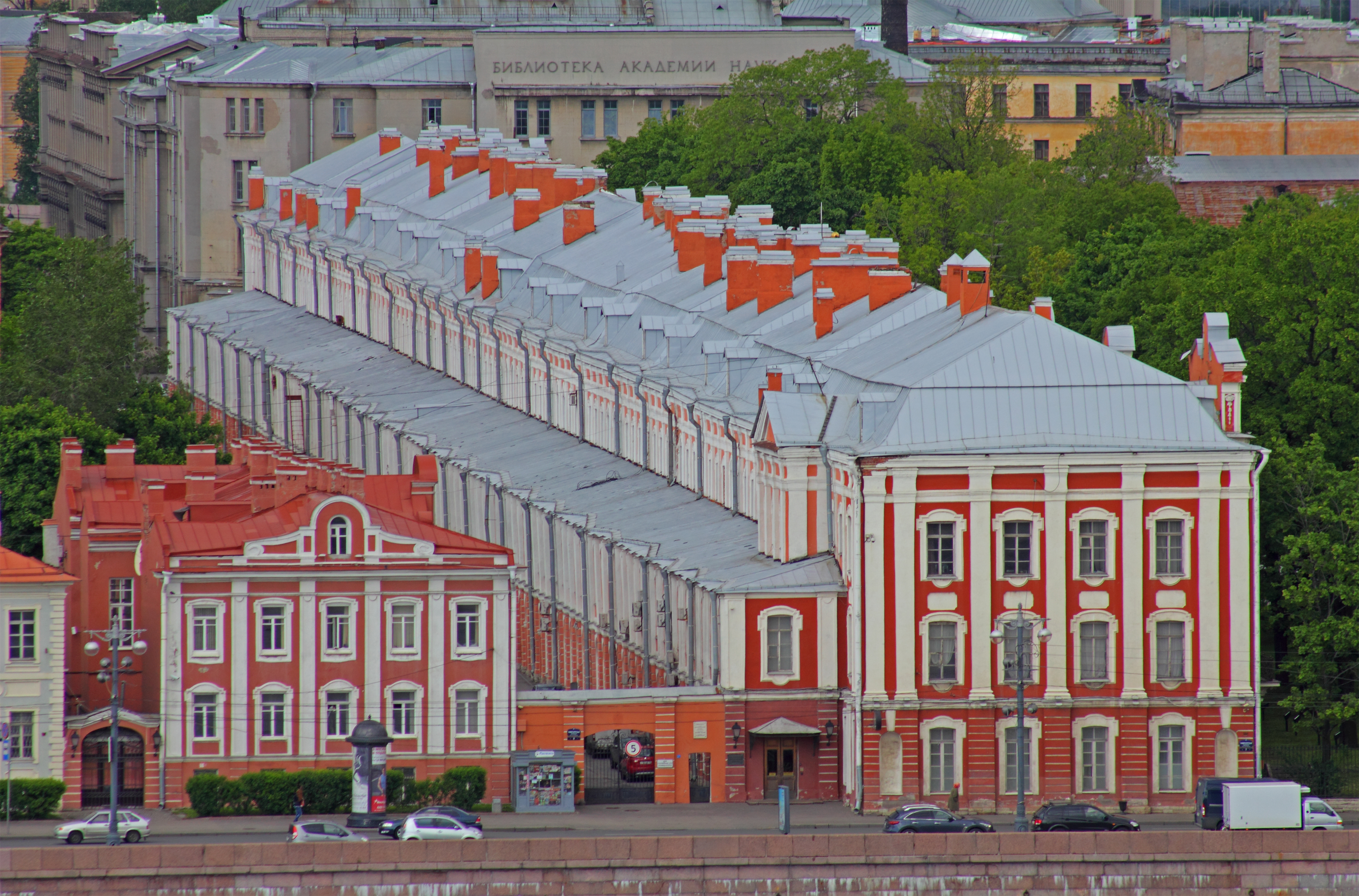
Saint Petersburg State University
 Russia
"Russia's oldest university, a powerhouse of research and intellectual tradition"
About
Saint Petersburg State University, often shortened to SPbU, is one of Russia's most storied seats of higher learning. Founded in 1724 by decree of Peter the Great, it holds the distinction of being among the oldest universities in the country. From its earliest days, the institution has prioritized fundamental research in science and engineering, a focus that continues to shape its identity today. The university operates as a sprawling public research institution, comprising 24 distinct departments and institutes, along with the Academic Gymnasium and the Medical College, making it a significant force in Russian academia.
With a student body numbering in the tens of thousands and a faculty that has included some of the most prominent names in science and culture, SPbU has long been a magnet for intellectual talent. Its alumni roster includes figures like Dmitri Mendeleev, Ivan Pavlov, and Vladimir Putin, underscoring its broad influence. The main campus sits on Vasilyevsky Island, with additional facilities scattered across Saint Petersburg, and the university even runs an international branch in Egypt that offers internationally accredited degrees.
While exact budget figures are not publicly detailed, the university's scale and reputation place it among the top-tier educational institutions in Russia, often compared with Moscow State University. In recent years, SPbU has ranked around #390 in the QS World University Rankings and #831 in U.S. News & World Report's Best Global Universities, with strong showings in fields like biology and biochemistry. The tone of campus life blends traditional academic rigor with a modern research drive, and the university's role in shaping Russian intellectual history is hard to overstate.
Mission
SPbU's mission centers on advancing fundamental research, particularly in the sciences and engineering, while offering a broad spectrum of undergraduate, graduate, and doctoral programs taught in both Russian and English. The university aims to cultivate scholars who can contribute to Russia's intellectual and technological development, and it maintains strong ties to state institutions, preparing students for service in government and diplomacy. It also seeks to preserve and extend the legacy of Russian scholarship, from the humanities to the hard sciences, and to engage with global academic communities through partnerships and international campuses.
History
Saint Petersburg State University traces its origins to a decree by Peter the Great on February 8, 1724, establishing the Russian Academy of Sciences with an attached Academic University and Gymnasium. The Tsar's vision was to train Russian scholars and specialists rather than rely on foreign imports, and the early curriculum emphasized mathematics, physics, and the natural sciences. For much of the 18th century, the university existed in a somewhat nebulous state, closely tied to the Academy, but it gained formal university status in 1819 under a reorganization by Tsar Alexander I.
Throughout the 19th century, SPbU grew into a major intellectual hub, attracting thinkers like Mendeleev, Pavlov, and the mathematician Pafnuty Chebyshev. The university weathered political upheavals, including the 1917 revolutions, after which it was renamed and restructured under Soviet rule. During the Soviet era, it became a key institution for training scientists and officials, a role it retained after the fall of the USSR. The post-Soviet period brought new challenges, including funding shortages, but the university adapted by expanding international partnerships and launching English-taught programs.
In recent years, SPbU has faced controversies, such as a 2026 mandate requiring staff and students to use the state-backed messaging app Max for internal communications, and a 2026 offer of a €550 signing bonus for students who enlist in the military. These developments reflect the university's tight integration with current Russian state priorities, a thread that runs through its entire history.
Subdivisions
Academic Gymnasium
A secondary school affiliated with the university, offering specialized education for gifted students.
Medical College
Provides vocational training in medical fields, including nursing and lab technology.
Notable People
Dmitri Mendeleev
Alumnus and Professor · 1834-1907
Formulated the periodic table of elements
Ivan Pavlov
Alumnus and Professor · 1849-1936
Nobel Prize in Physiology or Medicine (1904) for work on digestion
Vladimir Putin
Alumnus · 1970-1975
President of Russia
Alexander Blok
Alumnus · 1898-1906
Prominent Symbolist poet
Nikolai Gogol
Alumnus · 1828-1831
Author of Dead Souls and The Government Inspector
Ivan Turgenev
Alumnus · 1834-1837
Novelist, author of Fathers and Sons
Anna Akhmatova
Alumnus · 1910-1912
Acclaimed poet
Leonhard Euler
Professor · 1727-1741
Mathematician and physicist, made major contributions to graph theory and mechanics
Nikolai Lobachevsky
Professor · 1816-1827
Pioneer of hyperbolic geometry
Milestones
1724
Founded by decree of Peter the Great as part of the Russian Academy of Sciences.
1819
Reorganized as a formal university under Tsar Alexander I.
1869
Dmitri Mendeleev, a professor at the university, presented the periodic table.
1904
Ivan Pavlov, an alumnus, received the Nobel Prize in Physiology or Medicine.
1944
During the Siege of Leningrad, the university was evacuated to Saratov, but continued its work.
1991
After the Soviet collapse, the university regained its historical name and expanded international ties.
2026
Chemists developed a reusable magnetic catalyst for biodiesel production from soybean oil.
Departments
Sources
Organization Info
- Founded
- February 8, 1724
- Headquarters
- Saint Petersburg, Russia
- Country
- Russia
- Parent
- Government of Russia
- Type
- University
- Founder
- Peter the Great
- Students
- Tens of thousands
- Departments
- 24
- International Campus
- Egypt
Official Website
www.spbu.ru/
Join the community
fans discussing