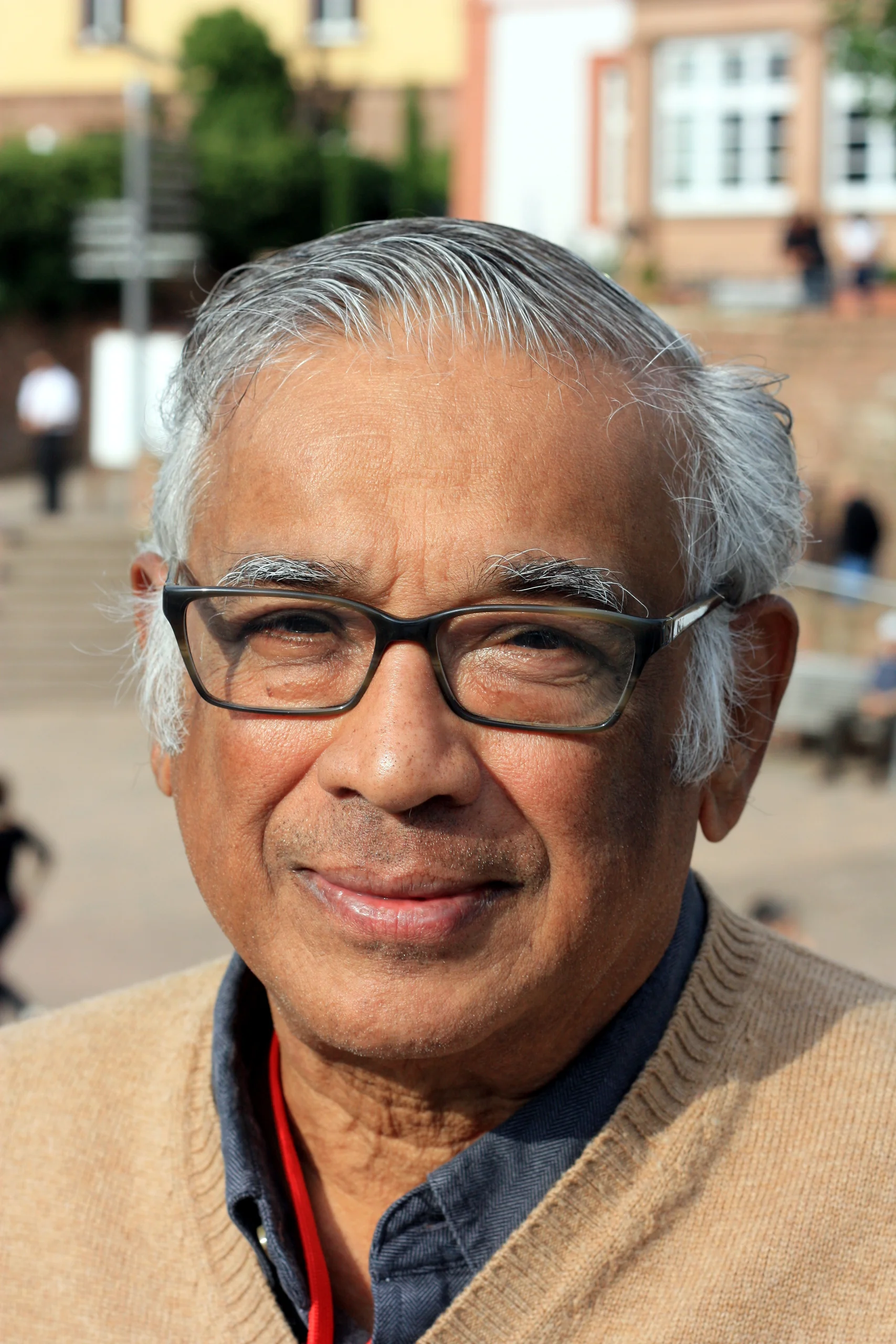
S. R. Srinivasa Varadhan
 India
Indiamathematician•university teacher•statistician
Also known as: Raghu, Sathamangalam Ranga Iyengar Srinivasa Varadhan
Birthday
January 2, 1940
Birth Sign
Capricorn
Birthplace
Chennai, India
Age
86 years old
About
Sathamangalam Ranga Iyengar Srinivasa Varadhan, known to colleagues as Raghu, is an Indian American mathematician and statistician whose work reshaped probability theory. He is best known for creating a unified theory of large deviations, a framework that quantifies the probability of rare events in stochastic systems. This work, often called the Varadhan principle, has found applications in fields as diverse as statistical mechanics, finance, and population dynamics.
Varadhan has spent most of his career at New York University's Courant Institute of Mathematical Sciences, where he joined the faculty in 1966 and currently holds the Frank J. Gould Professorship of Science. In 2007, he received the Abel Prize, often described as the Nobel Prize of mathematics, and in 2010 he was awarded the U.S. National Medal of Science. His influence extends through his mentorship of a generation of probabilists, and his lectures are remembered for their clarity and depth. He continues to be an active researcher, with his work on rare events and stochastic processes shaping how scientists model uncertainty across multiple disciplines. His contributions have earned him fellowship in the Royal Society and membership in several national academies, reflecting his standing as one of the foremost probabilists of his generation.
Early Life & Background
Varadhan grew up in a Tamil-speaking household in Chennai, where his father, Ranga Iyengar, worked as a science teacher and later became the principal of the Board High School in Ponneri, a small town about 30 kilometers from the city. The family's academic environment nurtured his early interest in mathematics, and he showed a natural aptitude from a young age.
For his undergraduate studies, Varadhan attended Presidency College in Madras, one of India's oldest and most prestigious institutions. He then moved to the Indian Statistical Institute in Kolkata, where he completed his PhD in 1963 under the supervision of the distinguished statistician C. R. Rao. His doctoral work laid the groundwork for his later contributions to probability theory.
Following his doctorate, Varadhan crossed the Atlantic for a postdoctoral position at New York University's Courant Institute of Mathematical Sciences. That appointment, which began in the mid-1960s, became the start of a decades-long association with the institute. He became a full professor in 1970 and later held the Silver Professorship before assuming his current endowed chair.
Career Growth
Varadhan's breakthrough came with his development of a unified theory of large deviations, a body of work that provided a single framework for understanding rare events in stochastic systems. This principle, which now bears his name, has been applied across physics, economics, and engineering. He also made significant contributions to diffusion processes, refining Kiyosi Itō's stochastic calculus, and collaborated with Claude Kipnis and Stefano Olla on the hydrodynamic limit of interacting particle systems. His research publications include a notable paper with S. Sethuraman on large deviations for the current and tagged particle in 1D nearest-neighbor symmetric simple exclusion, published in the Annals of Probability.
In 2007, the Norwegian Academy of Sciences and Letters awarded him the Abel Prize for his fundamental contributions to probability theory. Three years later, he received the U.S. National Medal of Science. He continues to be active in research and teaching at the Courant Institute, where he has been a professor since 1970.
Career Timeline
Public Image & Style
Varadhan is regarded as a towering figure in probability theory, known for the depth and clarity of his work. His public persona is that of a dedicated academic, more comfortable in a lecture hall than in the media spotlight. Colleagues and students describe his lectures as models of lucidity, and his mentorship has shaped a generation of probabilists. He is a member of several national academies, including those of the United States, India, and Norway, reflecting his international standing. His legacy is often described not just as a set of theorems but as a way of thinking about randomness and order. He has been honored by the Carnegie Corporation of New York, which lists him among its award honorees. Despite his fame, he has avoided the public spotlight, preferring the quiet of academic life.
Fame & Fandom
S. R. Srinivasa Varadhan commands a following defined not by screaming crowds or viral hashtags, but by the quiet reverence of the global mathematical community. There is no organized fanbase with a collective name like "Varadhans" marching in streets or funding billboard campaigns; his influence flows through lecture halls and academic journals rather than pop culture channels. The stories that circulate are not legends of chaos, but accounts of intellectual triumph, specifically the creation of large deviation theory and his journey from Chennai to the Courant Institute. These narratives serve as the bedrock of his reputation among students and peers, distinguishing his legacy from the fleeting fame of entertainment icons. His supporters are researchers who follow his work, celebrating milestones like the 2007 Abel Prize and the 2023 Padma Vibhushan through professional recognition rather than public adoration. iFANN has evaluated this unique form of stature, assessing his standing against all global figures based on enduring impact and reach. Despite his towering status in probability theory, S. R. Srinivasa Varadhan does not currently hold a placement in the Global Top 1,000 list or any other scope ranking published by iFANN at this time.
Interesting Facts and Legends
Born in 1940, S. R. Srinivasa Varadhan is known to colleagues worldwide simply as Raghu. He became a naturalized American citizen in 1985, securing his ability to continue groundbreaking work in the United States. Varadhan maintains strong ties to India, frequently lecturing at the Institute of Mathematical Sciences in Chennai. In 2007, he received the Abel Prize alone, a rare distinction highlighting the singularity of his contributions to probability theory. He is a Fellow of the Royal Society and holds the Frank J. Gould Professorship of Science at NYU's Courant Institute. His work extends into quantum field theory, traffic engineering, and econometrics. Varadhan does not maintain a notable public social media presence, relying instead on his faculty page for official communication. A recurring story in his biography details his trajectory from a student in Madras to a leading figure at NYU, often cited as an inspirational path for scholars. The 2007 Abel Prize ceremony stands as a solemn milestone, attended by the King and Queen of Norway, marking the formal recognition of his unified theory of large deviations. Another significant moment occurred in January 2023 when he was honored with the Padma Vibhushan, celebrated widely in Indian media as a triumph for national intellect.
Family & Personal Life
Varadhan's father, Ranga Iyengar, was a science teacher who later served as principal of the Board High School in Ponneri, a town about 30 kilometers from Chennai. Growing up in a Tamil-speaking household, Varadhan was encouraged in his academic pursuits. Details about his mother, siblings, or his own family are not publicly documented. He has split his time between New York and Chennai, where he visits relatives and maintains connections to the Institute of Mathematical Sciences. He became a naturalized American citizen in 1985, which allowed him to continue his work in the United States while retaining his ties to India.
Notable Connections
Varadhan's doctoral advisor was C. R. Rao, one of the most influential statisticians of the twentieth century. At the Courant Institute, he collaborated with Claude Kipnis and Stefano Olla on the hydrodynamic limit of interacting particle systems. He also co-authored research with S. Sethuraman on large deviations, published in the Annals of Probability.
Relationships & Dating History
There is no public record of Varadhan's romantic relationships or marital history. He has kept his personal life private, and no spouse, partner, or children have been identified in any credible source. As of 2026, his relationship status remains unknown. His personal life has been centered on his academic career, and he has not publicly discussed any relationships.
Salary, Net Worth In 2026
$3 Million
iFANN Editorial Team estimate
As an academic mathematician, Varadhan's wealth stems primarily from his professorial salary at New York University, where he serves as the Frank J. Gould Professor of Science. Academic salaries at this level, combined with prize money from the Abel Prize, which carried a cash award of around $1 million in 2007, have contributed to his financial standing. Per iFANN's editorial analysis, his net worth is estimated at $3 Million as of 2026. This figure reflects his career earnings and prudent financial management rather than commercial ventures. Unlike celebrities in entertainment or business, Varadhan has not engaged in lucrative endorsements or investments, and his income has been derived strictly from his academic positions and awards. His financial profile aligns with that of a distinguished academic who has dedicated his life to research and teaching, with no public record of significant outside income or business interests.
Awards Won (2)
Varadhan's most prestigious honor is the Abel Prize, awarded in 2007 by the Norwegian Academy of Sciences and Letters for his fundamental contributions to probability theory, particularly the creation of a unified theory of large deviations. In 2010, he received the U.S. National Medal of Science, the highest scientific honor in the United States. These awards recognize a career that has profoundly shaped the field.
2007 · Mathematics
For fundamental contributions to probability theory and in particular for creating a unified theory of large deviations
2010 · Science
For foundational contributions to probability theory
Known For
Unified theory of large deviations
1966 · Creator
Varadhan principle
1966 · Developer
Keywords
Sources
Quick Facts
- Profession
- mathematician, university teacher, statistician
- Born
- January 2, 1940
- Birthplace
- Chennai, India
- Gender
- Male
- Birth Sign
- Capricorn
- Nationality
- Indian American
Personal Details
- Full Name
- Sathamangalam Ranga Iyengar Srinivasa Varadhan
- Education
- Presidency College, Madras (undergraduate); Indian Statistical Institute, Kolkata (PhD, 1963)
Frequently Asked Questions
What is S. R. Srinivasa Varadhan known for?
Did S. R. Srinivasa Varadhan win a Nobel Prize?
Where does S. R. Srinivasa Varadhan work?
Is S. R. Srinivasa Varadhan Indian or American?
What is S. R. Srinivasa Varadhan's educational background?
Similar People
Join the community
fans discussing