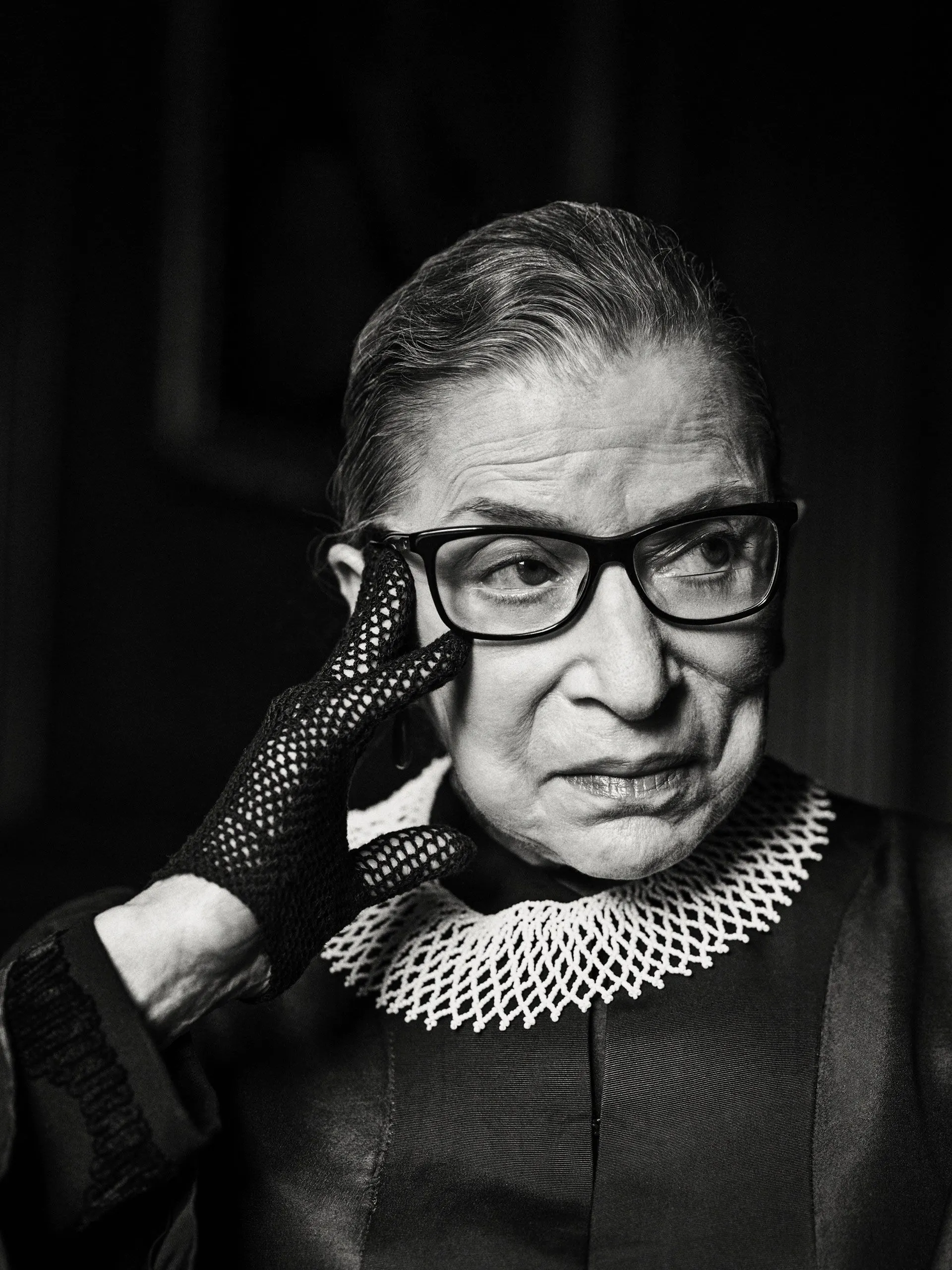
Ruth Bader Ginsburg
Also known as: Notorious RBG, RBG, Joan Ruth Bader
Birthday
March 15, 1933
Birth Sign
Pisces
Birthplace
Brooklyn, New York
Age
Died at 87
Height
5 ft 1 in (155 cm)
About
Ruth Bader Ginsburg was an American lawyer and jurist who served as an associate justice of the Supreme Court from 1993 until her death in 2020. She was the second woman and the first Jewish woman to sit on the Court, and she became a cultural icon under the nickname Notorious RBG. Known for her sharp dissents and her tireless advocacy for gender equality, Ginsburg authored landmark majority opinions in cases like United States v. Virginia and Olmstead v. L.C. Her legal career spanned academia, advocacy, and the judiciary, and her influence on American law and culture endures well beyond her time on the bench.
As a lawyer in the 1970s, Ginsburg argued six gender discrimination cases before the Supreme Court, winning five, and she co-founded the ACLU's Women's Rights Project. She later taught at Rutgers and Columbia Law School, where she was the first female professor to earn tenure. Appointed to the D.C. Circuit in 1980 by President Carter, she served there for 13 years before being nominated to the Supreme Court by President Clinton in 1993. She remained a steadfast voice for equality until her death at age 87 from complications of metastatic pancreatic cancer. Her legacy continues to inspire new generations, with streets renamed in her honor and scholarships established in her name.
Early Life & Background
Joan Ruth Bader was born on March 15, 1933, in the Flatbush neighborhood of Brooklyn, New York, to Celia and Nathan Bader, Jewish immigrants. Her older sister, Marilyn, died of meningitis when Ruth was just over a year old. Her mother, Celia, who had a profound influence on her education, died of cancer the day before Ruth graduated from high school. Ruth attended James Madison High School in Brooklyn, then went on to Cornell University, where she earned a bachelor's degree in government in 1954. That same year, she married Martin D. Ginsburg, a fellow Cornell student.
In 1956, Ginsburg entered Harvard Law School, one of only nine women in a class of over 500. She faced open discrimination, including being asked by the dean why she was taking a seat that should go to a man. When her husband took a job in New York, she transferred to Columbia Law School, where she graduated joint first in her class in 1959. Despite her academic record, she was rejected from law firms because of her gender. She eventually clerked for U.S. District Judge Edmund Palmieri from 1959 to 1961. In the early 1960s, she worked on the Columbia Law School Project on International Procedure, learned Swedish, and co-authored a book with Swedish jurist Anders Bruzelius. Her time in Sweden, where she observed women in positions of authority, profoundly shaped her views on gender equality. She then taught at Rutgers Law School from 1963 to 1972, where she co-founded the Women's Rights Law Reporter, the first law journal in the U.S. focused on women's rights.
Career Growth
Ginsburg's breakthrough as an advocate for gender equality came in the 1970s. As a volunteer attorney for the ACLU, she argued six cases before the Supreme Court and won five, strategically selecting cases to dismantle sex-based legal discrimination. Her arguments in Reed v. Reed (1971) and Frontiero v. Richardson (1973) were pivotal. In 1972, she co-founded the ACLU's Women's Rights Project and joined Columbia Law School, becoming its first tenured female professor. President Jimmy Carter appointed her to the U.S. Court of Appeals for the D.C. Circuit in 1980, where she served for 13 years.
On June 14, 1993, President Bill Clinton nominated her to the Supreme Court, and she was confirmed by a 96-3 vote on August 3, 1993. Early in her tenure, she authored majority opinions in United States v. Virginia (1996), striking down VMI's male-only admissions policy, and Olmstead v. L.C. (1999), affirming the rights of people with disabilities under the ADA. As the Court shifted rightward, she became known for her powerful dissents, including in Ledbetter v. Goodyear Tire & Rubber Co. (2007), which prompted the Lilly Ledbetter Fair Pay Act of 2009, and in Shelby County v. Holder (2013) and Burwell v. Hobby Lobby (2014). She served until her death on September 18, 2020. Her death, just 39 days before the 2020 presidential election, set off a political firestorm, and Amy Coney Barrett was confirmed as her successor in October 2020.
Career Timeline
Public Image & Style
Ruth Bader Ginsburg's public image evolved from that of a reserved jurist to a pop-culture phenomenon. The Notorious RBG persona, born on social media, turned her into an unlikely celebrity, with her face on t-shirts, mugs, and Halloween costumes. Her signature style, lace collars and jabots, became iconic, and her dissent collars were a subtle form of protest. She was admired for her fierce advocacy for equality, her sharp legal mind, and her ability to maintain civility and even friendship with colleagues across the political spectrum, most notably with Justice Antonin Scalia. Fans connected with her determination and resilience, especially after her two battles with cancer. The documentary RBG (2018) won an Academy Award, cementing her cultural status. In 2026, the NYC Department of Transportation released a limited batch of new "Ruth Bader Ginsburg Way" street signs honoring the Brooklyn native, available on the first business day after her birthday during Women's History Month.
Fame & Fandom
Ruth Bader Ginsburg currently holds no placement in the iFANN Global Top 1,000 or any Top-100 scope list as of August 2026. The iFANN Global Fame Engine has evaluated her standing, yet she does not occupy a numbered rank in the published rankings.
While she lacks a formal fanbase name like those attached to pop stars, a distinct and highly organized cultural movement emerged around her persona, often referred to by supporters simply as "RBG fans" or the "RBG Army." This group is characterized by intense political activism and legal advocacy rather than chart pushes or streaming campaigns. Her image became a ubiquitous symbol of resistance and equality, appearing on merchandise, billboards, and subway ads long after her passing. Notable projects include the "Notorious RBG" phenomenon, which transformed her into a meme-friendly cultural figure through organic grassroots movements involving books and documentaries. Supporters engage in significant charitable drives in her name, such as the NYSBA Ruth Bader Ginsburg Memorial Scholarship awarded to law students. The influence of this audience is most visible in the widespread adoption of her likeness for apparel and public memorials, cementing her status as a national icon without the need for official fan clubs or sanctioned campaigns.
Interesting Facts and Legends
Ginsburg's nickname "Notorious RBG" was inspired by rapper The Notorious B.I.G., and she embraced it with humor. She kept a collection of lace collars and jabots; she wore a specific black collar when dissenting and a yellow one when writing majority opinions. She was known for her friendship with Justice Antonin Scalia, despite their ideological differences; they shared a love of opera and even appeared as extras in a Washington National Opera production. Ginsburg was an avid exerciser and famously worked out with a personal trainer twice a week. She also had a cameo in the opera Das Rheingold in 2016. One of her favorite quotes, which she often cited, was from Sarah Grimké: "I ask no favor for my sex. All I ask of our brethren is that they take their feet off our necks." She also received numerous honors, including the Presidential Medal of Freedom in 2015, the Berggruen Prize for Philosophy and Culture in 2019 (which she donated), and the American Bar Association's highest honor, the ABA Medal in 2019. She was inducted into the National Women's Hall of Fame in 2002.
A widely retold legend involves her battle with cancer and her refusal to miss oral arguments at the Supreme Court while undergoing treatment, specifically her famous quip about being "in the minority" when she had only one ovary left. Another verified story concerns her early career struggles; after graduating from Columbia Law School, she faced severe gender discrimination, including being rejected by every law firm in New York City because they would not hire women. Her "dissent collars" became an iconic visual symbol starting in 2016 when she began wearing black lace jabots during dissenting opinions. A specific viral moment occurred in 2013 when she famously said, "I am a great believer in luck, and I find the harder I work, the more I have of it," a quote that has become central to her inspirational lore.
Notable Quotes
“I ask no favor for my sex. All I ask of our brethren is that they take their feet off our necks.”
“Fight for the things that you care about, but do it in a way that will lead others to join you.”
“When I'm sometimes asked when will there be enough women on the Supreme Court, I say when there are nine.”
“I would like to be remembered as someone who used whatever talent she had to do her work to the very best of her ability.”
Family & Personal Life
Ruth Bader Ginsburg was born to Celia and Nathan Bader, Jewish immigrants. Her mother Celia was a major influence on her education, instilling in her a love of learning. Her older sister, Marilyn, died of meningitis when Ruth was young. Ginsburg married Martin D. Ginsburg in 1954. Martin was a prominent tax lawyer and later a professor at Georgetown University Law Center. He was a devoted supporter of her career, famously campaigning for her Supreme Court nomination. They had two children: Jane, born in 1955, who became a law professor at Columbia Law School, and James, born in 1965, who founded Cedille Records, a classical music label. Jane married George T. Spera Jr. in 1981, and they have two children. Martin died of cancer on June 27, 2010. Ginsburg remained unmarried until her own death in 2020.
Notable Connections
Ruth Bader Ginsburg was closely associated with the American Civil Liberties Union (ACLU), where she co-founded the Women's Rights Project in 1972. She also had a famous friendship with Justice Antonin Scalia, with whom she shared a love of opera and appeared in a production together. Her successor on the Supreme Court was Amy Coney Barrett, confirmed in 2020. Her legacy is also tied to the documentary RBG (2018) and the biopic On the Basis of Sex (2018).
Relationships & Dating History
Ruth Bader Ginsburg met Martin D. Ginsburg at Cornell University, where they were both students. He was the first boy she ever knew who cared that she had a brain. They married on June 23, 1954, and had two children, Jane and James. Martin was a successful tax lawyer and later a professor at Georgetown University Law Center. He was a devoted supporter of her career, famously lobbying for her Supreme Court nomination. Martin died of cancer on June 27, 2010. Ginsburg never remarried and remained widowed until her own death on September 18, 2020.
- MarriedMartin D. Ginsburg1954 - 2010Met at Cornell; he was a tax lawyer and supported her career.
Death & Aftermath
Died
September 18, 2020 (aged 87)
Death Place
Washington, D.C., USA
Cause of Death
Metastatic pancreatic cancer
Ruth Bader Ginsburg died on September 18, 2020, at her home in Washington, D.C., at the age of 87. The cause was metastatic pancreatic cancer, a condition she had battled since 2018 through multiple surgeries and chemotherapy rounds. In her final days, she remained private after delivering her last public speech on August 19 at the National Constitution Center in Philadelphia, where she spoke about democracy before passing peacefully in her sleep. Tributes poured in immediately from across the political spectrum, with President Donald Trump calling her one of the greatest Justices while Vice President Kamala Harris praised her legacy as a champion of civil rights. Vigils erupted outside the Supreme Court and in cities nationwide, where mourners laid flowers and candles.
Streaming services saw a surge in viewership for the documentary RBG, and a mural honoring her life appeared in Brooklyn near her childhood home. A state funeral took place on September 25, 2020, at the U.S. Supreme Court Building, presided over by Chief Justice John Roberts and attended by dignitaries including former Presidents Barack Obama and George W. Bush. Following the service, her body was transported to Beth Olam Cemetery in Bethesda, Maryland, for burial beside her husband, Martin D. Ginsburg. Posthumous honors continued to mount, including the Ruth Bader Ginsburg Memorial Scholarship established by the NYSBA in 2026 and limited-edition street signs released by the NYC Department of Transportation that same year.
Net Worth (Estate Value)
$6 Million
iFANN Editorial Team estimate
iFANN currently estimates Ruth Bader Ginsburg's net worth at the time of her death in 2020 to be $6 Million. As a Supreme Court justice, her annual salary was approximately $255,300. She owned a Washington, D.C. apartment valued at around $700,000. Her estate has continued to earn revenue from book royalties, including from her memoir My Own Words (2016), and from documentary and film projects such as RBG (2018) and On the Basis of Sex (2018). The estate is managed by her children, Jane and James Ginsburg. As of 2026, the estate's value remains stable, with ongoing royalties contributing to its worth.
Awards Won (5)
Ruth Bader Ginsburg received numerous honors for her legal career and advocacy. She was awarded the Presidential Medal of Freedom in 2015, the Berggruen Prize for Philosophy and Culture in 2019, and the American Bar Association Medal in 2019. She was inducted into the National Women's Hall of Fame in 2002 and received the Liberty Medal from the National Constitution Center in 2017.
2015 · Civilian honor
Lifetime achievement
2019 · Philosophy and Culture
Lifetime achievement
Known For
United States v. Virginia
1996 · Majority opinion author
Ledbetter v. Goodyear Tire & Rubber Co.
2007 · Dissent author
Olmstead v. L.C.
1999 · Majority opinion author
ACLU Women's Rights Project
1972 · Co-founder
Keywords
Sources
Quick Facts
- Profession
- judge, lawyer, jurist
- Born
- March 15, 1933
- Birthplace
- Brooklyn, New York
- Died
- September 18, 2020
- Death Place
- Washington, D.C.
- Gender
- Female
- Spouse
- Martin D. Ginsburg
- Birth Sign
- Pisces
Personal Details
- Full Name
- Joan Ruth Bader
- Height
- 5 ft 1 in (155 cm)
- Spouse
- Martin D. Ginsburg
- Children
- Jane Ginsburg, James Ginsburg
- Education
- Cornell University, Harvard Law School, Columbia Law School
Frequently Asked Questions
How old was Ruth Bader Ginsburg when she died?
What is Ruth Bader Ginsburg's net worth?
Who replaced Ruth Bader Ginsburg on the Supreme Court?
Was Ruth Bader Ginsburg the first woman on the Supreme Court?
Why is Ruth Bader Ginsburg called Notorious RBG?
Similar People

Join the community
fans discussing