 Germany
“'Run Lola Run' is the kind of movie that could play on the big screen in a sports bar. It's an exercise in kinetic energy, a film of non-stop motion and visual invention.”
Roger Ebert
RogerEbert.com
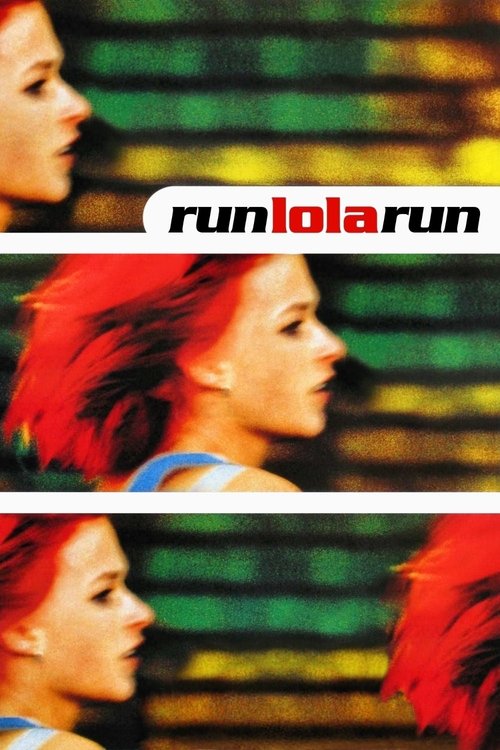
A phone rings in a cramped Berlin apartment. Lola picks up. On the other end, her boyfriend Manni is panicking: he has lost 100,000 Deutsche Marks that belong to his mobster boss, and he has twenty minutes to get it back or he is dead. Lola tells him to wait. Then she hangs up and runs. That is the whole engine of Run Lola Run, and director Tom Tykwer turns it into 80 minutes of pure momentum. Franka Potente, with hair dyed traffic-light red, sprints through Berlin while Moritz Bleibtreu's Manni waits by a phone booth, his panic climbing with every second. The film splits into three separate runs from the same starting moment. Each one diverges on a tiny detail. A dog on a staircase. A bicycle. A bump on a car. Same goal, three wildly different outcomes.
Tykwer wrote the script himself and shot it for roughly $1.5 million through X Filme Creative Pool, the company he co-founded. The film mixes live action with animated interludes, a techno score co-written by Tykwer with Johnny Klimek and Reinhold Heil, and a structure that borrows from video games as much as from cinema. It earned about $7.6 million worldwide, a solid return on that budget, and pulled in strong reviews. Its rating sits around 7.3 out of 10 across more than 2,700 votes. German audiences and international art-house crowds both responded to its energy.
The cast includes Herbert Knaup as Lola's father, a bank manager with his own problems, plus Nina Petri, Armin Rohde, and Joachim Król in supporting roles that shift meaning from run to run. The film runs just 80 minutes, and it moves. If you have seen Sliding Doors or Groundhog Day, you know the parallel-timeline idea, but Tykwer pushes it harder and faster. Potente runs, literally, for most of the movie, and the camera runs with her.
Availability and pricing can change. Confirm on the provider's site before purchasing.
A phone rings in a Berlin apartment. Lola picks up. On the other end, her boyfriend Manni is panicking: he has lost 100,000 Deutsche Marks that belong to his mobster boss, and he has twenty minutes to get it back or he is dead. Lola tells him to wait. Then she hangs up and runs. That is the whole engine of Run Lola Run, and director Tom Tykwer turns it into 80 minutes of pure momentum. Franka Potente, with hair dyed traffic-light red, sprints through Berlin while Moritz Bleibtreu's Manni waits by a phone booth, his panic climbing with every second. The film splits into three separate runs from the same starting moment. Each one diverges on a tiny detail. A dog on a staircase. A bicycle. A bump on a car. Same goal, three wildly different outcomes.
Tykwer wrote the script himself and shot it for roughly $1.5 million through X Filme Creative Pool, the company he co-founded. The film mixes live action with animated interludes, a techno score co-written by Tykwer with Johnny Klimek and Reinhold Heil, and a structure that borrows from video games as much as from cinema. It earned about $7.6 million worldwide, a solid return on that budget, and pulled in strong reviews. Its rating sits around 7.3 out of 10 across more than 2,700 votes. German audiences and international art-house crowds both responded to its energy.
The cast includes Herbert Knaup as Lola's father, a bank manager with his own problems, plus Nina Petri, Armin Rohde, and Joachim Król in supporting roles that shift meaning from run to run. The film runs just 80 minutes, and it moves. If you have seen Sliding Doors or Groundhog Day, you know the parallel-timeline idea, but Tykwer pushes it harder and faster. Potente runs, literally, for most of the movie, and the camera runs with her.
Official Trailer
Critical Consensus
Run Lola Run is widely praised as a kinetic, formally inventive thrill ride. A lean 80-minute burst of style, techno energy, and video-game logic anchored by Franka Potente's committed performance. Critics admire Tykwer's restless experimentation and the film's philosophical play with fate and chance, though some find the three-run structure repetitive and the style over substance. It is generally regarded as one of the defining art-house hits of the late 1990s.
“'Run Lola Run' is the kind of movie that could play on the big screen in a sports bar. It's an exercise in kinetic energy, a film of non-stop motion and visual invention.”
Roger Ebert
RogerEbert.com
“A visually arresting and energetic thriller that rewrites the rules of narrative cinema, praising Potente's performance and Tykwer's direction.”
Rotten Tomatoes Critics Consensus
Rotten Tomatoes
“An insanely entertaining thriller on all fronts, short and relentless, comparing its structure to the butterfly effect.”
Letterboxd User Review
Letterboxd
“Basically Crank as directed by the concept of the butterfly effect, praising it as an insanely entertaining thriller and noting its brevity as a strength.”
Reddit User
r/movies
Director
Tom Tykwer
Writer
Tom Tykwer
Composers
Johnny Klimek, Tom Tykwer, Reinhold Heil
Cinematographer
Frank Griebe
Producers
Stefan Arndt, Gebhard Henke, Andreas Schreitmüller
German Film Awards (1999)
Best Feature Film: Won
German Film Awards (1999)
Best Director: Won
German Film Awards (1999)
Best Actress: Won
European Film Awards (1998)
Best Film: Nominated
European Film Awards (1998)
Best Actress: Nominated
Independent Spirit Awards (2000)
Best Foreign Film: Nominated
Join the community
fans discussing