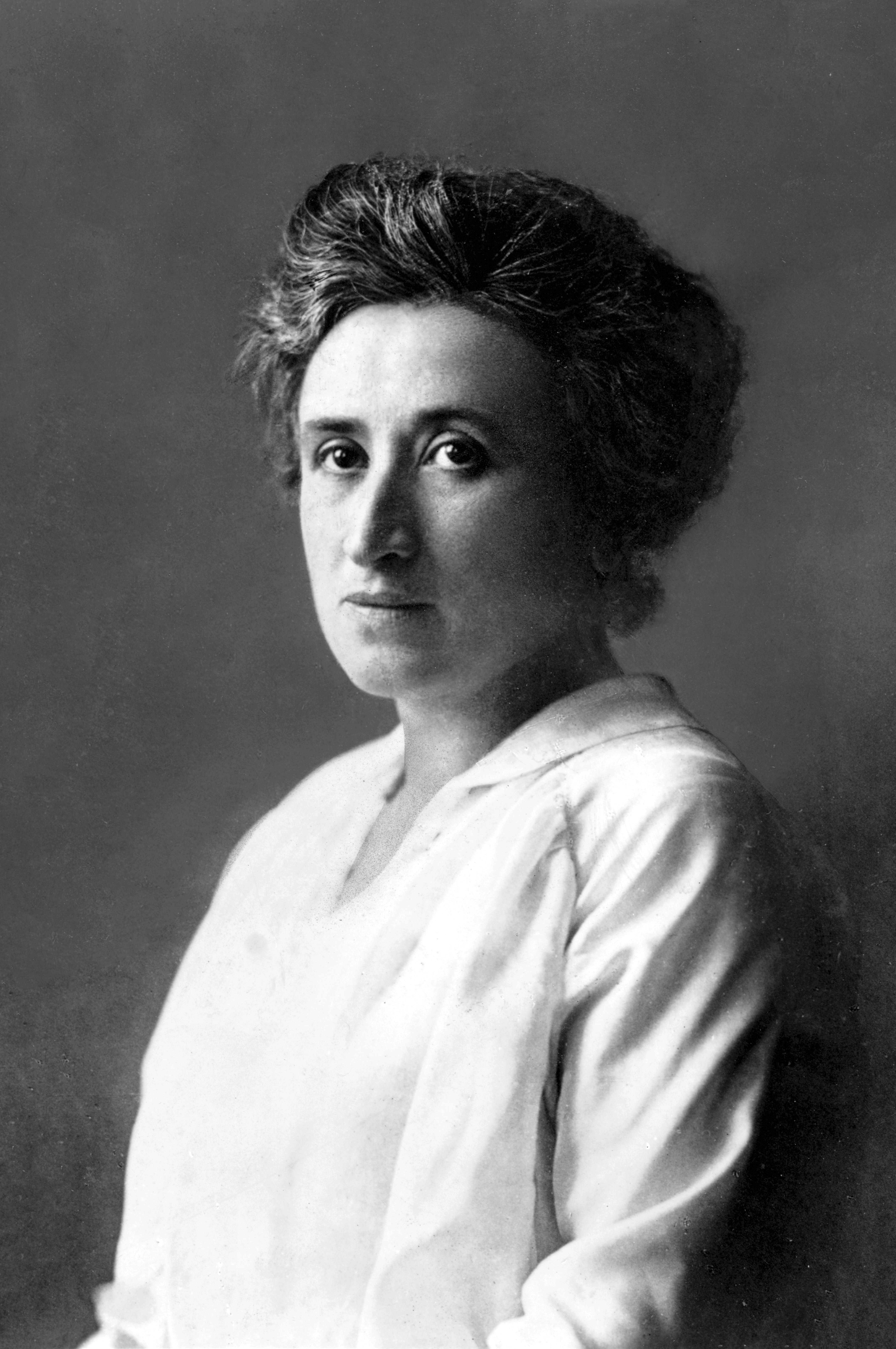
Rosa Luxemburg
 Germany
politician•philosopher•revolutionary
Birthday
+1871-03-05
Birth Sign
Pisces
Birthplace
Zamość
Age
Died at 47
About
Born Róża Luksemburg on March 5, 1871, in Zamość, Poland, Rosa Luxemburg became a towering figure in Marxist theory and revolutionary politics. She was a Polish and later naturalized German citizen, deeply involved in the international socialist movement. Her intellectual contributions and activism spanned decades, leaving a significant mark on political thought and action. She passed away tragically on January 15, 1919, at the age of 47.
Fame & Fandom
Rosa Luxemburg never met a fan, yet her intellectual legacy commands a disciplined, global following that functions with the intensity of modern fandom. Her adherents are not found in digital comment sections but within the Rosa Luxemburg Foundation and university departments worldwide, where they sustain her memory through rigorous scholarship and political activism. This organized network treats her 1899 pamphlet Social Reform or Revolution as a foundational text, while her personal herbarium of pressed plants serves as a rare cultural artifact for exhibitions. Commemorative rituals mark her death on January 15, 1919, transforming Berlin's Rosa-Luxemburg-Platz into a site of annual protest and reflection. The movement surrounding her is not a passive worship but an active battleground where her warnings against authoritarianism and reformist betrayal are constantly debated and applied to contemporary struggles. She remains a martyr whose life ended in brutal violence at the hands of paramilitary forces, cementing a mythology that spans over a century of socialist history. Today, her influence extends from German public policy to youth scholarships in Nigeria, proving her reach transcends national borders. According to the iFANN Global Fame Rankings, she holds a steady position as the 45th most famous person in Germany, reflecting her enduring status as a pivotal historical figure. These placements track global attention across media coverage, search, and consumption signals worldwide, confirming her relevance long after her death.
Interesting Facts and Legends
Rosa Luxemburg was born Róża Luksemburg in Zamość, Poland, in 1871 before becoming a naturalized German citizen. She died tragically on January 15, 1919, when she was shot in the head by Freikorps paramilitaries and thrown into Berlin's Landwehr Canal. Her body remained unidentified in the water for weeks before being recovered. A story from her early career involves her fierce intellectual battles against Eduard Bernstein regarding revisionism within the socialist movement. She argued that socialism could not be achieved through gradual reform alone, a stance that defined her theoretical contributions. Another aspect of her life is her deep connection to nature, preserved in a personal herbarium of pressed plants she collected during exile. Recent exhibitions have highlighted this collection alongside her political writings. In Berlin, her name is permanently etched into the urban landscape at Rosa-Luxemburg-Platz, where temporary public installations often blend revolutionary history with modern city life.
Death & Aftermath
Died
+1919-01-15 (aged 47)
Death Place
Berlin, Germany
Cause of Death
Reported extrajudicial shooting by Freikorps
The day after the killing, hundreds of thousands of workers marched through Berlin to protest the murder, a massive display of grief that galvanized the German left and intensified the polarization between social democrats and communists. Rosa Luxemburg and her close associate Karl Liebknecht had been arrested on the evening of January 15, 1919, at their apartment in Wilmersdorf before being taken to the Hotel Eden, where they were brutally beaten by members of the Freikorps led by Captain Waldemar Pabst. Luxemburg was shot in the head while attempting to walk toward Tiergarten park, and her body was subsequently thrown into the Landwehr Canal, an act initially disguised by police claims of a scuffle or attempted escape.
A military court trial held in 1920 and 1921 ended with the acquittal of all defendants, including Pabst, who ruled the killings as justified self-defense despite overwhelming evidence to the contrary. Her body was eventually buried in the Friedrichsfelde Central Cemetery within the Memorial Grove for the Victims of Fascism, where thousands of mourners gathered for a public memorial service featuring speeches and hymns. Decades later, her legacy flourished through the publication of her complete works, the founding of the Rosa Luxemburg Foundation, and the establishment of the Rosa-Luxemburg-Platz in Berlin, cementing her status as a central figure in Marxist theory.
Awards & Accolades
Keywords
Quick Facts
- Profession
- politician, philosopher, revolutionary
- Born
- +1871-03-05
- Birthplace
- Zamość
- Died
- +1919-01-15
- Death Place
- Berlin
- Gender
- Female
- Spouse
- Gustav Lübeck, Julian Marchlewski
- Birth Sign
- Pisces
Personal Details
- Spouse
- Gustav Lübeck, Julian Marchlewski
Join the community
fans discussing