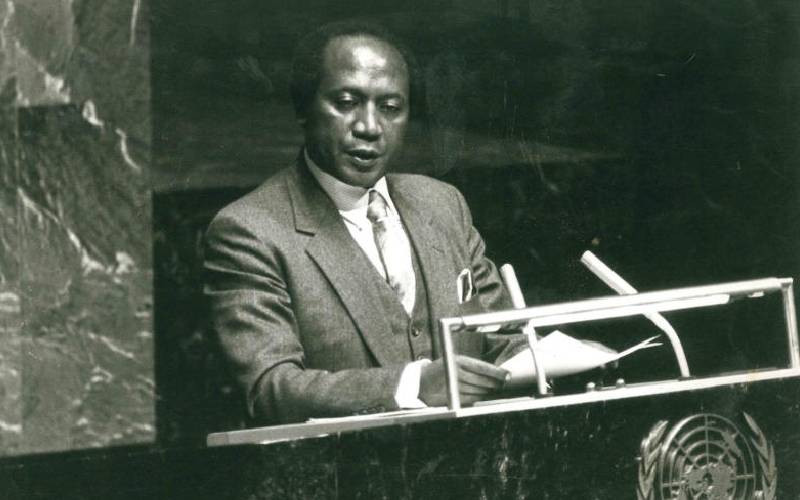
Robert Ouko
 Kenya
KenyaAlso known as: John Robert Ouko
Birthday
March 31, 1931
Birth Sign
Aries
Birthplace
Kenya
Age
Died at 58
About
John Robert Ouko was a Kenyan politician who served as the country's Minister of Foreign Affairs for two separate terms, first from 1979 to 1983 and again from 1988 until his death in 1990. He represented the Kisumu constituency in the National Assembly for multiple terms, making him a familiar and enduring figure in Kenyan governance.
Ouko is remembered for his steady presence in Kenyan politics across the presidencies of Jomo Kenyatta and Daniel arap Moi. He was known for his diplomatic skill and his efforts to navigate Kenya through complex international relations during his time as foreign minister. He is also credited with helping to establish the National Prayer Breakfast tradition in Kenya, a practice that continues to this day.
His life was cut short when he was murdered in February 1990, a case that remains one of Kenya's most enduring mysteries. He left behind a legacy of public service that is still discussed in the country, particularly in his home region of Nyanza.
Early Life & Background
John Robert Ouko was born on March 31, 1931, in Kenya. Details of his early years are scarce, but he grew up in the Nyanza region, an area that would later become central to his political identity. He attended local schools and showed an early interest in public affairs, which eventually led him into politics.
Ouko's political career began during the colonial era, and he rose through the ranks of Kenyan politics as the country moved toward independence. He was a cabinet minister during the presidency of Jomo Kenyatta, serving in various roles that helped shape the young nation's policies. His early work in government laid the groundwork for his later prominence as a diplomat.
By the time Daniel arap Moi took office, Ouko had established himself as a seasoned politician. His first appointment as Minister of Foreign Affairs came in 1979, a role that would define much of his career. This was not his first foray into international affairs, but it marked the beginning of his most influential period in government.
Career Growth
Robert Ouko's first term as Minister of Foreign Affairs ran from 1979 to 1983, during which he represented Kenya on the international stage. He was reappointed to the same position in 1988, a sign of the trust President Moi placed in him. In this second term, he worked on key diplomatic initiatives and fostered relationships with other African nations and Western allies.
One of his notable contributions was helping to establish the National Prayer Breakfast tradition in Kenya, alongside Kalonzo Musyoka. This event, which brings together political and religious leaders, continues to be held annually and is seen as a significant part of Kenya's political culture.
Ouko was serving as Minister of Foreign Affairs and International Cooperation when he was murdered in February 1990. His death cut short a career that had spanned several decades and left a void in Kenyan diplomacy. The circumstances of his murder remain a subject of intense speculation and investigation.
Career Timeline
Public Image & Style
Robert Ouko was perceived as a competent and respected diplomat, someone who carried himself with a sense of calm and professionalism. In the years since his death, he has been remembered as a tragic figure, a man whose potential was cut short by violence.
His murder has cast a long shadow over Kenyan politics, and many view him as a symbol of the political tensions that plagued the country during the late 1980s and early 1990s. For the people of Nyanza, he remains a local hero, and his name is often invoked in discussions about justice and accountability.
Fame & Fandom
The burnt and mutilated body of a former foreign minister found near Got Alila remains the defining chapter in Kenya's political mythology. Robert Ouko is not a celebrity in the entertainment sense, lacking the fan infrastructure, chart performance, or subway ads typical of modern stardom. His public presence was defined by high-stakes diplomacy and a tragic death that turned mourning into political theatre. As of August 2026, iFANN has evaluated this figure, but he does not currently hold a placement in the published rankings like the Global Top 1,000 or any Top-100 scope list. The absence of a formal rank reflects his status as a statesman rather than a pop icon; no numeric score or ordinal position applies to him within the current global fame engine. There is no documented fandom name for Dr. John Robert Ouko, and no organized fanbase exists to initiate birthday billboards or charity drives. Commemoration happens through academic research, official government inquiries, and journalistic investigations rather than grassroots movements. While the athlete Robert Ouko won gold in 1972, the politician's legacy is one of unresolved justice and state power. The story of his disappearance on February 13, 1990, and the subsequent decades of silence surrounding his murder have become a cultural touchstone. This narrative functions as historical lore rather than entertainment, symbolizing the brutality of the Moi era against its own officials. Even today, fear still stalks Koru, preventing full closure. The funeral under heavy guard set a precedent for how Kenyan political deaths are handled, transforming grief into a stage for confrontation. No specific rituals or inside jokes define a fan community because the audience is the nation itself, united by a shared history of tragedy.
Interesting Facts and Legends
Robert Ouko served as Kenya's Minister of Foreign Affairs during two separate terms, navigating complex international relations with a focus on dialogue rather than confrontation. He maintained a close working relationship with Kalonzo Musyoka, and together they launched the National Prayer Breakfast, a tradition now staple to the country's political calendar. Born in Nyanza Province, the same region that later became the epicenter of the investigation into his death, Ouko kept much of his personal life private despite his high profile. A farm in Koru remains a place of memory for many Kenyans who speak of his murder. The central legend of his life is the unsolved mystery of his death; on February 13, 1990, he disappeared from his home, and two days later, his burnt and mutilated body was discovered near Got Alila. This event is universally regarded as one of Kenya's most high-profile murders, steeped in folklore suggesting orchestration from within the highest levels of the state. His funeral on February 24, 1990, under heavy military guard, marked a turning point where funerals in Kenya became fierce political theatre. Even years later, reports indicate that fear still lingers in Koru, preventing new witnesses from emerging. The widow, Olive Kaigongi Ouko, passed away in 2025, adding another significant date to the ongoing saga of the family.
Family & Personal Life
Details about Robert Ouko's family are not widely documented in public sources. He was married at the time of his death, though his spouse's name is not consistently recorded. His family has largely stayed out of the public eye, and little is known about his children or extended relatives.
Ouko owned a farm in Koru, in Nyanza Province, where he lived and where he was last seen before his disappearance. The farm became a focal point of the investigation into his murder, and his family has continued to seek answers over the years.
Notable Connections
Relationships & Dating History
Robert Ouko was married at the time of his death, though the details of his marriage are not widely known. His wife's name is not consistently recorded in public sources, and she has largely remained out of the public eye. There is no information about his dating history before his marriage, and he was not known to have been involved in any public romantic relationships outside of his marriage.
As of 2026, Ouko is deceased, and his marital status at the time of his death was married.
- Married? - 1990Married at the time of his death; spouse's name not publicly documented.
Death & Aftermath
Died
February 13, 1990 (aged 58)
Death Place
Nandi Hills district, Kenya
Cause of Death
Murder; severe burns and torture
The official finding established that Dr. John Robert Ouko, Kenya's Foreign Minister, was murdered after disappearing from his farmhouse in Koru on the morning of February 13, 1990. His body emerged three days later in a shallow grave near the Jordan River in Nandi Hills, bearing severe burns consistent with being doused in petrol while alive and signs of torture. Investigations led by Justice Evans Gicheru and the subsequent Ndung'u Commission concluded the killing was politically motivated and implicated high-ranking officials, yet no masterminds faced criminal conviction despite a collapsed trial where three suspects were acquitted on appeal.
Public outrage erupted immediately, galvanizing the pro-democracy movement through massive vigils and turning Ouko's name into a potent symbol for the struggle against authoritarian rule. The funeral held on February 24 in Nyahera drew thousands of mourners under heavy military guard, creating a tense atmosphere where troops pointed weapons at the crowd to suppress potential unrest. Today, he is widely honored as a martyr for democracy, inspiring documentaries like Murder at Got Alila and books such as Reading the Minister's Remains, while his widow Christabel continues to seek justice for her husband's death.
Net Worth (Estate Value)
$1 Million
iFANN Editorial Team estimate
Robert Ouko's financial standing at the time of his death remains difficult to quantify precisely. Per iFANN's editorial analysis, his net worth is estimated at $1 Million. As a government minister in Kenya during the 1980s, his income derived primarily from his ministerial salary and personal investments, including his farm in Koru. It is unlikely his wealth was substantial by modern standards given the economic context of the era. In the years since his death, his estate has not been the subject of public financial reporting. There have been no notable posthumous earnings or business ventures associated with his name. His legacy remains firmly political rather than financial, and his family has not been involved in any high-profile financial matters.
Awards & Accolades
Known For
Minister of Foreign Affairs
1979-1983, 1988-1990 · Kenya's Foreign Minister
Member of Parliament for Kisumu
Multiple terms · MP
Keywords
Sources
Quick Facts
- Profession
- politician, minister
- Born
- March 31, 1931
- Birthplace
- Kenya
- Died
- February 13, 1990
- Death Place
- Nyanza Province
- Gender
- Male
- Birth Sign
- Aries
Personal Details
- Full Name
- John Robert Ouko
Frequently Asked Questions
How did Robert Ouko die?
Who was Robert Ouko?
What is Robert Ouko's net worth?
Is Robert Ouko still alive?
Why is Robert Ouko famous?
Join the community
fans discussing