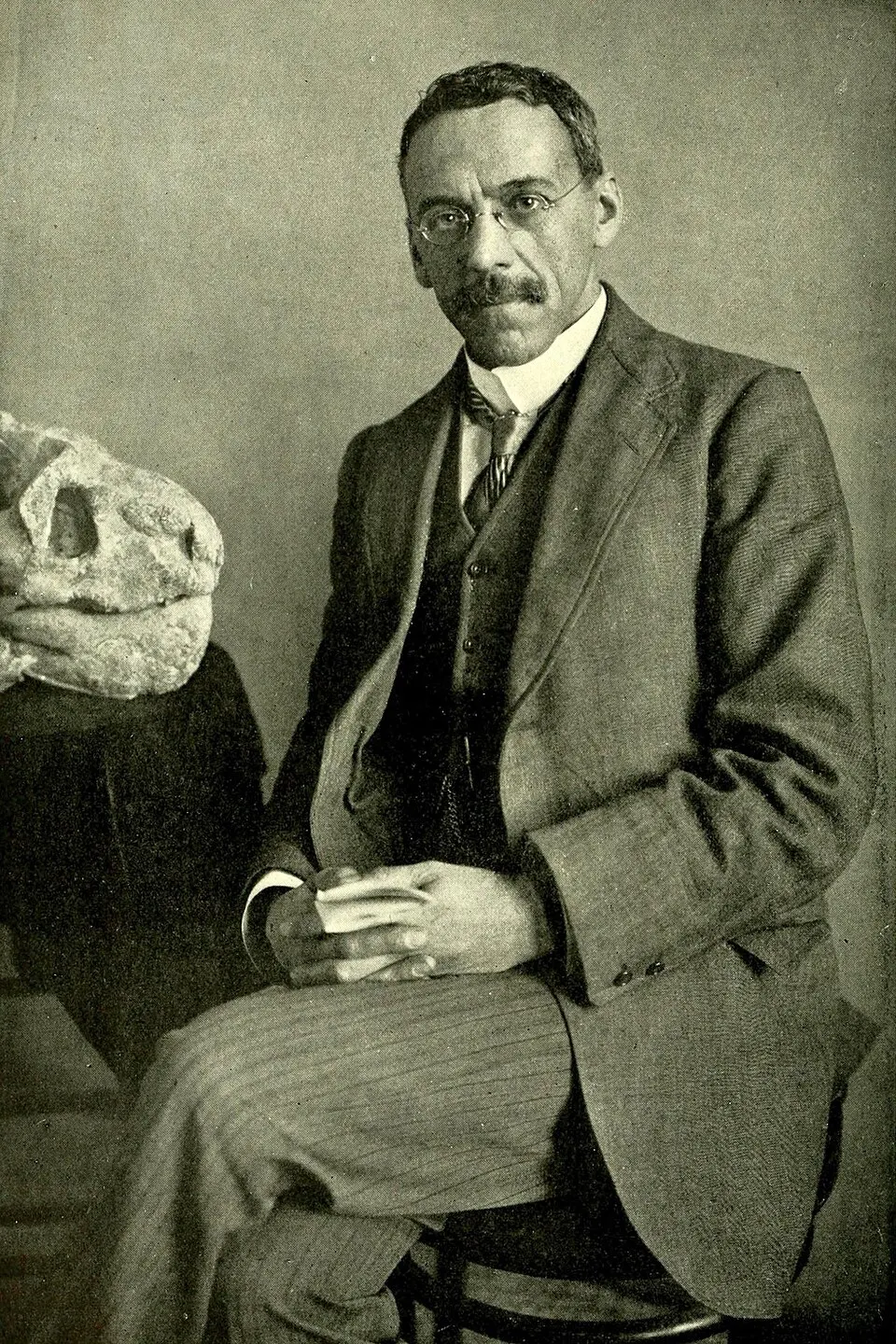
Robert Broom
 South Africa
paleontologist•paleoanthropologist•medical doctor•university teacher
Birthday
November 30, 1866
Birth Sign
Sagittarius
Birthplace
Paisley, Scotland
Age
Died at 84
About
Robert Broom was a Scottish-born medical doctor and palaeontologist whose meticulous fieldwork in South Africa rewrote the story of human origins. Trained as a physician in 1895, he later earned a DSc from the University of Glasgow in 1905, but his real calling lay in the ancient rocks of the Karoo and the caves of the Cradle of Humankind. As keeper of vertebrate palaeontology at the South African Museum in Cape Town, Broom spent decades unearthing fossils that would fundamentally challenge prevailing views on where humanity came from.
His most celebrated find came in 1947, when he recovered the remarkably complete Australopithecus africanus skull known as “Mrs Ples” from Sterkfontein, alongside a nearly intact australopithecine skeleton. These discoveries, together with his earlier work on mammal-like reptiles, helped establish Africa as the cradle of humankind, a notion that was still controversial in his lifetime. Broom published extensively, and his monographs remain essential reading in palaeoanthropology.
Broom died on 6 April 1951 in Pretoria, leaving a legacy of rigorous science and bold interpretation. He was elected a Fellow of the Royal Society and of the Royal Society of Edinburgh, and he received an honorary fellowship from the Royal Society of South Africa in recognition of a long life devoted to scientific work.
Early Life & Background
Robert Broom was born into poverty in Paisley, Scotland, on 30 November 1866. His family had little money, but his intellectual curiosity was evident early on. He pursued medicine at the University of Glasgow, qualifying as a doctor in 1895 with a specialisation in midwifery. Yet even while practising medicine, he was drawn to natural history, spending his spare hours studying fossils and geology.
In 1903, Broom moved to South Africa to take up a lectureship in zoology and geology at Victoria College in Stellenbosch. The move proved pivotal: the region’s rich fossil beds offered an endless supply of specimens, and Broom began publishing papers on fossil reptiles and mammals. His medical background gave him a unique anatomical perspective, and he quickly gained a reputation for meticulous observation.
By 1905, he had completed his DSc at Glasgow, a credential that legitimised his shift from medicine to palaeontology. In the years that followed, he established himself as a leading authority on the ancient vertebrates of the Karoo, setting the stage for his later hominin discoveries.
Career Growth
Broom’s major hominin discoveries began in the mid-1930s, when he started excavating at Sterkfontein, building on Raymond Dart’s 1924 Taung Child find. In 1936, he recovered additional Australopithecus africanus specimens that confirmed and expanded Dart’s claims. The breakthrough came in 1947, when he discovered the “Mrs Ples” skull, a nearly complete 2.1-million-year-old cranium that became one of the most iconic fossils in palaeoanthropology. That same year, he also found a nearly complete australopithecine skeleton, further solidifying the case for Africa as the cradle of humankind.
Broom’s work extended beyond hominins. His earlier research on mammal-like reptiles (therapsids) from the Karoo helped establish the evolutionary link between reptiles and mammals, a contribution that earned him international recognition. He published numerous papers and monographs, including the landmark “The South African Fossil Ape-Men” series.
In his later years, Broom served as keeper of vertebrate palaeontology at the South African Museum in Cape Town, where he mentored a new generation of palaeontologists. He continued fieldwork until shortly before his death in 1951, leaving behind a body of work that remains foundational to the field.
Career Timeline
Public Image & Style
In scientific circles, Broom is remembered as a brilliant but sometimes controversial figure. His bold interpretations and willingness to challenge established views earned him both admirers and critics. He was known for his energetic fieldwork and his ability to spot significant fossils that others might have overlooked. The public image that emerges from contemporary accounts is of a dedicated, slightly eccentric scientist, deeply committed to uncovering the secrets of human prehistory. Today, he is celebrated in South Africa as a pioneer of palaeoanthropology, with institutions like the University of South Africa and South African History Online maintaining profiles of his life and work.
Fame & Fandom (iFAMOUS Rankings)
Robert Broom commands a legacy that lives strictly within the hallowed halls of science rather than the chaotic energy of pop culture. Unlike modern celebrities, he never cultivated a fanbase with organized campaigns, birthday billboards, or charity drives. His influence remains anchored in academic institutions and museums, where colleagues and students continue to study his meticulous fieldwork decades after his passing. The scientific community honors him through publications and preserved specimens, not through social media trends or fan clubs. There is no documented name for any group dedicated to his memory, as his audience consists of paleoanthropologists and history enthusiasts who engage with his work through rigorous scholarship rather than fandom rituals. In August 2026, the iFANN Global Fame Engine evaluated Robert Broom's standing among historical figures. The evaluation determined that he currently holds no placement in the published rankings, including the Global Top 1,000 or any Top-100 scope list. This absence from the charts reflects his status as a specialized historical figure whose fame is measured by the permanence of his discoveries rather than current public consumption signals. While he does not appear on lists tracking contemporary celebrity reach or viral moments, his impact on the understanding of human origins remains absolute. The data confirms that while he is not ranked numerically against living personalities, his contributions to paleoanthropology stand as a foundational pillar of scientific thought. He is simply not currently placed in the global fame hierarchy.
Interesting Facts and Legends
Before dedicating his life to fossils, Robert Broom originally trained as a midwife, a specialty he rarely practiced once the ancient rocks of South Africa claimed his attention. Known for his sometimes unorthodox methods, he famously employed a hammer and chisel where other scientists would opt for finer tools, yet his results consistently spoke for themselves. A road in Krugersdorp named Robert Broom Drive stands as a permanent tribute to his legacy. He was also an accomplished artist, often sketching his specimens in remarkable detail that captured nuances lost to photography. The story of his most famous discovery, "Mrs Ples," has become a legend in its own right. Excavated in 1936 from Sterkfontein, this remarkably complete skull of Australopithecus africanus became a cornerstone of human evolution theory. Although recent analysis in 2018 verified that the fossil is actually male, earning the nickname "Mr Ples," the original moniker persists in popular science lore as a reflection of the excitement surrounding the find. Another enduring narrative follows his journey from a poor Scottish boy born into a Plymouth Brethren family to one of the world's most influential thinkers on human origins. This self-made success story highlights how a man with limited formal education could challenge established views and fundamentally rewrite the timeline of humanity.
Family & Personal Life
Details of Broom’s family life are scarce. He was born to a poor family in Paisley, Scotland, and little is recorded about his parents or siblings. He married, but his wife’s name and the dates of their marriage are not well documented in the available sources. Broom had no children that are mentioned in public records. He lived in South Africa for most of his adult life, and his household was likely modest, reflecting his academic salary.
Notable Connections
Raymond A. Dart, the discoverer of the Taung Child, was a close colleague and wrote a memorial tribute to Broom in 1951. Broom also worked alongside other prominent palaeontologists of the era, and his research was published in journals such as Nature, where editors A.J.V. Gale and L.J.F. Brimble oversaw the coverage of his discoveries.
Relationships & Dating History
Public records of Robert Broom’s romantic life are virtually nonexistent. He was married, but details of his wife, the marriage date, and any children are not documented in the available sources. As a scientist active in the late 19th and early 20th centuries, his personal life was not a subject of media attention. He died in 1951, and there is no information on any relationships after his marriage.
Death & Aftermath
Died
April 6, 1951 (aged 84)
Death Place
Pretoria, South Africa
Cause of Death
Natural causes
Robert Broom spent his final years continuing fieldwork in South Africa, maintaining an active pace until the very end of his life. On April 6, 1951, the renowned paleoanthropologist passed away naturally in Pretoria at the age of eighty-four. The event concluded a long career that had transformed our understanding of human origins without any dispute or legal complication surrounding the circumstances. Tributes poured in from the scientific community, with colleagues from the University of the Witwatersrand and the Transvaal Museum honoring his pivotal role in validating Raymond Dart's findings on Australopithecus africanus. His funeral was held shortly after his death in Pretoria, where he was laid to rest in the Old Cemetery alongside fellow academics who recognized his transition from obstetrician to one of the world's leading experts on early hominids.
In the decades following his passing, Broom's legacy has been cemented through enduring dedications rather than immediate commercial releases. The Palaeontological Society of Southern Africa established the Robert Broom Medal to recognize outstanding contributions to the field, while the University of the Witwatersrand named its Broom House in his memory. Streets across South Africa, including Robert Broom Drive, now bear his name as a permanent tribute to a man whose work remains foundational to the study of human evolution.
Net Worth (Estate Value)
N/A
iFANN Editorial Team estimate
Robert Broom passed away in 1951 with no substantial fortune to his name, a reality that aligns with the modest salaries of university lecturers and museum curators in mid-20th-century South Africa. iFANN's editorial research traces his income to these steady but unremarkable professional roles, which provided a comfortable living without generating significant wealth or posthumous earnings. No records exist regarding the value of his estate, and his enduring legacy is measured entirely by the impact of his paleoanthropological discoveries rather than any financial accumulation.
Awards & Accolades
View 4 records, honours and achievementsKnown For
Mrs Ples skull
1947 · Discoverer
Australopithecus africanus specimens at Sterkfontein
1936 · Discoverer
Keywords
Sources
Quick Facts
- Profession
- Paleontologist, paleoanthropologist, medical doctor
- Born
- November 30, 1866
- Birthplace
- Paisley, Scotland
- Died
- April 6, 1951
- Death Place
- Pretoria, South Africa
- Gender
- Male
- Birth Sign
- Sagittarius
- Education
- University of Glasgow
Personal Details
- Full Name
- Robert Broom
- Education
- University of Glasgow (MB, DSc)
Frequently Asked Questions
Who was Robert Broom?
What did Robert Broom discover?
Where was Robert Broom born?
When did Robert Broom die?
Why is Robert Broom important to human evolution studies?
Similar People
Join the community
fans discussing