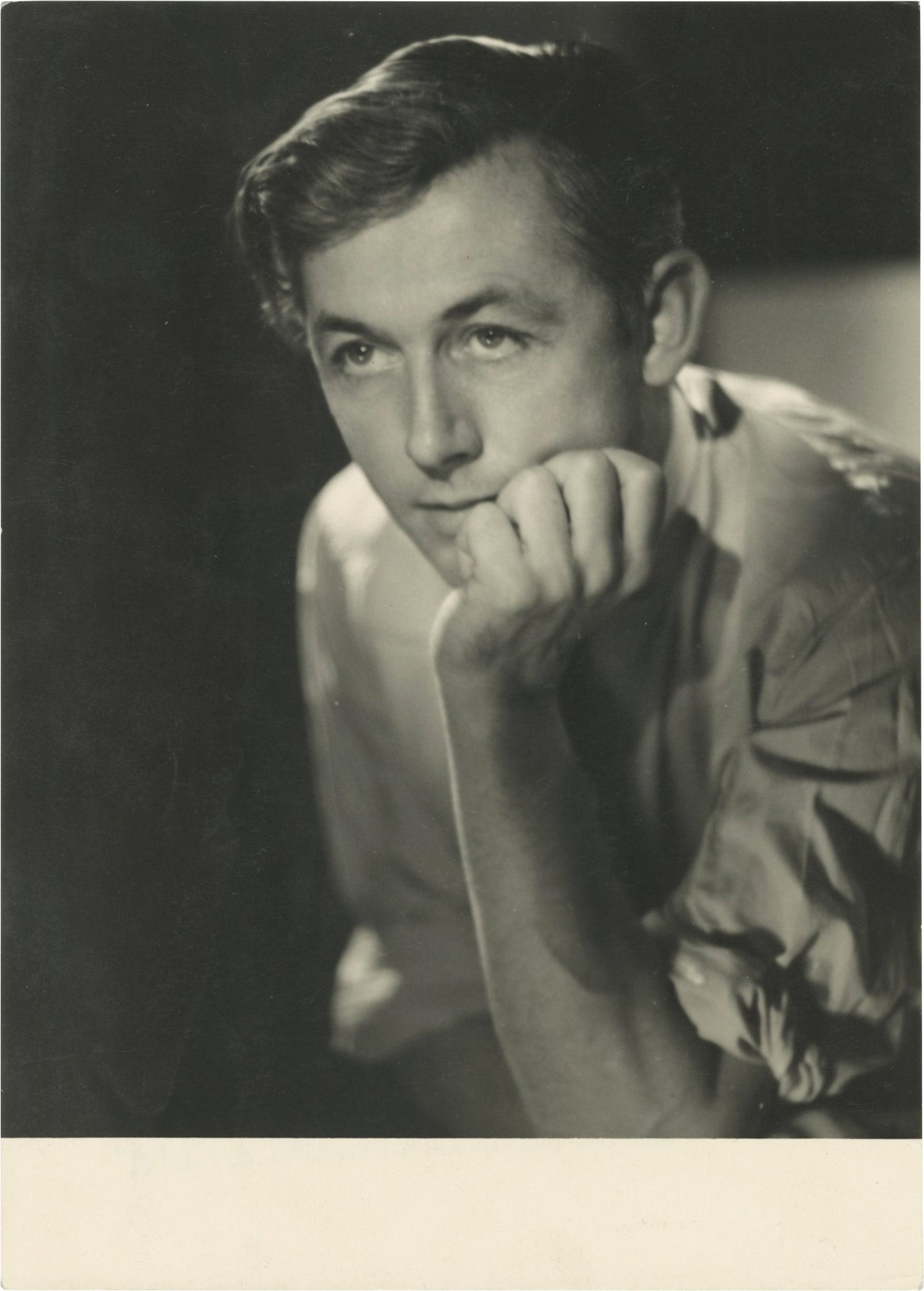
Robert Bresson
 France
screenwriter•film director•painter
Birthday
September 25, 1901
Birth Sign
Libra
Birthplace
Bromont-Lamothe, Puy-de-Dôme, France
Age
Died at 98
Height
5 ft 10 in (178 cm)
About
Robert Bresson was a French filmmaker whose austere, spiritual style set him apart. Over four decades he crafted just 13 feature films, each a study in restraint. Bresson used non-professional actors, stripped away musical scores, and employed elliptical storytelling to create what many call minimalist cinema. His films often explore themes of grace, redemption, and suffering, with a tragic undercurrent that feels both bleak and transcendent.
Bresson's career reached its peak in the 1950s and 1960s. A Man Escaped (1956), based on a true story of a prisoner's escape, is a masterclass in tension and detail. Pickpocket (1959) follows a compulsive thief, its sparse style mirroring the protagonist's isolation. Au hasard Balthazar (1966) traces the life of a donkey, a parable about human cruelty and innocence. These three films all ranked in the top 100 of the 2012 Sight and Sound critics' poll of the greatest films ever made. Other works like Mouchette (1967) and L'Argent (1983) also earned significant votes. In fact, Bresson holds the record for the most films (seven) on that historic list. He is revered as one of cinema's few authentic geniuses, a "true auteur" whose influence extends to directors like Paul Schrader, the Dardenne brothers, and Tsai Ming-liang.
Critics and fellow filmmakers revered him. Jean-Luc Godard once wrote, "He is the French cinema, as Dostoevsky is the Russian novel and Mozart is German music." Bresson's approach influenced directors from Paul Schrader to the Dardenne brothers. He died on December 18, 1999, at age 98, leaving behind a small but towering body of work.
Early Life & Background
Robert Bresson was born on September 25, 1901, in Bromont-Lamothe, a village in central France. His father, Léon Bresson, was an army officer, and the family moved frequently during Robert's childhood, exposing him to both city and rural environments that later informed his sensitive use of landscape imagery. His mother was Marie-Élisabeth (née Clausels) Bresson.
Bresson was educated at Lycée Lakanal in Sceaux, near Paris, where he excelled in Latin, Greek, and philosophy. After graduating, he turned to painting, though no record exists of him participating in exhibitions. He also studied philosophy at university. Three formative influences shaped his films: Catholicism, art, and his experience as a prisoner of war during World War II.
In the early 1930s, Bresson worked as a photographer for Thomas et Gibbs and for Coco Chanel, who provided him with a studio to shoot catalog photographs. A perfectionist, he found the work overwhelmingly stressful and eventually left. He worked as a scriptwriter on comedies in the mid-1930s, with writer credits including C'était un musicien. His first directorial effort was the short comedy Public Affairs (1934), which was atypical of his later style. During World War II, Bresson was a German prisoner of war for over a year (1940–1941), an experience that directly inspired his later masterpiece A Man Escaped.
Career Growth
Bresson's directorial career spanned from 1934 to 1983, producing only 13 feature films in nearly half a century. His first feature, Les Anges du péché (1943), set among Dominican nuns, featured a screenplay by Jean Giraudoux and became a commercial success, establishing Bresson as a major talent. Les Dames du Bois de Boulogne (1945) was the last time he would work with professional actors.
From Journal d'un curé de campagne (1951), which won the International Prize at the Venice Film Festival, Bresson developed his signature minimalist style, using non-professional actors (whom he called "models") and deliberately flat, expressionless performances. Un Condamné à mort s'est échappé (1956) won Best Director at the Cannes Film Festival (1957) and is considered a masterclass in tension. Pickpocket (1959) followed. Le Procès de Jeanne d'Arc (1962) won the Special Jury Prize at Cannes. Au hasard Balthazar (1966) and Mouchette (1967) are now regarded as masterpieces. In 1968, Bresson was elected President d'honneur de la Société des réalisateurs de films. Later works include Quatre nuits d'un rêveur (1971), adapted from Dostoevsky, Lancelot du lac (1974), his pet project costing $1 million, and Le Diable probablement (1977), which won the Silver Bear at Berlin. His final film, L'Argent (1983), based on a Tolstoy story, capped his career. He was also awarded the Grand Prix national des Arts et des Lettres and the French Legion of Honour.
Career Timeline
Public Image & Style
Bresson's public persona was one of ascetic minimalism, both in his films and his personal life. He was notoriously private and avoided publicity, once telling an interviewer, "Then you know as much as I do. What do we have to talk about?" Critics describe him as "mysterious" and "aloof." His films are immediately recognizable from a single image or cut: real locations, natural sounds, no musical scores or extremely sparse scoring, non-professional actors, elliptical storytelling, and diary-like narrative structures. Catholic themes of sin, grace, redemption, and suffering permeate his work. Jean-Luc Godard called him the French cinema itself. Bresson is revered as one of cinema's few authentic geniuses, a "true auteur" whose influence extends to directors like Paul Schrader, the Dardenne brothers, and Tsai Ming-liang. There is no official fandom name, but enthusiasts are simply "Bresson fans" or "Bresson scholars." Academic retrospectives and complete film series are held at archives such as the Harvard Film Archive.
Fame & Fandom (iFAMOUS Rankings)
Robert Bresson cultivated a legacy defined by silence and asceticism rather than the clamor of a mass movement. His fanbase has no formal name, functioning instead as an elite circle of academics, cinephiles, and film students who revere his strict adherence to artistic purity. The primary hub for this community is the official website curated by his widow, Mylène Bresson, which serves as an archival repository rather than a platform for social interaction. There are no documented rituals, birthday billboards, or organized campaigns; the reverence shown to him is intellectual, characterized by a deep study of his 'Model' method and his refusal to compromise his vision. While he never engaged with fans directly, viewing the concept of the director as a celebrity with disdain, his influence has generated enduring legends among filmmakers. A notable story from recent years involves Michael Haneke's retirement announcement in 2026, where he explicitly linked his own limited output to that of his idol, cementing a generational mythos that frames Bresson as a spiritual ancestor to modern auteur theory.
The scope of his global recognition remains steady within authoritative tracking systems. According to the iFANN Global Fame Rankings, Robert Bresson is the 62nd most famous person from France, a position holding steady from the previous cycle. This placement reflects his enduring status as a pivotal figure in cinema history. His films, particularly *Au hasard Balthazar* and *Pickpocket*, continue to be reviewed as masterworks, ensuring his name persists in cultural discourse despite his absence from the public eye for nearly thirty years.
Interesting Facts and Legends
Robert Bresson referred to his performers as 'models' rather than actors, demanding they deliver lines with a flat, expressionless tone to strip away theatricality. He identified himself as possibly Jansenist due to a belief in predestination and ceased attending church following the Second Vatican Council's liturgical changes. In his early career, he smoked and consumed significant amounts of alcohol. He preferred the term 'cinematography' over 'cinema,' feeling the latter was insufficient to describe his work. Following the release of *Quatre nuits d'un rêveur* in 1971, some French newspapers suggested he incited youth suicide, leading the minister of culture to briefly consider banning the film for viewers under eighteen. Bresson was notoriously private, once telling an interviewer, 'Then you know as much as I do. What do we have to talk about?' He stood 5′ 10″ (1.78 m) tall and rests in Droue-sur-Drouette, France. Jean-Luc Godard famously noted, 'He is the French cinema, as Dostoevsky is the Russian novel and Mozart is German music.'
A central legend surrounding his practice involves his creation of the 'Model' (*Modèle*), where he would record hundreds of takes of simple actions like reaching for a door handle until the actor's face showed no trace of performance. Another iconic moment in his mythology occurred in 2026 when Michael Haneke announced his retirement, stating he made his ten movies just like his idol, reinforcing the lore of Bresson's deliberate philosophical choice to limit his output to thirteen feature films over six decades.
Notable Quotes
“He is the French cinema, as Dostoevsky is the Russian novel and Mozart is German music., Jean-Luc Godard”
“Then you know as much as I do. What do we have to talk about?, Bresson to an interviewer”
“I am rather a Jansenist than a Jesuit., Bresson on his religious views”
Family & Personal Life
Bresson was married twice. His first wife was Leidia van der Zee, whom he married in 1926; little is documented about their relationship beyond the marriage date, and she predeceased him. His second wife was Mylène van der Mersch, who served as his intermediary with film crews and remained with him until his death. No credible sources document that Bresson had children from either marriage. He lived in Paris on the Île Saint-Louis for much of his life.
Notable Connections
Jean Giraudoux wrote the screenplay for Bresson's first feature, Les Anges du péché. Coco Chanel employed Bresson as her photographer in the early 1930s, giving him a studio to shoot catalog photographs. Bresson's minimalist style deeply influenced directors such as Paul Schrader, the Dardenne brothers, Rainer Werner Fassbinder, Tsai Ming-liang, and musician Patti Smith, who cited his influence.
Relationships & Dating History
Bresson was married twice. His first wife was Leidia van der Zee, whom he married in 1926; little is documented about their relationship beyond the marriage date, and she predeceased him. His second wife was Mylène van der Mersch, who served as his intermediary with film crews. They remained married until his death on December 18, 1999. No credible sources document Bresson having children from either marriage. At the time of his death, he was married to Mylène van der Mersch.
- MarriedLeidia van der Zee1926 - presentBresson's first wife; little documented beyond the marriage date; she predeceased him.
- MarriedMylène van der Mersch? - 1999CurrentBresson's second wife; served as his intermediary with film crews; remained married until his death.
Death & Aftermath
Died
December 18, 1999 (aged 98)
Death Place
Unknown
Cause of Death
Unknown
Robert Bresson died on December 18, 1999. The specific location of his passing and the official medical cause remain unrecorded in available documentation. His death marked the end of a career defined by extreme restraint, yet it did not trigger immediate public mourning or vigils; tributes from peers and institutions emerged gradually over subsequent decades rather than as an immediate response to the event. No details regarding the date, location, or nature of a funeral service have been preserved in the historical record, leaving the disposition of his remains unknown. Posthumous preservation of his work has proceeded through private management by his heirs, specifically Mylène Bresson, who curates the official website robert-bresson.com.
Critical attention to his filmography continued long after his death, evidenced by high-profile restorations such as the 4K release of Four Nights of a Dreamer announced in late 2025. His standing among critics remained formidable, holding the record for the most films included in the 2012 Sight & Sound critics' poll. Contemporary directors like Michael Haneke and Kelly Reichardt have frequently cited his influence, ensuring his aesthetic principles endure within modern cinema.
Net Worth (Estate Value)
Robert Bresson died in 1999, and his net worth at death and current estate value are not publicly documented by credible financial sources. Bresson was not a commercially driven filmmaker; his 13 feature films were often difficult to finance and did not generate blockbuster revenues. His estate is managed privately by his heirs (likely his second wife's family), and no posthumous releases, licensing deals, or estate-managed businesses are publicly reported. No reliable net worth estimate is available.
Awards Won (23)
Bresson won the International Prize at the Venice Film Festival for Diary of a Country Priest (1951), the Best Director Award at Cannes for A Man Escaped (1957), the Special Jury Prize at Cannes for The Trial of Joan of Arc (1962), and the Silver Bear at the Berlin Film Festival for The Devil, Probably (1977). He also received the Grand Prix national des Arts et des Lettres and was a recipient of the French Legion of Honour.
1962 · Special Jury Prize
Le Procès de Jeanne d'Arc (The Trial of Joan of Arc)
1957 · Best Director
Un Condamné à mort s'est échappé (A Man Escaped)
Known For
A Man Escaped
1956 · Director, Screenwriter
Pickpocket
1959 · Director, Screenwriter
Au hasard Balthazar
1966 · Director, Screenwriter
Diary of a Country Priest
1951 · Director, Screenwriter
Mouchette
1967 · Director, Screenwriter
L'Argent
1983 · Director, Screenwriter
The Trial of Joan of Arc
1962 · Director, Screenwriter
Keywords
Sources
Quick Facts
- Profession
- screenwriter, film director, painter
- Born
- September 25, 1901
- Birthplace
- Bromont-Lamothe, Puy-de-Dôme, France
- Died
- December 18, 1999
- Death Place
- Paris, France
- Gender
- Male
- Birth Sign
- Libra
- Height
- 5 ft 10 in (178 cm)
- Spouse
- Mylène van der Mersch
- Education
- Lycée Lakanal, Sceaux; studied philosophy at university
Personal Details
- Full Name
- Robert Bresson
- Height
- 5 ft 10 in (178 cm)
- Spouse
- Mylène van der Mersch
- Education
- Lycée Lakanal, Sceaux; studied philosophy at university
Filmography
14
Total
13
Film
0
TV
Frequently Asked Questions
Why is Robert Bresson important?
Did Robert Bresson have children?
What is Robert Bresson's most famous film?
How many films did Robert Bresson make?
What was Robert Bresson's filmmaking style?
Similar People
Join the community
fans discussing