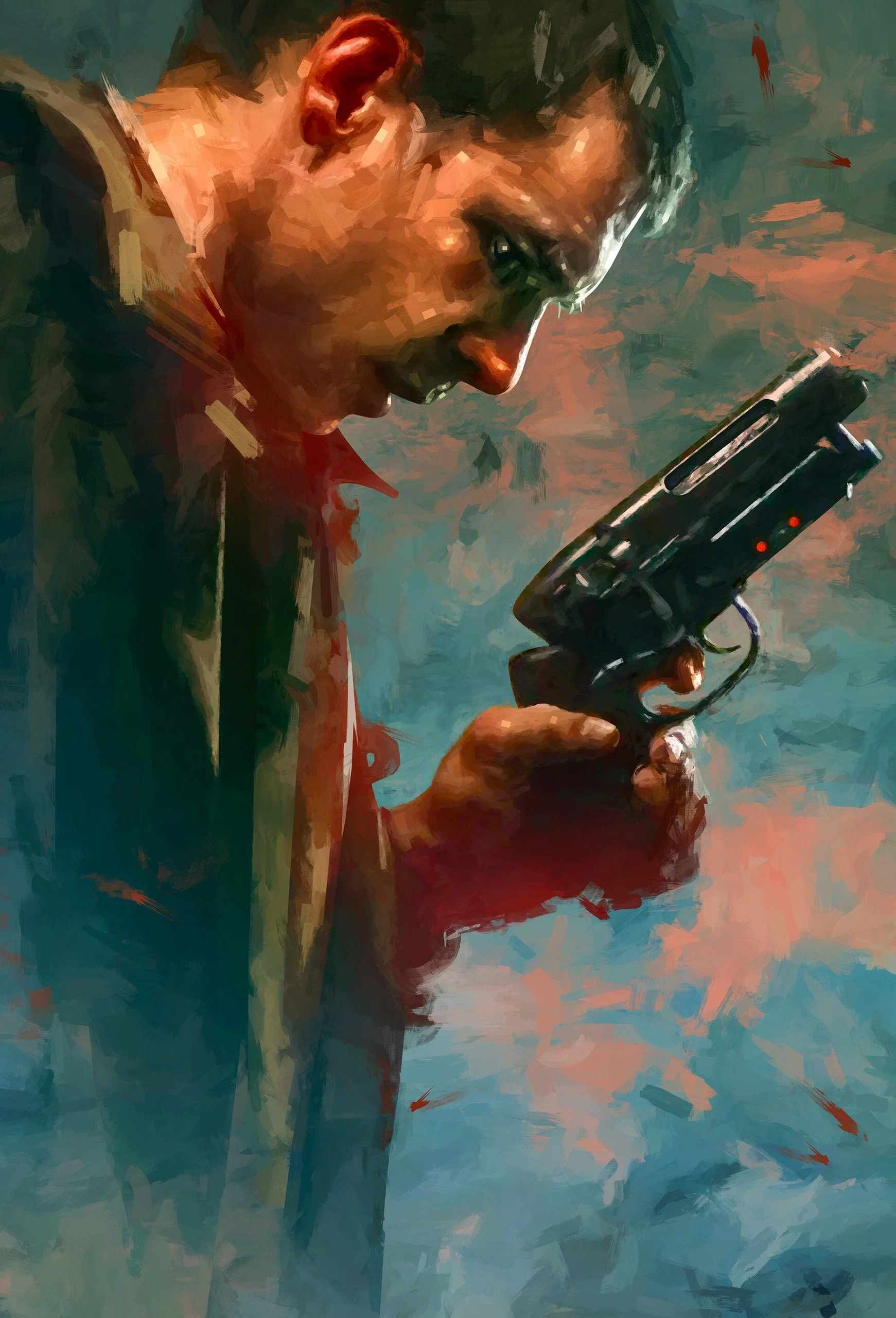
Rick Deckard
Appears In
Blade Runner
Species
Human (ambiguous, possibly replicant)
First Appearance
Do Androids Dream of Electric Sheep? (1968)
Occupation
Blade Runner (bounty hunter for the LAPD)
Creator
Philip K. Dick
Overview
Origin Story
Rick Deckard's origins trace back to Philip K. Dick's 1968 novel Do Androids Dream of Electric Sheep?, where he works as a bounty hunter in a post-apocalyptic San Francisco, tasked with 'retiring' androids who have escaped from off-world colonies. The novel paints a world where empathy is the defining human trait, and owning a real animal is a status symbol; Deckard's electric sheep is a constant reminder of his financial struggles and emotional detachment.
In Ridley Scott's 1982 film Blade Runner, the setting shifts to a rain-soaked Los Angeles in 2019. Deckard, badge number B26354, is a retired blade runner reluctantly pulled back into service to hunt four replicants who have hijacked a ship and returned to Earth. His past is murky, hinted at through sparse dialogue and the weary resignation in Harrison Ford's performance.
Personality
Deckard embodies the hardboiled detective noir archetype, a loner, bitter and cynical, with a drinking problem and a moral compass that has dulled from years of killing. He is a reluctant participant in his own story, often questioning the ethics of his profession even as he carries out his duties. His narration in the film captures this ambivalence: 'I don't know why he saved my life. Maybe in those last moments he loved life more than he ever had before.'
Despite his gruff exterior, Deckard shows flashes of empathy, especially toward Rachael, and his encounter with Roy Batty forces him to confront his own humanity. He is a man without a past and largely without a future, drifting through a world that has lost its meaning.
Story Arc
In Blade Runner, Deckard is dragged out of retirement to hunt down four replicants: Roy Batty, Pris Stratton, Zhora, and Leon Kowalski. His mission takes a turn when he meets Rachael, a replicant who believes she is human, and their uneasy romance forces him to question his assumptions. The climax sees Deckard saved by Roy Batty, the very replicant he was sent to kill, in a moment that redefines his understanding of life and death.
Thirty years later, in Blade Runner 2049, Deckard has gone into hiding in a radioactive Las Vegas, living alone with his memories. The sequel reveals that he and Rachael had a child, Ana Stelline, whose existence is a secret that could topple the world order. Deckard's reunion with his daughter in the film's final moments offers a rare emotional resolution, as he finally finds a reason to re-engage with life. The film leaves his fate ambiguous, but his role as a father and protector becomes his defining act.
Powers & Abilities
Expert marksmanship
Skilled in hand-to-hand combat
Proficient in investigative techniques
Administration of the Voight-Kampff test
Use of the Esper photo-analysis device
Equipment & Signature Items
Blaster pistol
Esper photo-analysis device
Voight-Kampff test kit
LAPD badge
Relationships
Rachael
Love InterestA replicant who believes she is human; Deckard's romance with her becomes the emotional core of the franchise.
Roy Batty
EnemyThe leader of the rogue replicants; his final act of mercy saves Deckard's life and challenges his worldview.
Gaff
AllyA fellow officer who communicates through origami, leaving cryptic clues about Deckard's fate.
Ana Stelline
FamilyDeckard's daughter, a replicant memory designer whose existence he has protected for decades.
Iran Deckard
FamilyDeckard's wife in the original novel, whose relationship is strained by his work.
Memorable Quotes
“I don't know why he saved my life. Maybe in those last moments he loved life more than he ever had before.”
“All he'd wanted were the same answers the rest of us want. Where did I come from? Where am I going? How long have I got?”
“I've seen things you people wouldn't believe.”
“Do you like our owl?”
Portrayed By
Key Appearances
Do Androids Dream of Electric Sheep? (1968 novel)
Blade Runner (1982 film)
Blade Runner 2049 (2017 film)
Blade Runner (BBC Radio 4, 2014)
Reception & Legacy
Blade Runner was a box office disappointment upon its initial release, grossing over $41 million worldwide, but it took roughly 25 years to be recognized as one of the greatest science fiction films ever made. The 2007 'Final Cut' restoration cemented its critical reputation, and Blade Runner 2049 earned over $259 million globally, demonstrating the franchise's enduring appeal. Fans and critics alike frequently rank Blade Runner as the greatest science fiction film of all time, with Deckard's character at the center of discussions about identity, memory, and artificial intelligence. His ambiguity, whether he is human or replicant, has sparked endless debate, making him a touchstone for philosophical inquiry in cinema.
Interesting Facts and Legends
Harrison Ford deliberately delivered his voice-over narration lines poorly in an attempt to have them removed from the theatrical cut, but the tactic backfired.
The Esper photo-analysis scene, often taken literally, is actually a demonstration of Deckard's subjective perception rather than a realistic depiction of technology.
The origami unicorn left by Gaff at the end of the original film has been interpreted as evidence that Deckard's memories are implanted, suggesting he may be a replicant.
In the novel, Deckard's electric sheep represents his inability to afford a real animal, a status symbol in a world where empathy is paramount.
The name 'Deckard' is thought to evoke the hardboiled detective tradition, though its exact origin remains speculative.
Frequently Asked Questions
Who is Rick Deckard?
Is Rick Deckard a replicant?
Does Rick Deckard die in Blade Runner 2049?
Who plays Rick Deckard?
Who does Rick Deckard end up with?
Keywords
Sources
Character Info
- Creator
- Philip K. Dick
- Portrayed By
- Harrison Ford
- First Appearance
- Do Androids Dream of Electric Sheep? (1968)
- Occupation
- Blade Runner
- Affiliation
- Los Angeles Police Department
Join the community
fans discussing