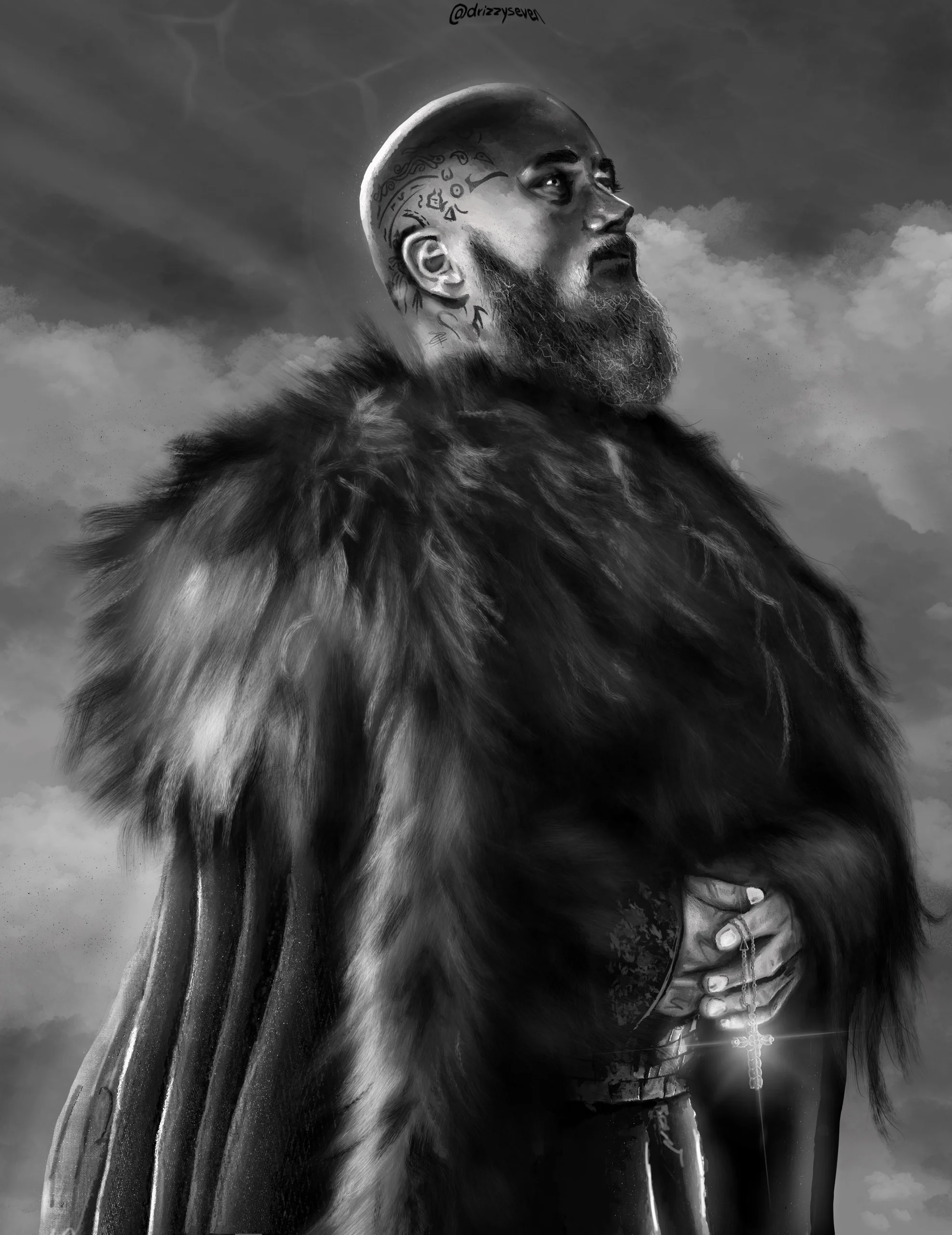
Ragnar Lodbrok
Viking chieftain and legendary king (semi-legendary figure)
Also known as: Ragnar Lothbrok, Ragnar loðbrók, Ragnar Hairy-Breeches, Ragnar Sigurdsson
Birthday
c. 850
Birth Sign
Unknown
Birthplace
Scandinavia
Age
Died at 15
About
Ragnar Lodbrok was a semi-legendary Viking hero and king, known from Old Norse poetry, Icelandic sagas and near-contemporary chronicles rather than from any verified contemporary record. He is the figure behind the epithet loðbrók, "hairy-breeches," and the tradition makes him a king of both Sweden and Denmark as well as a raider of the British Isles and the Frankish Empire. Whether a single man of that name ever lived is still argued over. Most historians treat the surviving Ragnar as a composite, built from the deeds of several ninth-century chieftains and stitched together by storytellers. The story spans decades of folklore before being written down, potentially blending the deeds of several different warriors into one legendary persona.
What is not in doubt is his reach. The Great Heathen Army that landed in England in 865 is credited in later tradition to his sons, and that link alone made him the ancestral figure of the Viking invasions in the popular imagination. He died, according to the sagas, in a Northumbrian snake pit around 865, and the story of his sons' revenge became one of the most enduring narratives of the medieval North. Modern discussions continue to focus on the disparity between the dramatic portrayal and the fragmented historical reality, noting that while his existence is plausible, the specific events are likely folklore.
Today he belongs less to history than to storytelling. Travis Fimmel's portrayal in Vikings (2013 to 2020) made him a global screen character, and the 2026 immersive exhibition at Dock X in London and his 2025 addition to World of Warships show a figure who keeps being reinvented for new audiences. He is the protagonist of a television series that brought the legend to a global audience and cemented the image of Ragnar as a complex, philosophical warrior.
Early Life & Background
There is no childhood to report, and that is the first thing worth knowing about Ragnar Lodbrok. No contemporary source records his birth, his schooling or his early household, and there are no verified records of his childhood, education, or early life prior to his rise as a warrior. The sagas fill the gap with genealogy: he is named the son of Sigurd Hring, a king of Sweden, though the line is unverifiable and probably constructed to give him royal pedigree. Some traditions instead start him as a farmer or peasant who won his standing through fighting, which is a very different origin story and a hint that two separate figures may have been merged. According to traditional literature, including the Tale of Ragnar's Sons and the Gesta Danorum, he was born in Scandinavia around the mid-ninth century, with c. 850 CE a common folkloric estimate, though some sources suggest an earlier date.
The nickname carries the most reliable early detail. Loðbrók means "hairy-breeches," and the story behind it is that Ragnar wore trousers of tough animal hide, sometimes described as treated with tar or pitch, so that arrows and sword cuts could not reach his legs. He is said to have made them for climbing into fortified places and for close combat, and the name stuck hard enough to outlast everything else about him. In Old Norse the name Ragnar itself means something close to "warrior" or "army decision-maker," which is either a lucky coincidence or a sign the name was chosen for the story.
His first steps as a raider are placed in the early to mid ninth century, along the coasts of the British Isles and into the Frankish Empire. The sagas send him up shallow rivers in fast, light ships, the classic Viking hit-and-run pattern, and credit him with a string of small campaigns before he ever held a crown. Those early raids are where the legend begins to accumulate detail, and they are also where the chronology starts to strain, since the events attached to him stretch across several decades.
The moment just before the breakthrough is the courtship of Thora, which some versions place early in his career. He is said to have won her by clearing a serpent or monster guarding her hall, a deed that reads like a folktale initiation rather than a historical campaign. From there the tradition moves him quickly into the big set pieces, the siege of Paris and the invasions of England, where the legend proper takes over.
Career Growth
The career of Ragnar Lodbrok, as the sagas tell it, is a sequence of raids that map almost perfectly onto the Viking Age's greatest hits. The most famous is the siege of Paris in 845, when a fleet under his command sailed up the Seine and forced Charles the Bald to pay a large ransom in silver to be left alone. Some accounts add that Ragnar promised never to return and broke the promise immediately, which is exactly the kind of detail a storyteller adds to a raider's reputation.
He is also credited with campaigns across Northumbria in northern England and with holding rule over both Sweden and Denmark. Those titles are probably honorary within the saga frame, but they matter for how the tradition used him: Ragnar became the archetype of the Viking king who fights, negotiates and rules all at once.
The real historical anchor is his family. The Great Heathen Army that invaded England in 865 is widely associated with his sons, Ivar the Boneless, Halfdan, Ubbe, Bjorn Ironside and Sigurd Snake-in-the-Eye, and that connection is what makes Ragnar a turning point rather than a footnote. Whether or not the father existed as described, the sons' campaigns did, and the tradition used him to explain them.
Modern career, in a sense, is still running. Vikings ran for six seasons from 2013 to 2020 and made him a television protagonist. In May 2025 he was added as a playable commander in World of Warships, and in March 2026 Vikings: The Immersive Experience opened at Dock X in London, with reconstructed villages and battlefields built around his era. The character keeps getting new work.
Career Timeline
Public Image & Style
The public image of Ragnar Lodbrok is a Viking hero with a philosopher's streak and a raider's temper. The hairy breeches, the snake pit, the taunt to his sons: these are the images that stick, and they have been recycled for centuries. Modern portrayals tend to lean into the contradiction, a man curious about the world who is also perfectly willing to burn it, and that tension is what makes him usable as a character rather than just a warlord. He is often seen as a tragic hero, a man of vision and brutality, torn between the pagan gods and the emerging Christian world.
He has no personal style in the fashion sense, but he has a visual signature: hide trousers, a raider's fleet, a Northumbrian pit. Media treatment since the nineteenth century has moved him steadily from chronicle to screen, and the 2013 to 2020 series fixed a particular face on him for a generation. The image now travels faster than the history.
Fame & Fandom (iFAMOUS Rankings)
iFANN has not yet collected fame data for Ragnar Lodbrok, so there is no ranking to report here, and he does not appear on the September 2026 iFAMOUS Rankings flagship list. That is a fair reflection of his status: he is enormously famous as a story and impossible to measure as a person. There is no verified birth record, no confirmed grave, and no contemporary chronicle that names him, which makes the usual fame metrics awkward to apply.
The audience around him is real, though it has no formal name. History enthusiasts, saga readers, reenactors and gamers all claim a piece of him, and fans of the television series simply call themselves Vikings fans. Some followers refer to themselves collectively as followers of "The Hairy Breeches." Online communities gather around the show and around Norse history more broadly, and the recurring activities are familiar: rewatch pushes for the series, discussion threads parsing which scenes have any basis in the sources, and heritage-themed events around Scandinavian festivals. The 2026 immersive exhibition in London drew exactly this crowd, part tourist, part enthusiast, part cosplayer.
What fans respond to is the ambiguity. Ragnar is the rare figure who can be argued about endlessly without the argument ever being settled, and that keeps the conversation alive in a way a documented king's never could be.
Interesting Facts and Legends
The snake pit death is treated by many scholars as a mythological trope rather than a recorded execution, the sort of ending ancient literature liked to give heroes, similar to the stories of other figures in ancient lore. The television series invented Floki, Ragnar's closest friend, from a real historical figure who was heavily fictionalized for the screen. The most repeated line attributed to him, the one about the little pigs and the old boar, is a piece of saga dialogue rather than anything a ninth-century man is likely to have said out loud. Another quote, "If you want to know what lies beyond the horizon, you must first cross it," is a paraphrase of his philosophy on exploration found in various dramatizations.
Notable Quotes
“How the little pigs would grunt if they knew how the old boar is suffering!”
“If you want to know what lies beyond the horizon, you must first cross it.”
Family & Personal Life
The family of Ragnar Lodbrok, as the sagas construct it, is the engine of the whole legend. His father is named as Sigurd Hring, a king of Sweden, though the link is unverified. His wives are the famous part: Lagertha the shield-maiden, mother of Bjorn Ironside; Thora Borgarhjört, mother of Ivar the Boneless and Ubbe; and Aslaug, daughter of Sigurd the Dragon Slayer in her own claim, mother of Sigurd Snake-in-the-Eye and possibly Eysteinn. A fourth woman, Svanloga, appears in some genealogies with almost no detail attached, and she may be a later addition to tidy a family tree.
The sons are the point of the family story. Ivar, Halfdan, Ubbe, Bjorn and Sigurd are the ones who raise the Great Heathen Army after their father's death, and later dynasties in England, Ireland and Normandy traced themselves back to these lines. Many European nobility claim descent from these lines, but direct genetic proof is impossible given the age of the legends. No household details survive, no pets, no domestic anecdotes, only the political architecture of a legendary family.
Notable Connections
Relationships & Dating History
The relationships of Ragnar Lodbrok come from saga tradition, not from records, and they are structured to produce the sons who matter to the story. Lagertha, a shield-maiden, is the first. The tale has Ragnar approach her home and confess his love, and the marriage ends in separation, with Lagertha later marrying again and Bjorn Ironside born of the union. Her independence is a recurring note in the accounts, and the split is sometimes attributed to her desire for independence and perhaps political maneuvering.
Thora Borgarhjört follows. She is a noblewoman, sometimes described as having prophetic dreams, and Ragnar is said to have won her by clearing a serpent or monster that guarded her hall. She bore him Ivar the Boneless and Ubbe, and her death, often framed as illness or tragedy, is one of the griefs attached to him.
Aslaug, also called Kráka, is the third and most consequential wife. She claimed descent from Sigurd the Dragon Slayer, and the meeting story involves a test or a prophecy rather than a simple courtship, with Ragnar recognizing her through a prophecy or a test involving a magical necklace. She gave him Sigurd Snake-in-the-Eye and possibly Eysteinn, and she was, by the tradition's reckoning, his wife at the time of his death.
A fourth name, Svanloga, appears in some genealogical lists with almost no narrative attached, and she may be a later addition to tidy a family tree. As of the saga accounts, Ragnar was married to Aslaug when he died in Northumbria around 865.
- MarriedLagerthaShield-maiden and first wife in the sagas; mother of Bjorn Ironside, and the marriage ended in separation.
- MarriedThora BorgarhjörtNoblewoman won after clearing a serpent guarding her hall; mother of Ivar the Boneless and Ubbe.
- MarriedAslaug? - c. 865Third wife per tradition, mother of Sigurd Snake-in-the-Eye, and married to Ragnar at the time of his death.
- MarriedSvanlogaNamed in some genealogies as a fourth wife or concubine, with almost no narrative detail.
Death & Aftermath
Died
c. 865 (aged 15)
Death Place
Kingdom of Northumbria, England
Cause of Death
Snake bites (per saga tradition; not historically verified)
The death of Ragnar Lodbrok is one of the most retold scenes in Norse literature, and it comes to us almost entirely through the Tale of Ragnar's Sons and the wider saga tradition. Captured after raiding Northumbria, he was brought before King Ælla, who ordered him thrown into a pit of snakes. The sagas say he died slowly there, and that he met it with a smile rather than a scream. His reported last words, "How the little pigs would grunt if they knew how the old boar is suffering," are a taunt aimed at his sons, and they set the whole revenge plot in motion.
That revenge is the part historians take most seriously, because it lines up with a real event. In 865 the Great Heathen Army landed in England, and later tradition credits its leadership to Ragnar's sons: Ivar the Boneless, Halfdan, Ubbe, Bjorn Ironside and Sigurd Snake-in-the-Eye. Ælla was killed after his defeat, and the sagas describe a ritual execution known as the blood eagle. Whether that ritual ever happened is debated by scholars, and no contemporary source describes Ragnar's own death, so the snake pit should be read as legend rather than record. Ragnar's body was left to rot in the pit.
No burial site has ever been identified, and no archaeology can be tied to him with confidence. What followed instead was a literary afterlife. The story passed through oral tradition into twelfth and thirteenth century Icelandic manuscripts, then into Gesta Danorum, and from there into Victorian retellings and eventually television. Modern tributes take the form of exhibitions, games and documentaries rather than graveside vigils, and the 2026 immersive show at Dock X in London is the latest chapter in a very long retelling.
Awards & Accolades
Known For
Siege of Paris
845 · Leader of the fleet up the Seine
Ragnars saga Loðbrókar
c. 1200 · Subject of the Icelandic saga
Vikings
2013 · Protagonist, portrayed by Travis Fimmel
Great Heathen Army
865 · Father of its leaders in tradition
Keywords
Sources
Quick Facts
- Profession
- Viking chieftain and legendary king
- Born
- c. 850, Scandinavia
- Died
- c. 865, Northumbria
- Gender
- Male
- Spouse
- Lagertha, Thora Borgarhjört, Aslaug, Svanloga (per saga tradition)
- Children
- Bjorn Ironside, Ivar the Boneless, Ubbe, Halfdan, Sigurd Snake-in-the-Eye
- Nickname meaning
- Hairy breeches
- Historic status
- Semi-legendary; historicity debated
Personal Details
- Full Name
- Ragnar Sigurdsson (traditional attribution)
- Spouse
- Lagertha, Thora Borgarhjört, Aslaug, Svanloga (all per saga tradition)
- Children
- Bjorn Ironside, Ivar the Boneless, Ubbe, Halfdan Ragnarsson, Sigurd Snake-in-the-Eye, Eysteinn (per saga tradition)
Frequently Asked Questions
Did Ragnar Lodbrok actually exist?
How did Ragnar Lodbrok die?
Who were Ragnar Lodbrok's wives?
What does the name Lodbrok mean?
Why is Ragnar Lodbrok famous today?
Similar People
Join the community
fans discussing