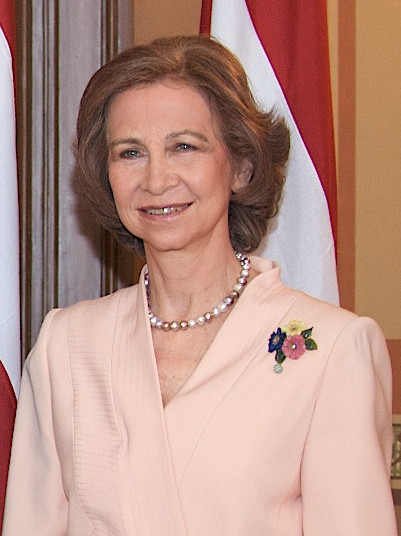
Queen Sofía of Spain
 Spain
SpainBirthday
+1938-11-02
Birth Sign
Scorpio
Birthplace
Psychiko palace
Age
87 years old
About
Queen Sofía of Spain, born Sophia Margarita Victoria Frederica on November 2, 1938, at the Psychiko Palace near Athens, is a member of the Spanish royal family and served as Queen of Spain from 1975 until her husband King Juan Carlos I's abdication in 2014. She is the eldest and last surviving child of King Paul and Queen Frederica of Greece, and also the last surviving grandchild of King Constantine I and Queen Sophia. Her early life was marked by exile and upheaval, as the Greek royal family fled the country during World War II and later lived in Egypt and South Africa before returning to Greece. Sofía married then Infante Juan Carlos of Spain in 1962, and they had three children: Elena, Cristina, and Felipe. When Juan Carlos became king in 1975, she took on the role of queen consort, supporting numerous charitable causes and cultural initiatives. She has been particularly active in the fight against drug addiction, serving as honorary president of the Spanish Red Cross and the Queen Sofía Foundation. Her work with the Reina Sofía Museum in Madrid, which houses contemporary art, reflects her dedication to the arts. After Juan Carlos abdicated in 2014, their son Felipe VI ascended the throne, and Sofía has been referred to as reina emérita, or queen emerita. She remains a respected figure in Spanish public life, often seen at official events and family gatherings. Her legacy is tied to her longevity as a royal and her charitable work, which has left a lasting impact on Spanish society.
Fame & Fandom
Queen Sofía of Spain commands a presence defined not by the chaotic energy of pop culture, but by the quiet, enduring weight of history. Her public life has never been driven by fan campaigns, viral moments, or organized groups chanting her name in subway stations. The Spanish monarchy operates as a state institution, and while social media accounts aggregate photos of her family, they function as news archives rather than clubs with inside jokes or collective rituals. There is no formal fandom name to attach to her legacy, nor any record of crowds shutting down streets for her personal appearances. The discourse surrounding her remains grounded in news reporting on royal duties, family dynamics, and health updates. Yet, her status as the last surviving child of King Paul and Queen Frederica anchors her in a unique historical niche that transcends typical celebrity metrics. She represents a living bridge between exiled Greek royalty and the modern Spanish crown, a resilience that resonates far beyond traditional entertainment circles. This distinct position places her firmly within the global consciousness of historical figures. According to the latest data from the iFANN Global Fame Rankings, she holds specific, measurable prominence in her region. She is the 98th most famous person in Spain, a standing she has maintained steadily through recent cycles. Furthermore, when measuring fame strictly by origin, she ranks as the 77th most famous person from Spain. These placements reflect a sustained level of attention across media coverage, search trends, and consumption signals worldwide, confirming her relevance without the need for manufactured hype.
Interesting Facts and Legends
Born Sophia Margarita Victoria Frederica at the Psychiko Palace near Athens in 1938, she carries the distinction of being the last surviving grandchild of King Constantine I and Queen Sophia. Her early years were marked by significant upheaval, forcing the Greek royal family into exile during World War II before they eventually returned to Greece. A notable moment in her later public life occurred during a meeting with Pope Leo XIV in Madrid, where she paid a solemn tribute to her late sister, Princess Irene. In July 2026, following his return to Marivent, she shared a rare joint public appearance with her ex-husband, King Juan Carlos I, drawing attention to their enduring familial bond despite decades of separation. While often overshadowed by the younger generation's fashion choices and interactions with Queen Letizia, her role as the matriarch of the Spanish royal family remains central to the nation's continuity. She served as Queen Consort from 1975 until King Juan Carlos I's abdication in 2014, navigating the transition from dictatorship to democracy alongside her husband.
Awards & Accolades
Keywords
Quick Facts
- Profession
- aristocrat
- Born
- +1938-11-02
- Birthplace
- Psychiko palace
- Gender
- Female
- Spouse
- Juan Carlos I of Spain
- Birth Sign
- Scorpio
Personal Details
- Spouse
- Juan Carlos I of Spain
Join the community
fans discussing