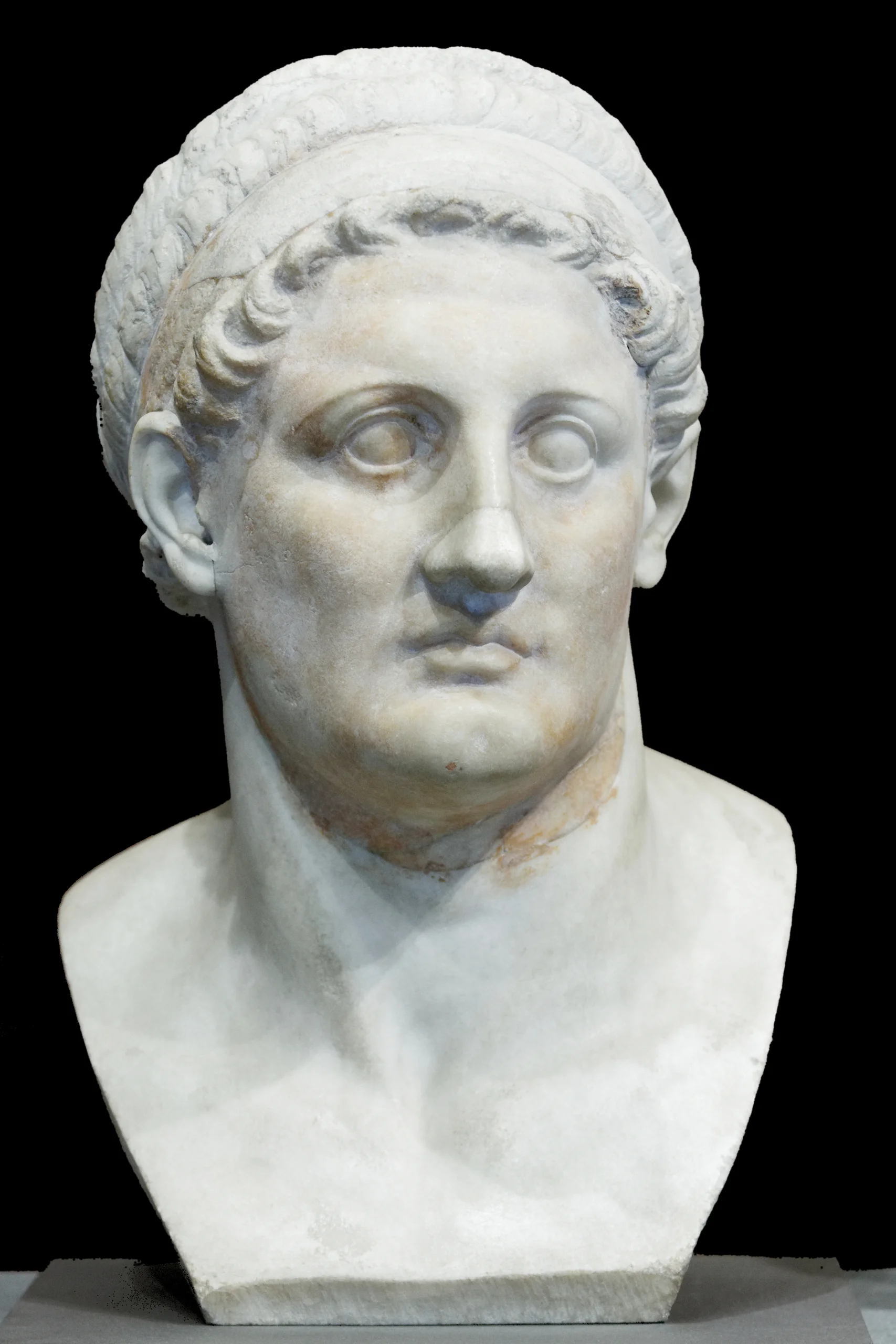
Ptolemy
 Egypt
mathematician•geographer•astronomer
Also known as: Claudius Ptolemaeus, Claudius Ptolemy
Birthday
100
Birth Sign
Capricorn
Birthplace
Ptolemais Hermiou, Egypt
Age
Died at 70
About
Claudius Ptolemy was a Greco-Roman mathematician, astronomer, geographer and astrologer who worked in Alexandria in the 2nd century AD. He is the author of the Almagest, the only mathematically rigorous geocentric model of the solar system to survive from antiquity, and of the Geography, a gazetteer and cartographic survey that gathered Greco-Roman knowledge of places and coordinates into a single reference. His astrological handbook, the Tetrabiblos, attempted to fit horoscopic astrology into Aristotelian natural philosophy. He also wrote on optics, covering illumination, colour, size, shape and binocular vision.
Ptolemy died around 170 CE, aged roughly seventy, almost certainly in Alexandria. His geocentric system dominated astronomy until Copernicus, and his writings, unlike most Greek mathematical texts, were continuously copied and studied through late antiquity and the Middle Ages. Because few readers mastered the mathematics, abridged and simplified introductions to Ptolemaic astronomy circulated widely among Arab and Byzantine scholars.
Early Life & Background
There is essentially no surviving record of Ptolemy's childhood, upbringing, education or early interests. What can be inferred is that he was trained in the Greek mathematical and astronomical tradition of Alexandria and had access to earlier work, most importantly the observations and geometric models of Hipparchus, which he built on extensively. His earliest dated astronomical observation is conventionally placed in 127 CE, and his major works were composed in the middle decades of the 2nd century. The name Claudius suggests he held Roman citizenship, and Ptolemaeus indicates Greek Egyptian origin.
Career Growth
Ptolemy's output was roughly a dozen scientific treatises. The Almagest (original title Mathēmatikē Syntaxis, Mathematical Treatise) laid out epicycles, eccentrics and the equant, and prevailed for roughly 1,400 years. The Geography compiled Greco-Roman knowledge of places and coordinates into a single reference; a 1478 Roman edition survives and has been digitized by the American Geographical Society Library. The Tetrabiblos attempted to fit horoscopic astrology into Aristotelian natural philosophy. He also wrote on optics, covering illumination, colour, size, shape, movement and binocular vision, and dividing illusions into categories, as well as harmonics and other subjects. Because few readers mastered the mathematics, abridged and simplified introductions to Ptolemaic astronomy circulated widely among Arab and Byzantine scholars.
Career Timeline
Public Image & Style
Ptolemy's public image in later centuries was that of the most accomplished and influential astronomer of the ancient world, a verdict that belongs to history rather than to any recorded reaction at the time of his death. His geocentric system dominated astronomy until Copernicus, and the Catholic Church later promoted his work. His writings, unlike most Greek mathematical texts, were continuously copied and studied through late antiquity and the Middle Ages.
Fame & Fandom (iFAMOUS Rankings)
iFANN has not yet collected fame data for Ptolemy, so no rank is available. He does not appear on the September 2026 iFAMOUS Rankings flagship list. There is no organized modern fandom and no fandom name.
Interesting Facts and Legends
The star cluster M7 in Scorpius is popularly called Ptolemy's Cluster because he catalogued it. A 2026 study explained why the star Theta Eridani appeared brighter to ancient astronomers for a thousand years. The name itself derives from Greek Ptolemaios, meaning warlike. A 2026 Greek Reporter feature, The Genius of Ptolemy: How a Lost Ancient Greek Treatise Mapped the Universe, revisits his legacy.
Family & Personal Life
Notable Connections
Relationships & Dating History
Death & Aftermath
Died
170 (aged 70)
Death Place
Alexandria, Egypt
Cause of Death
Unknown
In the last decades of his life, Claudius Ptolemy was working in Alexandria, the Greek city in Roman Egypt where he had spent most of his career. The final entry in his astronomical record is an observation he made there, and from such terminal data scholars have fixed his death at around 170 CE, when he was roughly seventy. No day, no month, and no firm year survive. The conventional estimate, born c. 100 CE and died c. 170 CE, appears in standard references; a divergent scholarly estimate places his death about five years earlier, at c. 165, a reminder of how little the record preserves. Alexandria is implied as the place of death only by his long residence and work there.
Nothing is recorded of the circumstances of his final days, his last public appearance, or the cause of his death. His posthumous reputation was the work of later centuries: the geocentric system he set out in the Almagest prevailed for some 1,400 years, and he came to be regarded as the most accomplished and influential astronomer of the ancient world. That verdict belongs to history, not to any recorded reaction at the time of his death.
What endured was the work itself. The Almagest, the Geography, and his treatise on optics were copied, translated, and studied for well over a millennium. A 1478 Roman edition of the Geography survives and has been digitized by the American Geographical Society Library, a late monument to a man whose death went unmarked in its own age.
Net Worth (Estate Value)
Awards & Accolades
Known For
Almagest
c. 150 CE · Author
Geography
c. 150 CE · Author
Tetrabiblos
c. 150 CE · Author
Keywords
Sources
Quick Facts
- Profession
- mathematician, geographer, astronomer
- Born
- c. 100 CE
- Birthplace
- Ptolemais Hermiou
- Died
- c. 170 CE
- Death Place
- Alexandria
- Gender
- Male
Personal Details
- Full Name
- Claudius Ptolemaeus
Frequently Asked Questions
What was Ptolemy best known for?
How do you pronounce the name Ptolemy?
Was Cleopatra a Ptolemy?
When was Ptolemy born and when did he die?
What did Cleopatra do to Ptolemy?
Join the community
fans discussing