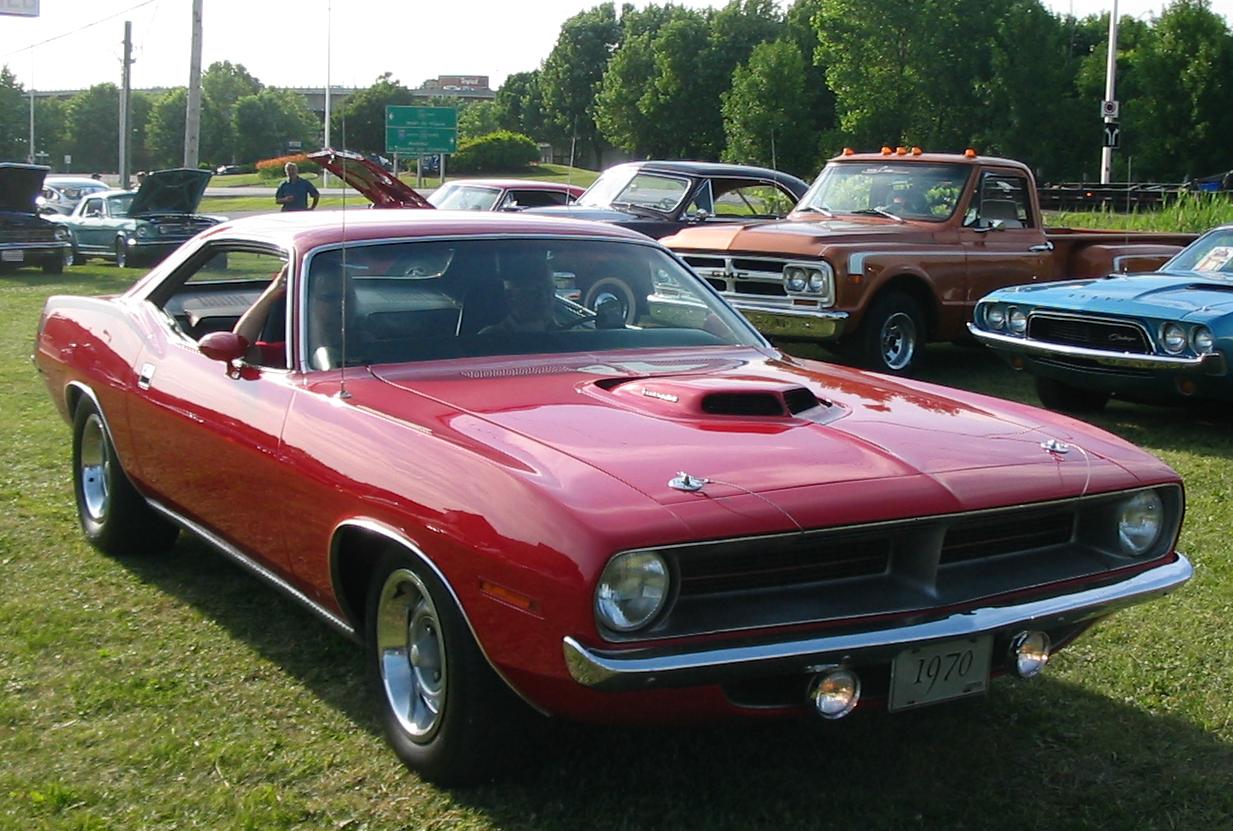
Overview
Plymouth launched the Barracuda on April 1, 1964, about two weeks before the Ford Mustang reached showrooms. That timing gives the car a permanent footnote in muscle car history, but the Barracuda was never just a footnote. It started life as a fastback version of the Valiant compact, sharing most of its bodywork and mechanicals. The difference was that huge wraparound rear window, a piece of glass so distinctive it made the car look like it was moving even when parked.
Three generations followed, each with its own character. The second generation, from 1967 to 1969, kept the Valiant platform but added notchback and convertible body styles alongside the fastback, and introduced the Formula S performance package. Then came the big change: the 1970 model moved to Chrysler's E-body platform, shared with the Dodge Challenger. That third generation, sold through 1974, is the one most people picture when they hear Barracuda. It had a wider stance, a lower roofline, and room for Chrysler's biggest engines, including the 426 Hemi and the 440 Six Pack.
The car's reputation rests on more than looks. The Barracuda was a legitimate performance machine in the right trim, and it competed directly against the Mustang, Camaro, and Firebird in the pony car segment. Sales were modest compared to Ford and GM, but the Barracuda built a devoted following that has only grown as survivors become rarer. Today, well-kept examples, especially Hemi and convertible models, command serious money at auction.
Key Features
- Wraparound rear glass on first-generation fastback
- Formula S performance package (1967–69)
- 'Cuda performance sub-model (1970–74)
- Gran Coupe luxury trim (1969–71)
- Available 426 Hemi and 440 Six Pack big-block V8s (1970–74)
- E-body wide stance and lower roofline (1970–74)
- Convertible and notchback body styles added for 1967
Specifications
| Production years | 1964–1974 |
| Body styles | 2-door fastback, 2-door notchback hardtop, 2-door convertible |
| Platforms | A-body (1964–69), E-body (1970–74) |
| Engines | Slant-6 six-cylinder; small-block V8s (273, 318, 340, 360); big-block V8s (383, 440, 440 Six Pack, 426 Hemi) |
| Transmissions | 3-speed manual, 4-speed manual, 3-speed automatic |
| Drive | Rear-wheel drive |
| Wheelbase | 106 in (1964–66); 108 in (1967–69); 108 in (1970–74) |
| Length | 188.2 in (1970–74) |
Pros & Cons
Pros
- • First pony car to market, beating the Mustang by two weeks
- • Huge wraparound rear glass gives unmistakable styling
- • Available with Chrysler's biggest engines, including the 426 Hemi
- • Strong collector demand and active aftermarket support
- • Distinctive alternative to the Mustang and Camaro
Cons
- • Always outsold by the Mustang and Camaro
- • Early Valiant-based cars share humble compact roots
- • Rust-prone unit-body construction
- • Hemi and convertible models are expensive to buy and maintain
- • No modern revival or factory parts support
Frequently Asked Questions
Is Plymouth coming out with a 2027 Barracuda?
How much is a 1970 Barracuda worth today?
Is there really a 2026 Plymouth Barracuda?
What was the Dodge version of the Plymouth Barracuda?
What engine did the Plymouth Barracuda have?
Keywords
Sources
Product Info
- Brand
- Plymouth
- Manufacturer
- Plymouth (Chrysler Corporation)
- Category
- pony car
- Released
- 1964-04-01
- Price
- Original base price around $2,500 (1964); today $30,000–$60,000 for driver-quality small-block coupes, six figures for Hemi and convertible models
- Availability
- Discontinued
- Model years
- 1964–1974
- Assembly
- Hamtramck, Michigan; Los Angeles, California; and others
- Designer
- Chrysler design staff
- Platform
- A-body (1964–69), E-body (1970–74)
- Predecessor
- None (new model)
- Successor
- None (discontinued)
Where to Buy
Join the community
fans discussing