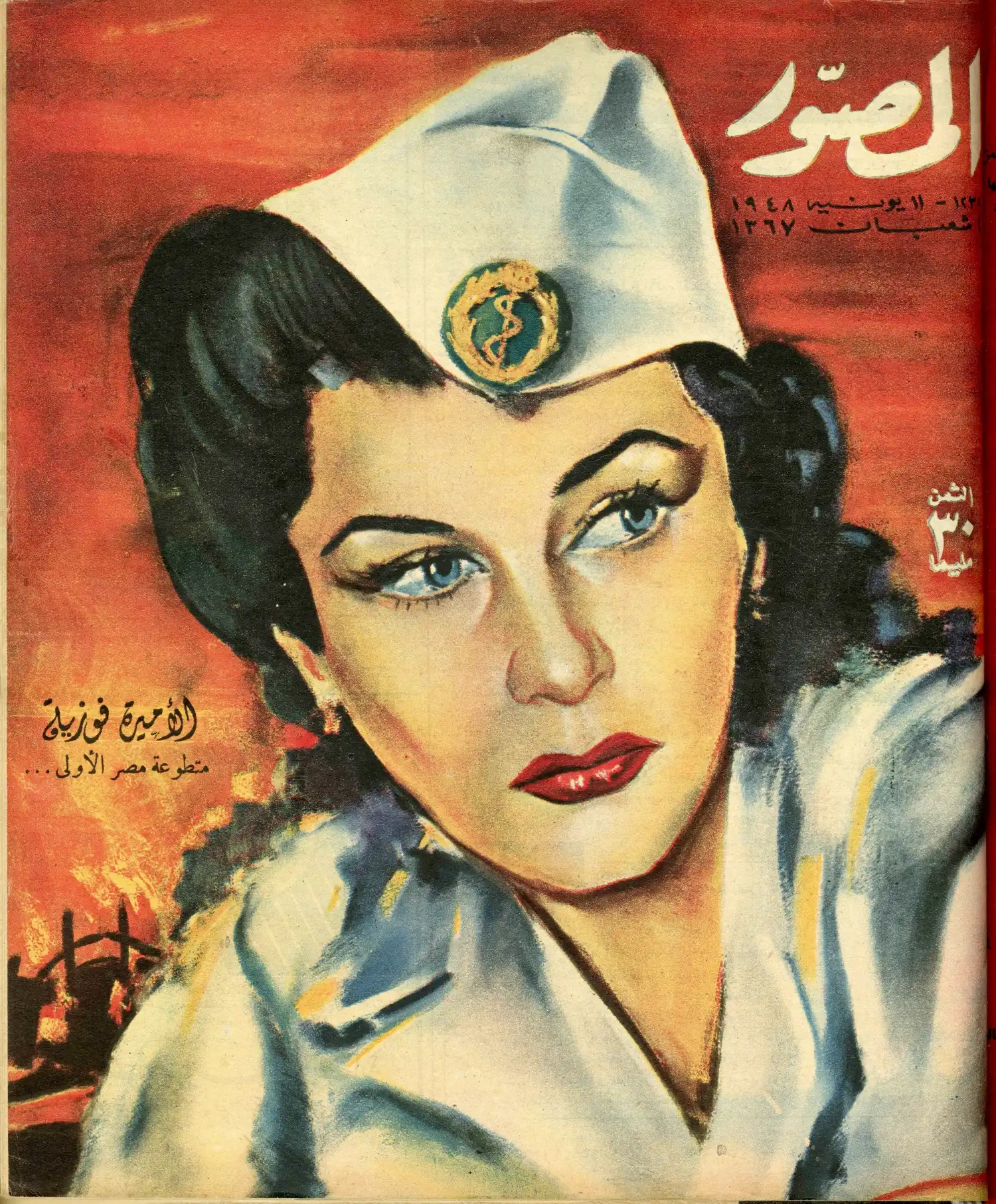
Princess Fawzia Fuad of Egypt
 Egypt
Also known as: Princess Fawzia of Egypt, Empress Fawzia of Iran, Shahbanu Fawzia, Princess Fawzia Chirine
Birthday
November 5, 1921
Birth Sign
Scorpio
Birthplace
Ras el-Tin Palace, Alexandria, Egypt
Age
Died at 91
About
Princess Fawzia Fuad of Egypt was an Egyptian royal who became the first wife of Mohammad Reza Pahlavi and, from 1941 to 1948, the Shahbanu of Iran. A daughter of King Fuad I and Queen Nazli Sabri, she belonged to the Muhammad Ali dynasty that had governed Egypt since the early nineteenth century.
She is remembered today for two things that rarely sit together: a face that made her one of the most photographed women of the 1930s and 1940s, and a withdrawal from public life so complete that the press nicknamed her the sad queen. Her annulled marriage to the Shah was a diplomatic event as much as a private failure, and it left a mark on Egyptian-Iranian relations for years.
Fawzia died in Alexandria on July 2, 2013, at 91. Her photographs circulate widely on fashion and royal-history accounts, and her wardrobe has been the subject of museum attention in Cairo and retrospective coverage in Tatler and Cairo Scene. She holds no placement in the current iFANN Global Fame Rankings, though interest in her life has proven durable across several generations of readers.
Early Life & Background
Fawzia Fuad was born on November 5, 1921, at Ras el-Tin Palace in Alexandria, the eldest daughter of King Fuad I and his second wife, Queen Nazli Sabri. Her arrival came at an awkward moment for the Egyptian monarchy: her father was consolidating power after the British declaration of Egyptian independence in 1922, and every royal birth was read in the Cairo press as a statement about the dynasty's durability. She was raised among the Muhammad Ali family's sprawling households, with French and English spoken at table alongside Arabic.
Her education followed the pattern set for Egyptian princesses of the period. She attended the Convent of the Sacred Heart in Cairo, run by French nuns, and later spent time in Switzerland, where her languages sharpened and her taste for European couture took shape. Contemporaries described a reserved, watchful child who preferred drawing and dressmaking to the ceremonial duties that came with her rank. Her mother, Queen Nazli, was a forceful presence in the palace and pushed her daughters toward the European social calendar, a decision that would later shape Fawzia's public image.
By her late teens she had become a fixture in illustrated magazines. Photographs from 1938 and 1939 show her at Cairo society events, and her looks drew comparisons to film stars of the day. That visibility mattered politically. When talks began in 1938 over a marriage alliance with Iran, the Egyptian court had a photogenic princess to offer, and the Iranian side had a crown prince in need of a consort from a respected Muslim royal house.
The engagement to Crown Prince Mohammad Reza Pahlavi was arranged through diplomatic channels in 1938 and announced in 1939. Fawzia was 17. The wedding, held in Cairo in March 1939, was staged as a spectacle: streets were decorated, the ceremony was broadcast regionally, and the couple's departure for Tehran was covered by wire services across Europe. It was the moment her private life ended and her public one began.
Career Growth
Fawzia's working life was the life of a consort, and it ran from 1939 to 1948. She arrived in Tehran as Crown Princess and was received with the ceremonial weight due a future queen. The Iranian court, however, was a different world from Cairo: stricter in its protocols, more suspicious of outsiders, and dominated by a Shah who was nineteen and preoccupied with the army and the British and Soviet presence in his country.
In September 1941, British and Soviet forces invaded Iran, forced Reza Shah to abdicate, and placed Mohammad Reza on the throne. Fawzia became Shahbanu at 19. The coronation period brought a burst of international press attention, with Western magazines treating the young empress as a symbol of a modernizing Iran. Her public appearances were carefully managed, her clothes and jewels photographed and described in detail. Behind the ceremonial surface, the marriage was failing. The couple had no children, the Shah was frequently absent, and Fawzia's health suffered; by 1945 she was spending long stretches in Egypt, ostensibly for medical treatment.
Negotiations over a divorce ran from 1945 to 1948 and became a diplomatic problem. Egypt's King Farouk, Fawzia's brother, insisted that the marriage be annulled rather than dissolved, a distinction that allowed both courts to save face. The annulment was finalized in November 1948. Fawzia returned to Egypt and, in 1949, married Colonel Ismail Chirine, an Egyptian army officer and diplomat who had served in her brother's household. She took the title Princess Fawzia Chirine and stepped back from public duties.
The 1952 revolution ended the Egyptian monarchy, and Fawzia's family went into exile. She and Chirine lived in Europe, chiefly in France and later Switzerland, where she obtained citizenship. She raised two children, Shirin and Kaveh, and made no attempt to reclaim a public role. Her formal career as a royal figure effectively closed in 1952; the remaining six decades were private.
Career Timeline
Public Image & Style
In photographs, Fawzia reads as a studio-era star rather than a constitutional figure: dark hair set close to the head, arched brows, and a habit of looking slightly past the camera. The press of the 1940s leaned on that image, and the phrase movie-star looks followed her from Cairo to Tehran and back.
Her style was a deliberate blend. She wore European couture for state occasions and traditional Egyptian dress for family and religious events, and the combination was read at the time as a diplomatic statement about the two courts she belonged to. Fashion historians now treat her wardrobe as a case study in how mid-century royal women used clothing as soft power, and her veiling and jewelry choices are discussed in the same breath as her politics.
The later image is the opposite: reclusive, unphotographed, described in obituaries as withdrawn. The gap between the 1941 Shahbanu portraits and the 1990s sightings is the central fact of her public persona, and it is the reason her story keeps being retold.
Fame & Fandom (iFAMOUS Rankings)
Fawzia Fuad occupies an unusual position in the fame landscape: widely recognized in image, thinly documented in life. Her photographs circulate constantly on royal-history and vintage-fashion accounts, yet she gave almost no interviews and left no memoir, so the audience for her work has to reconstruct her from archives. iFANN's Global Fame Engine has evaluated her, but she does not currently hold a placement in the published rankings, neither in the Global Top 1,000 nor in a Top-100 scope list. That is a fair reflection of her status: a figure of durable curiosity rather than mass attention.
The fanbase has no formal name. It is a loose network of genealogy hobbyists, Middle Eastern history readers, and fashion archivists who post her portraits, compare her wardrobe to that of contemporaries like Queen Fawzia's sister-in-law, and track auction appearances of the jewelry she once wore. The 2019 Finding Fawzia exhibition at the American University in Cairo gave that network a physical anchor, and the 2026 reissue of her Van Cleef & Arpels emerald design gave it a fresh talking point. There are no streaming campaigns or birthday billboards here. The engagement is quieter and slower: a photograph reposted, a caption corrected, a date verified.
Interesting Facts and Legends
She was known in the Egyptian and Iranian press as the sad queen, a name that stuck because she rarely left her room in the years after the annulment. Royal historians have debated how much of that withdrawal was temperament and how much was the clinical depression that contemporaries described.
Her jewelry is a subject in its own right. She wore a Van Cleef & Arpels emerald necklace as Shahbanu, and in 2026 the house reimagined the piece, an unusual case of a private client's jewel re-entering the market as a design reference.
She was one of the few Egyptian royals of her generation to take Swiss citizenship after the revolution, a practical move that signaled how completely she had detached from the politics of her birth family.
A story fans still retell concerns the 1939 wedding itself: Cairo crowds reportedly lined the route for hours, and the ceremony was treated as the social event of the decade in the Middle East. The marriage it celebrated lasted nine years.
Family & Personal Life
Fawzia was the eldest daughter of King Fuad I and Queen Nazli Sabri. Her siblings included King Farouk I, who reigned from 1936 until the 1952 revolution, and Princesses Faiza, Faika and Fathia. The household was large, formal and politically watchful, with the queen mother taking an active hand in her daughters' marriages.
Her second marriage, to Colonel Ismail Chirine in 1949, produced two children: Princess Shirin Chirine, born in 1950, and Prince Kaveh Chirine, born in 1952. The family left Egypt after the revolution and settled in Europe, eventually in Switzerland, where Fawzia lived out her widowhood. Chirine died in 1994. She kept a small household in Alexandria in her final years, close to her daughter and grandchildren, and avoided the royal-social circuit that her cousins maintained abroad.
Notable Connections
Her story is inseparable from Mohammad Reza Pahlavi, the Shah of Iran she married in 1939 and divorced in 1948, and from her brother King Farouk I, whose reign ended in the 1952 revolution that sent the family into exile. Her second husband, Colonel Ismail Chirine, and her children Shirin and Kaveh shaped her private life in Switzerland and Alexandria.
Relationships & Dating History
Fawzia's marriage to Mohammad Reza Pahlavi began as a state project. The two were introduced through formal royal channels in 1938 and engaged the following year, when she was 17 and he was 19. The Cairo wedding in March 1939 was treated as a regional spectacle, and she moved to Tehran as Crown Princess. When her husband took the throne in September 1941, she became Shahbanu.
The marriage did not hold. The couple had no children, the Shah was often away on military and political business, and Fawzia found the Iranian court isolating. By 1945 she was spending extended periods in Egypt, and divorce negotiations began the same year. The sticking point was form: King Farouk insisted on annulment rather than divorce, so that neither the Egyptian nor the Iranian court would be recorded as having dissolved a royal marriage. The annulment was completed in November 1948, and Fawzia returned to Egypt.
In 1949 she married Colonel Ismail Chirine, an Egyptian army officer and diplomat who had served in her brother's household. The marriage was stable and produced two children, Shirin in 1950 and Kaveh in 1952. The couple left Egypt after the 1952 revolution and settled in Europe, later in Switzerland. Chirine died in 1994, and Fawzia remained a widow for the rest of her life.
She was married to Ismail Chirine at the time of her death in 2013. No other relationships have been documented, and she gave no public account of her marriages.
- MarriedMohammad Reza Pahlavi1939 - 1948Politically arranged marriage to the Crown Prince, later Shah, of Iran; the union produced no children and was annulled in November 1948 after years of separation.
- MarriedIsmail Chirine1949 - 1994Egyptian army officer and diplomat; the couple had two children, Shirin and Kaveh, and lived in exile in Europe after the 1952 revolution. Chirine died in 1994.
Death & Aftermath
Died
July 2, 2013 (aged 91)
Death Place
Alexandria, Egypt
Cause of Death
Natural causes
Fawzia Fuad died at her home in Alexandria on July 2, 2013, at the age of 91. She had spent the final decades of her life in seclusion, and her death, reported as the natural consequence of old age, prompted no autopsy and no official inquiry. The Egyptian royal family confirmed the passing within a day, and coverage in the Arabic and English press noted that she was the last surviving consort of the Pahlavi court's founding generation.
Tributes came chiefly from diplomatic and genealogical circles rather than the street. Egypt's former royal house issued a statement mourning a member of the Muhammad Ali dynasty, and Iranian monarchist groups abroad, still attached to the memory of the Pahlavi era, marked her death as the loss of a link to the 1941 accession. The funeral, held privately in Alexandria, drew close relatives and a small number of dignitaries. There was no public lying-in-state and no mass gathering, which suited a woman who had avoided the spotlight since the 1950s.
Posthumous attention arrived slowly and then steadily. A 2019 exhibition at the American University in Cairo, titled Finding Fawzia, assembled photographs, garments and press clippings to examine how she had been portrayed in Western and Egyptian media. Fashion writers returned to her wardrobe, particularly the Van Cleef & Arpels pieces she wore as Shahbanu, and in 2026 a reimagined version of her emerald necklace was unveiled by the same house. Her estate, never large after the 1952 revolution stripped the family of its holdings, passed quietly to her children. No foundation or memorial trust was established in her name; her remembrance has been carried instead by archives, exhibitions and the recurring anniversary posts of royal-history accounts.
Net Worth (Estate Value)
$2 Million
iFANN Editorial Team estimate
No reliable public accounting of Fawzia Fuad's estate exists. She was a member of a dynasty whose assets were nationalized after the 1952 revolution, and she spent her later life in Switzerland on family money and modest holdings rather than income from any commercial activity. She never endorsed products, held directorships, or licensed her image, and no publisher or brand paid her for the use of her name during her lifetime.
What she did possess was jewelry, some of it significant. The Van Cleef & Arpels pieces she wore as Shahbanu, including an emerald necklace that the house reimagined in 2026, are the most documented objects connected to her. Whether those pieces remained in her possession at her death is not a matter of public record; royal jewelry of this period was often returned to the court, sold, or divided among heirs without documentation.
Real estate is similarly opaque. She lived quietly in Switzerland and later in Alexandria, and no property transactions involving her name have been reported. Her children inherited whatever remained, and no estate dispute has been made public.
Given the absence of documented income streams, the iFANN Editorial Team's assessment of her estate places its current value at approximately $2 Million, a figure that reflects the likely worth of residual jewelry, personal effects and family property rather than any active financial enterprise. It is an estimate of historical estate value, not a reflection of earnings, because there were no earnings in the commercial sense. For comparison, the personal fortunes of her contemporaries in the Egyptian royal family were largely destroyed by the 1952 land reforms, and Fawzia's own financial trajectory followed that pattern: comfortable before the revolution, unremarkable afterward.
Awards Won (1)
Fawzia received no competitive awards, as she was a royal consort rather than a performer. Her distinctions were honorific: the titles of Princess of Egypt, Crown Princess of Iran and Shahbanu of Iran, along with Egyptian royal orders including the Grand Cordon of the Order of the Nile.
National honour
Egyptian royal honours
Known For
Shahbanu of Iran (1941-1948)
1941 · Empress consort
Marriage to Mohammad Reza Pahlavi
1939 · Crown Princess of Iran
Finding Fawzia exhibition, American University in Cairo
2019 · Subject
Keywords
Sources
Quick Facts
Personal Details
- Full Name
- Fawzia Fuad
- Spouse
- Mohammad Reza Pahlavi (1941-1948), Ismail Chirine (1949-1994)
- Children
- Princess Shirin Chirine, Prince Kaveh Chirine
- Education
- Convent of the Sacred Heart, Cairo; schooling in Switzerland
Frequently Asked Questions
Who was Princess Fawzia Fuad of Egypt?
Why did Princess Fawzia divorce the Shah of Iran?
Did Princess Fawzia have any children?
How did Princess Fawzia of Egypt die?
What is Princess Fawzia remembered for today?
Similar People
Join the community
fans discussing