 Japan
Japan“Mr. Miyazaki's genius is to make the everyday world strange and the fantastic world familiar, and 'Ponyo' is full of moments that feel both miraculous and perfectly natural.”
A.O. Scott
The New York Times
Hayao Miyazaki's Ponyo is a 2008 animated fantasy from Studio Ghibli that reimagines Hans Christian Andersen's The Little Mermaid with a gentler, more whimsical touch. The story follows Sosuke, a five-year-old boy living in a house on a cliff, who rescues a goldfish named Ponyo. She is no ordinary fish: Ponyo is the daughter of Fujimoto, a reclusive wizard, and Gran Mamare, a goddess of the sea. When Ponyo escapes her father's underwater realm and befriends Sosuke, she uses her father's magic to transform into a human girl, setting off a chain of events that threatens the balance of nature. The film features voice work by Yuria Kozuki as Ponyo and Hiroki Doi as Sosuke, with Tomoko Yamaguchi as Sosuke's caring mother Risa and George Tokoro as the overprotective Fujimoto. Joe Hisaishi composed the score. Produced on a budget of $34 million, Ponyo earned over $202 million worldwide, making it one of Ghibli's highest-grossing films. Rated G, it blends Miyazaki's signature hand-drawn animation with themes of childhood innocence, environmental harmony, and unconditional love. Critics praised its visual beauty and emotional warmth, earning a 7.8/10 on IMDb.
Availability and pricing can change. Confirm on the provider's site before purchasing.
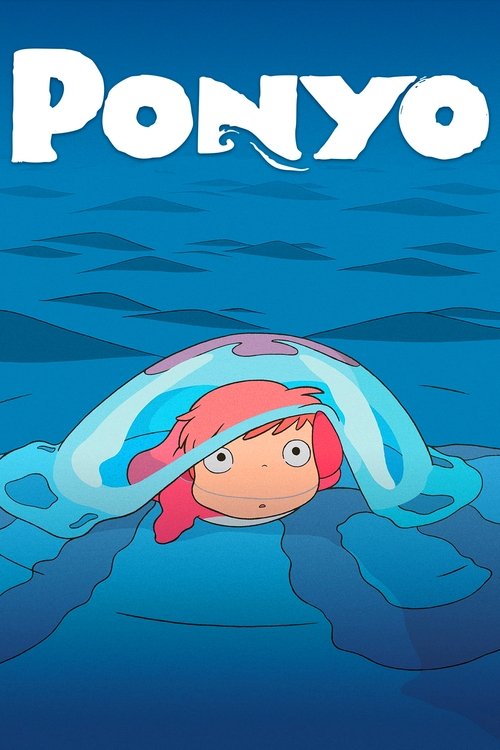
Deep beneath the sea, a curious goldfish named Brunhilde escapes her father Fujimoto's underwater kingdom. Fujimoto is a reclusive wizard who once lived among humans but now despises them for polluting the ocean. Brunhilde floats to the surface inside a jellyfish and becomes trapped in a glass jar. She is rescued by Sosuke, a kind five-year-old boy who lives with his mother Risa in a house perched on a cliff overlooking the sea. Sosuke names the goldfish Ponyo and promises to care for her.
Ponyo is no ordinary fish: she is the daughter of Fujimoto and Gran Mamare, a powerful goddess of the sea. When Fujimoto sends waves to retrieve Ponyo, she resists, having grown fond of Sosuke. In a defiant act, Ponyo uses her father's stolen magic to transform into a human girl. The transformation is incomplete and chaotic, causing a magical imbalance that triggers a massive storm and tsunami. The sea swells, flooding Sosuke's coastal town, and Ponyo, now in human form, rides the waves to find him.
Sosuke and his mother Risa navigate the flooded town in their small car, rescuing elderly neighbors from the rising waters. Sosuke's father Koichi, a sailor, is away at sea, and his communication with Risa is strained but loving. When Ponyo finally reunites with Sosuke, she is in a hybrid state, part fish, part human, and her magic is unstable. The central conflict emerges: Ponyo's transformation has upset the natural order, and unless she can truly become human, the world will remain in peril. Fujimoto pursues them, desperate to reverse the damage, while Gran Mamare observes from the deep, holding the key to the resolution.
The story unfolds as a whimsical, tender adventure where Sosuke and Ponyo explore the flooded world together. Ponyo's sisters, thousands of smaller goldfish, swarm the area, and the sea itself seems alive. Sosuke's house becomes an ark, surrounded by ancient fish and prehistoric sea creatures. The film balances moments of childlike wonder, Ponyo jumping on waves, eating ramen for the first time, sleeping in a towel, with underlying tension about whether Ponyo can stay human without destroying everything. The plot builds toward a test of love and commitment, where Ponyo must give up her magic permanently and Sosuke must prove his unconditional devotion.
Official English Trailer
15th Anniversary Trailer
10th Anniversary Trailer - Studio Ghibli Fest 2018 Trailer
Critical Consensus
Ponyo is a visually stunning and emotionally resonant fairy tale that captures the wonder of childhood with Hayao Miyazaki's signature warmth. While simpler than his previous works, its hand-drawn beauty and gentle storytelling enchant both children and adults.
“Mr. Miyazaki's genius is to make the everyday world strange and the fantastic world familiar, and 'Ponyo' is full of moments that feel both miraculous and perfectly natural.”
A.O. Scott
The New York Times
“Hayao Miyazaki's 'Ponyo' is a movie that feels like a dream you want to have again. It is so gentle and loving that it seems to exist in a state of grace.”
Roger Ebert
RogerEbert.com
“A ravishing, hand-drawn delight that reaffirms Miyazaki's status as the world's greatest living animator, even if it lacks the narrative complexity of his masterpieces.”
Justin Chang
Variety
“It's a gorgeous, funny, and sometimes genuinely moving story about love, family, and the environment, told with a childlike simplicity that never feels dumbed down.”
Peter Bradshaw
The Guardian
“A visually ravishing work that, although aimed at a younger audience than 'Spirited Away' or 'Princess Mononoke,' contains the same depth of feeling and attention to detail.”
Todd McCarthy
The Hollywood Reporter
Yuria Kozuki
Ponyo (voice)
Hiroki Doi
Sosuke (voice)
George Tokoro
Fujimoto (voice)
Tomoko Yamaguchi
Risa (voice)
Yuki Amami
Gran Mamare (voice)
Kazushige Nagashima
Koichi (voice)
Akiko Yano
Ponyo's Sister (voice)
Shin'ichi Hatori
Anchorman (voice)
Tokie Hidari
Kayo (voice)
Rumi Hiiragi
Young Mother (voice)
Tomoko Naraoka
Yoshie (voice)
Kazuko Yoshiyuki
Toki (voice)
Director
Hayao Miyazaki
Writer
Hayao Miyazaki
Composer
Joe Hisaishi
Cinematographer
Atsushi Okui
Producer
Toshio Suzuki
Venice Film Festival (2008)
Golden Lion: Nominated
Venice Film Festival (2008)
Future Film Festival Digital Award: Won
Mainichi Film Awards (2008)
Best Animation Film: Won
Japan Academy Prize (2009)
Best Animation of the Year: Won
Tokyo Anime Award (2009)
Best Film of the Year: Won
Annie Awards (2009)
Best Animated Feature: Nominated
Annie Awards (2009)
Best Directing in an Animated Feature: Nominated
Annie Awards (2009)
Best Music in an Animated Feature: Nominated
Annie Awards (2009)
Best Voice Acting in an Animated Feature: Nominated
Golden Globe Awards (2009)
Best Animated Feature Film: Nominated
Saturn Awards (2009)
Best Animated Film: Nominated
BAFTA Children's Awards (2009)
Best Feature Film: Nominated
Grammy Awards (2010)
Best Score Soundtrack Album: Nominated
Join the community
fans discussing