 South Korea
“Given the abundant potential for missteps into sappiness with this sort of premise, what's notable here is the lack of sentimentality in Lee's approach.”
Justin Chang
Variety
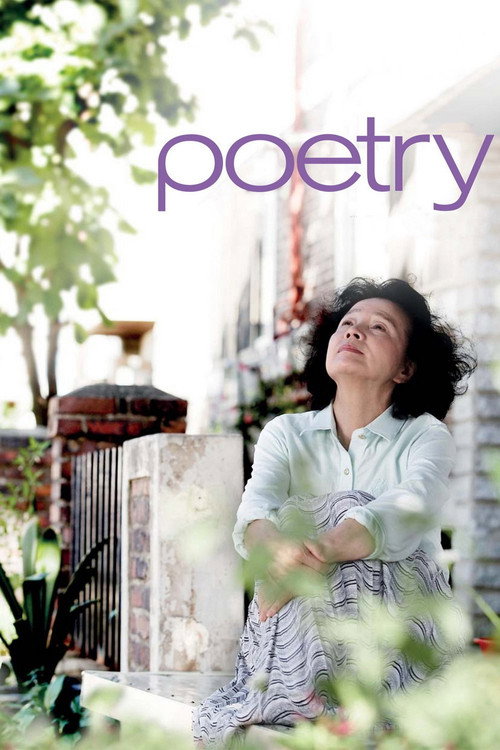
Lee Chang-dong's Poetry is a film that moves with the unhurried, deliberate pace of someone learning to see the world for the first time. Yang Mi-ja, a 66-year-old grandmother living in a small city along the Han River, enrolls in a poetry class at her local cultural center. The teacher tells her students that poetry requires fresh eyes, a willingness to notice the details that ordinary life obscures. Mi-ja takes this instruction literally, carrying a notebook everywhere and recording the way light falls on fruit, the shape of clouds, the sound of wind. But her search for beauty collides with something terrible: her teenage grandson Jong-wook and five of his friends have raped a 16-year-old girl, who later killed herself. The fathers of the boys have arranged a settlement to buy off the girl's mother, and they pressure Mi-ja to contribute her share. As her memory begins to fail her, Mi-ja must decide whether to protect her grandson or seek justice for a dead girl whose voice has been silenced.
Released in 2010, Poetry was the first film Yoon Jeong-hee made after a 16-year retirement. It would be her last. The film premiered at Cannes, where it won Best Screenplay, and earned $349,899 at the box office on a budget of about $1.1 million. Lee Chang-dong directs from his own script, with cinematography by Kim Hyun-seok, and the production was a co-venture between South Korean and French companies. The film holds a 7.6 rating on IMDb and a perfect 100% on Rotten Tomatoes, a testament to its quiet, devastating power.
Stream
Criterion Channel
Availability and pricing can change. Confirm on the provider's site before purchasing.
A young girl's body floats down the Han River, her school uniform billowing in the current. This is Agnes, a 16-year-old who has jumped from a bridge. The film does not dwell on this image, but it lingers like a stain. Yang Mi-ja lives nearby with her grandson Jong-wook, a sullen teenager who treats her with casual cruelty. She works as a caretaker for Elder Kang, a half-paralyzed man who requires constant assistance after a stroke. The job supplements her modest government income. At home, she cooks, cleans, and manages Jong-wook's demands, receiving little gratitude in return.
During a routine hospital visit, a doctor notices Mi-ja's struggle to recall simple words. She loses track of conversations, forgets names, and experiences moments of disorientation. The doctor refers her to a specialist, suggesting early signs of dementia. As she leaves the hospital, she passes the grieving father of the drowned girl, a moment that plants a seed of unease she cannot yet name.
Seeking purpose in her increasingly confusing world, Mi-ja joins a poetry class at the neighborhood cultural center. The teacher, a poet himself, challenges the students to write a single poem by the end of the course. To write poetry, he insists, they must learn to see the world clearly. Mi-ja embraces this challenge with childlike enthusiasm. She buys a notebook and begins to observe her surroundings with fresh attention: the way light falls on flowers, the sound of wind through trees, the texture of fruit at the market. She attends poetry readings and listens to the work of established poets, trying to absorb the language of beauty.
The central conflict of the film emerges when Mi-ja is summoned to a meeting with the fathers of Jong-wook's five closest friends. They reveal a horrifying truth: over several months, the six boys systematically raped Agnes, the girl who killed herself. The fathers, with the school's endorsement, have already arranged a financial settlement to buy off the girl's mother, hoping to avoid legal consequences. They pressure Mi-ja to contribute her share of the money, about 5 million won (approximately $4,500), to make the problem disappear.
Mi-ja is shattered by this revelation. The gentle, beautiful world she has been trying to capture in poetry collides violently with the ugly reality of her grandson's actions. She must now confront an impossible moral dilemma: protect her grandson and participate in a cover-up, or seek justice for a dead girl whose voice has been silenced. As Mi-ja's memory continues to deteriorate, she struggles to hold onto clarity, to find the right words, and to decide what kind of person she wants to be. The film traces her quiet, devastating journey as she attempts to reconcile her search for poetic inspiration with the darkness closing in around her.
Trailer [Subtitled]
Official UK Trailer
Critical Consensus
Poetry is an absorbing, poignant drama because it offers no easy answers to its complex central conflict. Lee Chang-dong's restrained direction and Yoon Jeong-hee's luminous performance create a film that lingers long after the credits roll.
“Given the abundant potential for missteps into sappiness with this sort of premise, what's notable here is the lack of sentimentality in Lee's approach.”
Justin Chang
Variety
“By the end, Mija has indeed found her voice, but the rest of her life is a shambles and Chang-dong ends his film on a singularly devastating series of shots.”
Chris Cabin
FilmCritic.com
“The male sense of entitlement seemingly running through every layer of Korean society.”
Trevor Johnston
Sight and Sound
Yoon Jeong-hee
Yang Mi-ja
David Lee
Jong-wook
Kim Hee-ra
Elder Kang
Director
Lee Chang-dong
Writer
Lee Chang-dong
Cinematographer
Kim Hyun-seok
Producer
Lee Joon-dong
Cannes Film Festival (2010)
Best Screenplay: Won
Cannes Film Festival (2010)
Palme d'Or: Nominated
Join the community
fans discussing