“Jackson and Shakur have a magnetic chemistry that makes the film's emotional core believable, even when the script stumbles.”
Roger Ebert
Chicago Sun-Times
 United States
"'Cause nobody, but nobody can make it out here alone."
Part of a Collection
John Singleton's Hood Trilogy
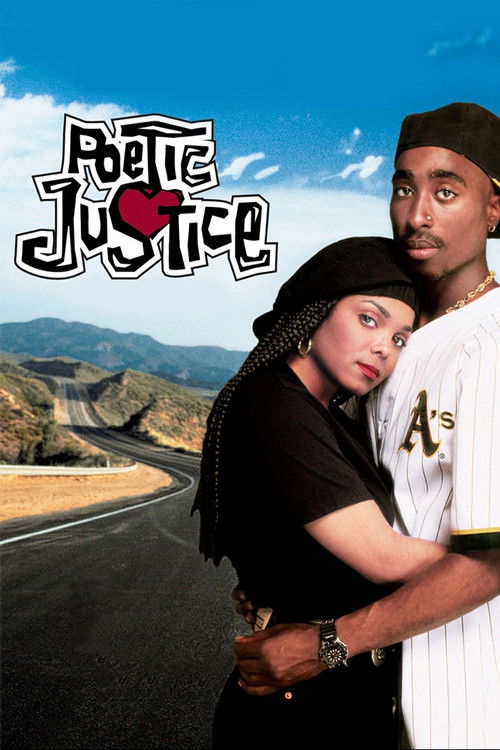
Justice is a hairdresser in South Central Los Angeles who has built a wall of silence around her heart after losing her boyfriend to a drive-by shooting. Her grief runs deep, compounded by the earlier suicide of her mother, leaving her with little hope for the future. She pours her pain into writing poetry, using words as a shield against the noise of the world and the quiet of her loss.
When her car breaks down just days before a planned trip to Oakland for a writers' convention, her path forward vanishes. Stranded on the side of the road, she encounters Lucky, a delivery driver with his own history of trouble and regret. What begins as a transactional arrangement quickly evolves into a journey across California that forces both characters to confront their pasts and imagine new possibilities.
Availability and pricing can change. Confirm on the provider's site before purchasing.
The story opens in the gritty streets of South Central Los Angeles during the late 1980s. Justice works at a local salon where she tends to clients while nursing a fresh wound from the murder of her boyfriend, Bumpy. The violence of the city feels personal and inescapable, especially since he was killed right outside her workplace. She spends her evenings pouring her emotions onto paper, crafting poems that serve as both a diary and a lifeline. Her only escape is a dream of attending a literary convention in Oakland, hoping that connecting with other writers might help her process the trauma that keeps her awake at night.
Just as she packs her bags for the trip, her vehicle gives out, leaving her stranded miles from home. A young man named Lucky pulls over in his beat-up truck. He is a delivery driver for a record store and carries the weight of his own family's history, including the death of his brother Chicago. Initially suspicious of each other, they strike a deal: Lucky will drive Justice to Oakland if she lets him tag along to visit his sister. The arrangement seems temporary, yet the road ahead promises to change everything.
As they leave Los Angeles behind, the landscape shifts from urban density to open highways. The film unfolds as a series of conversations set against the backdrop of changing scenery. They stop at diners, rest stops, and small towns, sharing stories about love, faith, and the struggle to survive in a system that often overlooks them. Justice slowly lowers her guard, admitting how much she misses Bumpy and how hard it is to forgive the world for taking him away. Lucky reveals his fear of becoming like the men he grew up with, haunted by the memory of his brother's death and the cycle of violence that threatens to consume him.
Along the way, they encounter a cast of memorable characters who reflect the diversity of their experiences. Iesha, Lucky's friend and the sister of a man whose death still weighs on him, joins them for part of the journey. Her presence adds layers of tension and humor, challenging both protagonists to look beyond their immediate pain. The group navigates mechanical breakdowns, police encounters, and moments of unexpected tenderness that blur the line between strangers and soulmates.
The narrative builds toward the convention in Oakland, where Justice prepares to read her work aloud. The road trip serves as more than just travel; it acts as a metaphor for their internal journeys. Every mile brings them closer to a moment of decision. Will Justice let go of her grief enough to embrace a new beginning? Can Lucky break free from the patterns that have defined his life? The film captures the raw reality of urban life without romanticizing it, showing how community and resilience can emerge even in the harshest environments.
As they approach their destination, the stakes become deeply personal. The external obstacles fade, replaced by the internal struggle of facing one's demons. The journey forces them to acknowledge their feelings for each other, not as a quick fix for their pain, but as a potential source of strength. The film culminates in a series of choices that define who they are and who they want to become, setting the stage for a resolution that prioritizes growth over convenience.
Official Trailer
Critical Consensus
Critics praised the authentic portrayal of Black life and the magnetic chemistry between Janet Jackson and Tupac Shakur. While some reviewers found the plot formulaic and dialogue occasionally melodramatic, the film remains celebrated for its cultural significance and powerful soundtrack.
“Jackson and Shakur have a magnetic chemistry that makes the film's emotional core believable, even when the script stumbles.”
Roger Ebert
Chicago Sun-Times
“A visually stunning and emotionally resonant film that showcases the talents of its leads, though it sometimes gets bogged down in its own sentimentality.”
Variety Staff
Variety
“Singleton's direction is sensitive and observant, capturing the nuances of urban life with a grace that is rare in mainstream cinema.”
Janet Maslin
The New York Times
Janet Jackson
Justice
Tupac Shakur
Lucky
Regina King
Iesha
Joe Torry
Chicago
Roger Guenveur Smith
Heywood
Maya Angelou
Aunt June
Director
John Singleton
Writer
John Singleton
Composers
Janet Jackson, Stanley Clarke, Jimmy Jam, Terry Lewis
Cinematographer
Peter Lyons Collister
Producers
John Singleton, Steve Nicolaides
NAACP Image Awards (1994)
Outstanding Motion Picture: Won
NAACP Image Awards (1994)
Outstanding Actress in a Motion Picture: Nominated
NAACP Image Awards (1994)
Outstanding Supporting Actor in a Motion Picture: Nominated
MTV Movie Awards (1994)
Best On-Screen Duo: Nominated
Join the community
fans discussing