 United States
“The animation is wonderful, and the songs are lovely, but the story is thin and the characters are not as fully realized as in the best Disney films.”
Roger Ebert
Chicago Sun-Times
Part of a Collection
Pocahontas Collection
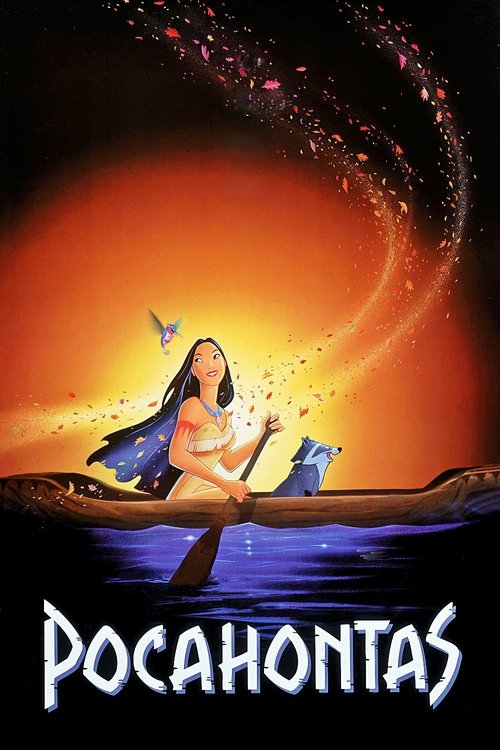
Disney's 33rd animated feature, released in 1995, marked a bold departure from the fairy-tale adaptations that defined the studio's Renaissance era. Set against the backdrop of early 17th-century Virginia, the film tells a fictionalized account of the encounter between English colonists and the Powhatan tribe. With its painterly animation style inspired by American landscape artists and a score by Alan Menken, the movie aimed for a more serious, historically grounded story than its predecessors.
The film was a commercial success, grossing over $346 million worldwide, and its signature song 'Colors of the Wind' became an anthem for environmentalism and cross-cultural understanding. However, it also drew sharp criticism for its romanticized portrayal of colonization and historical inaccuracies, particularly the age of the real Pocahontas and the nature of her relationship with John Smith. Despite mixed reviews, the film won two Academy Awards and launched a franchise that includes a direct-to-video sequel and theme park appearances.
Pocahontas holds a complicated legacy as both a visually stunning artistic achievement and a problematic entry in Disney's catalog. It was the first Disney film to feature a protagonist based on a real historical figure and the first Native American Disney Princess. The film's environmental themes and message of listening to the earth have resonated with audiences, even as debates about its cultural representation continue.
Availability and pricing can change. Confirm on the provider's site before purchasing.
In 1607, the Susan Constant sails from London to the New World, carrying English settlers led by the greedy Governor Ratcliffe, who dreams of finding gold. Among the crew is John Smith, an adventurous and open-minded young man who clashes with Ratcliffe's ruthless methods. Meanwhile, in the Virginia wilderness, Pocahontas, the free-spirited daughter of Chief Powhatan, feels constrained by her tribe's expectations that she marry the strong warrior Kocoum. Seeking guidance, she consults Grandmother Willow, a wise talking tree who encourages her to listen to her heart.
The English colonists arrive and begin clearing land for Jamestown, sparking tension with the Powhatan tribe. Pocahontas and John Smith meet by chance when she saves him from a bear attack. Despite their cultural differences and language barriers, they form a deep connection, spending time together with Grandmother Willow's help. Through songs like 'Colors of the Wind,' they learn about each other's worlds. Their secret friendship is discovered by Kocoum and the English soldier Thomas, leading to a violent confrontation. Kocoum attacks Smith, and Thomas shoots Kocoum dead in self-defense. This escalates the conflict, with Powhatan declaring war and ordering Smith's execution at dawn.
Pocahontas must navigate her loyalty to her people and her love for Smith, racing against time to prevent a catastrophic battle between the colonists and her tribe. The story explores themes of prejudice, environmental harmony, and the clash between European colonization and Native American ways of life. Key supporting characters include Pocahontas's animal friends—the mischievous raccoon Meeko and the hummingbird Flit—as well as Percy, Ratcliffe's pampered pug. The narrative builds toward a dramatic confrontation as both sides prepare for war, with Pocahontas caught in the middle, trying to bridge two worlds before violence erupts.
Pocahontas - Teaser Trailer #1 (November 18, 1994)
Pocahontas - Sneak Peek #2 (December 16, 1994)
Pocahontas - 2005 10th Anniversary Edition DVD Trailer
Critical Consensus
Critics praised the film's stunning animation, Alan Menken's score, and the powerful message of environmentalism and cultural understanding, but criticized the thin plot, historical inaccuracies, and the underdeveloped romance. While visually breathtaking, 'Pocahontas' is often considered a weaker entry in the Disney Renaissance due to its lack of narrative depth and problematic portrayal of Native American history.
“The animation is wonderful, and the songs are lovely, but the story is thin and the characters are not as fully realized as in the best Disney films.”
Roger Ebert
Chicago Sun-Times
“The film is visually ravishing, with a lush, painterly style that evokes the American wilderness, but it lacks the emotional depth and narrative drive of Disney's best work.”
Janet Maslin
The New York Times
“A beautifully animated, musically accomplished film that nonetheless feels somewhat static and emotionally distant compared to the studio's recent triumphs.”
Todd McCarthy
Variety
“The film is a feast for the eyes, with some of the most gorgeous animation Disney has ever produced, but the story is a letdown, lacking the magic and wit of 'Beauty and the Beast' or 'Aladdin'.”
Peter Stack
San Francisco Chronicle
“For all its visual beauty and musical charms, 'Pocahontas' is a film that can't quite decide what it wants to be, caught between a serious historical drama and a lighthearted animated musical.”
Kenneth Turan
Los Angeles Times
Irene Bedard
Pocahontas (voice)
Mel Gibson
John Smith (voice)
David Ogden Stiers
Governor Ratcliffe (voice)
Judy Kuhn
Pocahontas (singing voice)
Christian Bale
Thomas
Russell Means
Chief Powhatan
Linda Hunt
Grandmother Willow
Billy Connolly
Ben
John Kassir
Meeko
Frank Welker
Flit
Danny Mann
Percy
James Apaumut Fall
Kocoum
Gordon Tootoosis
Kekata
Joe Baker
Lon
Jim Cummings
Additional voices
Directors
Mike Gabriel, Eric Goldberg
Writers
Carl Binder, Susannah Grant, Philip LaZebnik, Chris Buck, Tom Sito, Stephen Schwartz
Composer
Alan Menken
Cinematographer
Andreas Deja
Producer
James Pentecost
Academy Awards (1996)
Best Original Song: Won
Academy Awards (1996)
Best Original Musical or Comedy Score: Won
Golden Globe Awards (1996)
Best Original Song: Won
Golden Globe Awards (1996)
Best Original Score: Won
Golden Globe Awards (1996)
Best Motion Picture – Musical or Comedy: Nominated
Annie Awards (1996)
Best Animated Feature: Won
Annie Awards (1996)
Best Individual Achievement for Animation (Glen Keane): Won
Grammy Awards (1996)
Best Song Written for a Motion Picture: Won
Grammy Awards (1996)
Best Instrumental Composition Written for a Motion Picture: Won
Join the community
fans discussing