 Italy
Italy“Pierrot le Fou is a dizzying, delirious, and ultimately tragic spectacle.”
Glenn Kenny
The New York Times
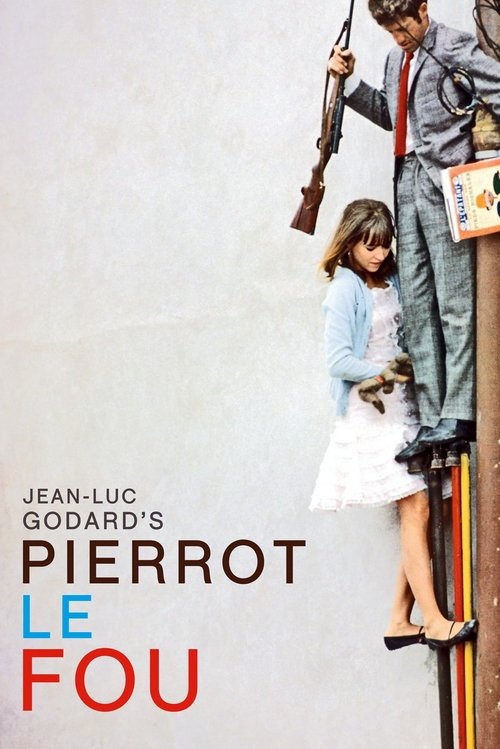
Jean-Luc Godard's 1965 film, Pierrot le Fou, throws Ferdinand Griffon, a man weary of his bourgeois existence, into a chaotic, vibrant flight across France with the enigmatic Marianne Renoir. Ferdinand, played by Jean-Paul Belmondo in one of his most memorable roles, abandons his shallow life, his wife, and his advertising job to follow Marianne, a character brought to life by Anna Karina, into the unknown.
This colorful road trip, shot in both French and Italian, quickly morphs into a crime-tinged adventure as Marianne is revealed to be on the run from dangerous figures. The film is a dazzling, often anarchic, exploration of freedom, love, and the absurdity of modern life. With a modest budget of around $300,000, Godard, alongside cinematographer Raoul Coutard, crafts a visually arresting experience that pulses with energy. The movie, which garnered a rating of 7.317 out of 10 from 950 votes, captures a spirit of rebellion against convention, blending elements of drama, romance, and crime into a distinctive cinematic cocktail.
Stream
Max
Rent
Amazon Prime Video
Apple TV
Google Play Movies
YouTube
Availability and pricing can change. Confirm on the provider's site before purchasing.
Ferdinand Griffon, embodied by Jean-Paul Belmondo, finds himself suffocating in the gilded cage of his comfortable, yet profoundly unfulfilling, bourgeois life. His days are spent in advertising, his nights often spent at superficial parties, and his personal life includes a wife, Maria (Graziella Galvani), and a young daughter. Yet, a deep-seated ennui pervades his existence, a feeling that something essential is missing.
His monotonous routine is disrupted by the arrival of Marianne Renoir, portrayed by Anna Karina, who is engaged as a babysitter for his child. Marianne is also a former lover of Ferdinand's, and their reunion ignites an immediate, potent spark. Sensing an escape route from the stifling predictability of his world, Ferdinand makes a rash decision. He walks away from his wife, his job, and the social expectations that have bound him, choosing instead to flee Paris with Marianne on a spontaneous adventure.
They commandeer a vehicle and set off, their destination a hazy ideal of freedom symbolized by the Mediterranean Sea. What begins as a romantic flight of fancy soon reveals a darker undercurrent. Marianne is not merely seeking a carefree escape; she is entangled with dangerous individuals and is actively evading pursuers, including hitmen. Ferdinand, initially naive to the full gravity of Marianne's situation, finds himself increasingly drawn into her perilous world. Their journey transforms into a frantic, unpredictable flight, punctuated by confrontations with criminals, fleeting moments of joy, and a growing sense of dread.
As their travels progress, Marianne's true identity and her deep involvement with the criminal underworld become more apparent. Ferdinand, who has adopted the persona of 'Pierrot', the fool, as he sheds his former self, becomes inextricably linked to Marianne's dangerous game. The film navigates their tumultuous relationship amidst a backdrop of vivid, often surreal, imagery. It masterfully blends satire, sociopolitical commentary, and a graphic novel aesthetic. Ferdinand and Marianne come to represent a final pair of romantics, desperately searching for genuine connection and liberty in a world that seems determined to thwart them. Their journey is characterized by impulsive actions, bursts of violence, and philosophical reflections, all while being relentlessly pursued by unseen forces. The narrative steadily builds toward an unavoidable reckoning, propelled by the escalating revelations of Marianne's secrets and Ferdinand's deepening entanglement.
Pierrot Le Fou - Trailer
Critical Consensus
A visually dazzling and anarchic exploration of love and freedom, Jean-Luc Godard's 'Pierrot le Fou' is a high point of the French New Wave, celebrated for its vibrant performances and audacious style.
“Pierrot le Fou is a dizzying, delirious, and ultimately tragic spectacle.”
Glenn Kenny
The New York Times
“Jean-Paul Belmondo and Anna Karina are incandescent in this vibrant, anarchic road movie.”
David Jenkins
Little White Lies
“Godard's masterpiece is a riot of color, music, and existential despair.”
Nick Schager
Slant Magazine
“A film of ecstatic, uninhibited freedom, 'Pierrot le Fou' is a burst of pure cinema.”
Leo Goldsmith
Film Comment
Jean-Paul Belmondo
Ferdinand Griffon, 'Pierrot'
Anna Karina
Marianne Renoir
Graziella Galvani
Maria, Ferdinand's Wife
Samuel Fuller
Samuel Fuller
Roger Dutoit
The Gangster
Director
Jean-Luc Godard
Writers
Lionel White, Rémo Forlani, Jean-Luc Godard
Composer
Antoine Duhamel
Cinematographer
Raoul Coutard
Producers
Georges de Beauregard, Dino De Laurentiis
Join the community
fans discussing