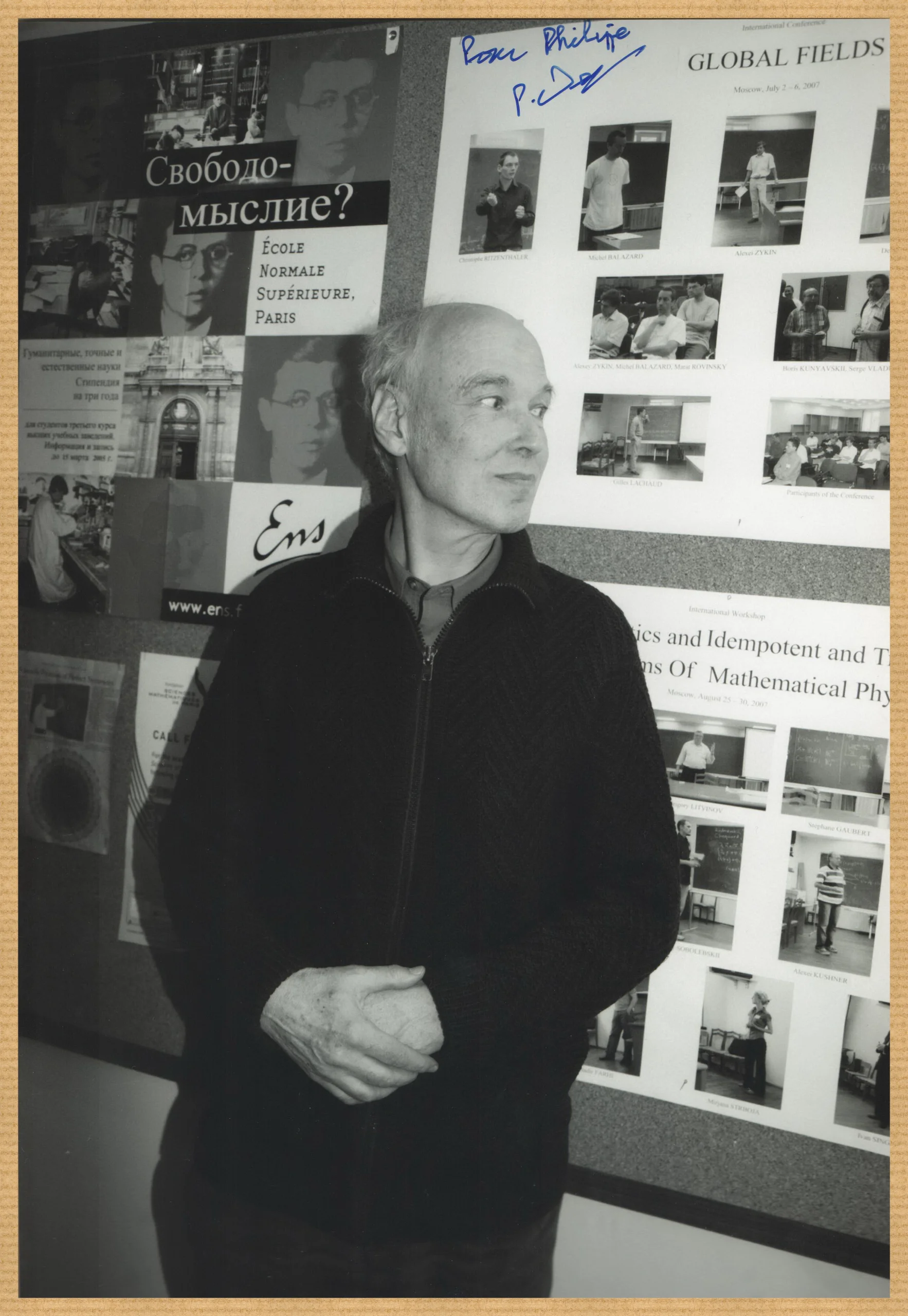
Pierre Deligne
 Belgium
mathematician•university teacher
Also known as: Pierre Rene Deligne
Birthday
October 3, 1944
Birth Sign
Libra
Birthplace
Etterbeek, Belgium
Age
82 years old
About
Pierre Deligne is a Belgian mathematician whose proof of the Weil conjectures in 1973 reshaped algebraic geometry and number theory. That single achievement, completed before he turned thirty, earned him the Fields Medal in 1978 and set the course for a career marked by deep conceptual breakthroughs.
Now Professor Emeritus at the Institute for Advanced Study in Princeton, he continues to influence the field through his work on motives and mixed Hodge structures. His contributions have been recognized with nearly every major prize in mathematics, including the Crafoord Prize, the Wolf Prize, and the Abel Prize.
Deligne is known for his quiet intensity and preference for thinking in bed with a cushion behind his back. He holds the hereditary title of Viscount, a rarity among mathematicians, and has built a vast intellectual lineage with over two hundred mathematical descendants.
Early Life & Background
Born in Etterbeek, a municipality of Brussels, on October 3, 1944, Deligne showed exceptional mathematical talent early. He skipped grades and entered the Université libre de Bruxelles at sixteen, where he fell under the influence of Alexander Grothendieck, the towering figure of algebraic geometry.
During his doctoral studies, Deligne took on the hardest open problem in the field: the Weil conjectures, proposed by André Weil in 1949. These conjectures predicted deep connections between the number of solutions to polynomial equations over finite fields and topological properties of complex varieties. For two decades, the brightest minds had failed to crack the final and most difficult part.
Deligne developed étale cohomology, a new theoretical tool, and applied it with startling originality. His 1970 Ph.D. thesis already contained the seeds of his later triumph, and by 1973 he had completed a full proof of all four conjectures, a result that stunned the mathematical community.
Career Growth
The proof of the Weil conjectures in 1973 made Deligne's reputation overnight. In 1978, at the International Congress of Mathematicians in Helsinki, he received the Fields Medal at age thirty-three, the youngest recipient in history at that time.
He spent the next decade at the Institut des Hautes Études Scientifiques near Paris, where he continued to produce landmark work, including the Riemann hypothesis for varieties over finite fields. In 1988 he won the Crafoord Prize, and in 2004 the Balzan Prize.
Moving to the Institute for Advanced Study in Princeton in the 1990s, he became a professor and later Professor Emeritus. The Wolf Prize arrived in 2008, followed by the Abel Prize in 2013, often called the Nobel of mathematics. His later work on motives and mixed Hodge structures opened new avenues that remain active today.
Career Timeline
Public Image & Style
Within mathematics, Deligne is regarded as a figure of almost mythical stature, the person who solved the problem others had spent decades circling. His style is characterized by extreme rigor and a preference for conceptual clarity over computational brute force.
In the broader public sphere, he is largely invisible by choice. He gives few interviews and has no social media accounts. When he does speak, his remarks are measured and often self-deprecating. Colleagues describe him as generous with ideas and remarkably humble for someone of his accomplishments.
Fans of mathematics appreciate his willingness to engage with younger researchers, and his lecture series are known for their lucidity. He represents a model of pure intellectual pursuit, untainted by celebrity culture.
Fame & Fandom (iFAMOUS Rankings)
Pierre Deligne is currently evaluated by the iFANN Global Fame Engine but holds no placement in the published rankings, standing outside the Global Top 1,000 and all scope-specific leaderboards. While his name echoes through lecture halls from Princeton to Paris, he remains a figure of immense academic reverence rather than popular fandom. The mathematical community serves as his audience, measuring influence through citations and the adoption of theories rather than chart pushes or streaming numbers. There is no formal fandom name documented for Deligne; his legacy lives in the quiet rigor of algebraic geometry and number theory, not in viral campaigns or organized rituals. Colleagues describe him as a generous wit with a boyish appearance, yet his public presence is almost entirely invisible by choice. He gives few interviews, maintains no social media accounts, and has never sparked the kind of street shutdowns or fainting crowds associated with pop culture icons. The stories that define him are historical achievements within the scientific world, such as his proof of the Weil conjectures at age twenty-nine or his receipt of the Abel Prize in 2013. These moments are celebrated globally in academic circles but lack the mass consumer mythology found elsewhere. His work on motives and mixed Hodge structures continues to shape the field, earning him nearly every major prize in mathematics. Yet this towering stature exists in a sphere separate from the noise of celebrity culture. No fan-funded projects, charity drives, or birthday billboards mark his path. The only crowd that gathers for Deligne consists of students and researchers seeking clarity in complex proofs. This absence of a traditional fanbase does not diminish his impact; it simply reflects a life devoted to ideas rather than material wealth or public adoration.
Interesting Facts and Legends
Pierre Deligne prefers to work lying in bed, propped up by a large cushion, a habit he shared in a 2012 interview. He holds the hereditary title of Viscount, a distinction few mathematicians can claim. According to the Mathematics Genealogy Project, he has three direct students but more than two hundred mathematical descendants, a reflection of his influence. He has never had a public social media presence, and his personal life remains almost entirely private. His proof of the Weil conjectures is often ranked among the top ten mathematical achievements of the twentieth century in historical surveys. A widely retold narrative focuses on his breakthrough when he proved the remaining parts of the Weil conjectures at just twenty-nine years old. This achievement was so profound that it led to him being awarded the Fields Medal, making him one of the youngest recipients ever. Another iconic moment occurred when King Harald V of Norway presented him with the Abel Prize for his lifetime contributions to algebraic geometry. These verified events solidified his status as one of the most celebrated mathematicians of the 20th century, though they remain confined to the realm of academic history rather than pop culture folklore.
Notable Quotes
“When I want to get mathematics done, I take to my bed.”
“Mathematics is not a spectator sport.”
“The beauty of mathematics is that it is both a tool and an art.”
Family & Personal Life
Deligne was born into a noble Belgian family, inheriting the title of Viscount. Details about his parents and siblings are not publicly documented. He has kept his family life out of the public eye, and no information about a spouse or children has ever been reported. He maintains a residence in Princeton, New Jersey, where he lives quietly in retirement.
Notable Connections
Alexander Grothendieck was Deligne's doctoral advisor and the dominant influence on his early work. André Weil formulated the conjectures that Deligne proved, and Jean-Pierre Serre, a fellow Fields Medalist, was a contemporary and collaborator. These three figures form the intellectual circle that shaped Deligne's approach to mathematics.
Relationships & Dating History
Pierre Deligne has kept his personal life intensely private. No public records, interviews, or biographies mention any romantic relationships, engagements, or marriages. He has never been linked to a partner in the media, and his dating history is effectively nonexistent in the public domain.
As of 2026, Deligne is single and has no reported children. His focus has always been on mathematics, and he seems to have deliberately kept his personal affairs away from public scrutiny. This absence of information is itself a notable aspect of his public profile, distinguishing him from figures whose personal lives are widely covered.
Salary, Net Worth In 2026
$5 Million
iFANN Editorial Team estimate
As an academic mathematician, Deligne's wealth does not resemble that of entertainers or business leaders. His income has come from university salaries, research stipends, and modest royalties from publications. In 2026, per iFANN's editorial analysis, his net worth is estimated at around $5 million, a figure that reflects decades of academic earnings and prudent savings. The Abel Prize, which he won, carries a monetary award of roughly one million dollars, a significant addition to his finances. Deligne has never pursued commercial ventures, and his estate, if any, is not a matter of public record. He lives modestly, consistent with his reputation for a life devoted to ideas rather than material wealth.
Awards Won (5)
Deligne has received the highest honors in mathematics. He won the Fields Medal in 1978, the Crafoord Prize in 1988, the Balzan Prize in 2004, the Wolf Prize in 2008, and the Abel Prize in 2013. He also holds honorary doctorates from several universities and is a Grand Officer of the Order of Leopold II of Belgium.
2013 · Mathematics
For his profound contributions to mathematics
2008 · Mathematics
For his fundamental contributions to algebraic geometry and number theory
Known For
Proof of the Weil Conjectures
1973 · Mathematician
Fields Medal
1978 · Recipient
Abel Prize
2013 · Recipient
Keywords
Sources
Quick Facts
- Profession
- mathematician, university teacher
- Born
- October 3, 1944
- Birthplace
- Etterbeek, Belgium
- Gender
- Male
- Birth Sign
- Libra
- Title
- Viscount
- Education
- Université libre de Bruxelles (Ph.D., 1970)
Personal Details
- Full Name
- Pierre René, Viscount Deligne
- Education
- Université libre de Bruxelles (Ph.D., 1970)
Frequently Asked Questions
Is Pierre Deligne still alive?
What is Pierre Deligne's net worth?
Who is Pierre Deligne married to?
What did Pierre Deligne win the Fields Medal for?
Where does Pierre Deligne live?
Similar People
Join the community
fans discussing