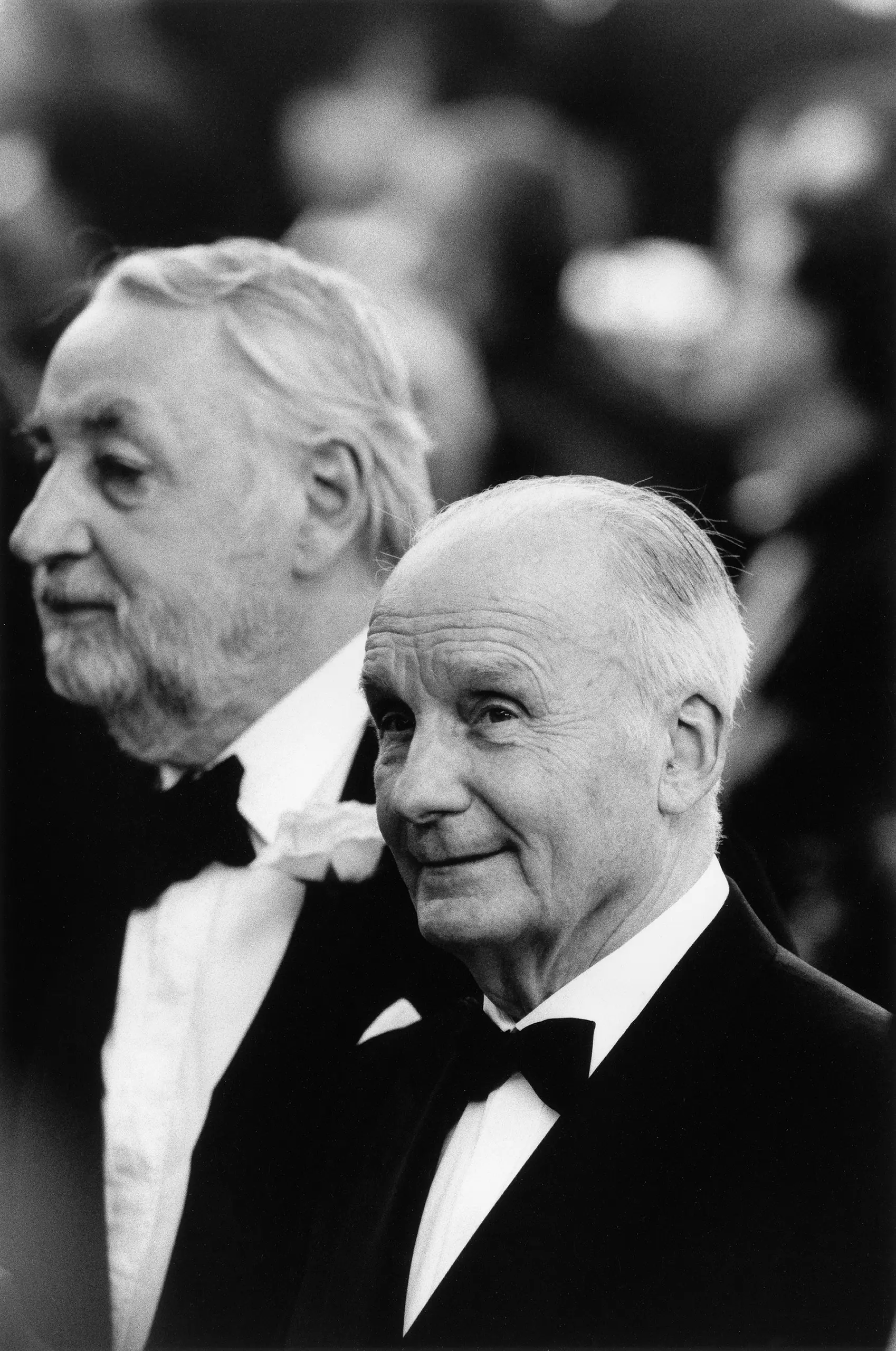
Philippe Noiret
 France
film actor•stage actor•cabaret performer•voice actor
Also known as: Philippe Noiret
Birthday
October 1, 1930
Birth Sign
Libra
Birthplace
Lille, France
Age
Died at 76
About
Philippe Noiret was a French film, stage and cabaret actor who appeared in more than 140 films across a career of over half a century. He died of cancer on November 23, 2006, in Paris, at 76.
International audiences know him as Alfredo the projectionist in Giuseppe Tornatore's Cinema Paradiso (1988) and as Pablo Neruda in Michael Radford's Il Postino (1994). In France he was a two-time César Award winner for Best Actor, for Old Goriot in 1989 and Life and Nothing But in 1990, and a fixture of the Maigret television films. A holder of the Légion d'honneur, he worked steadily into his final year, shooting Trois amis shortly before his death.
What set him apart was a face and a voice that carried ordinary decency without strain. He played policemen, husbands, projectionists and poets with the same unhurried gravity, and directors returned to him for exactly that reason.
Early Life & Background
Noiret was born in Lille on October 1, 1930 and raised in a bourgeois Catholic household. French obituaries repeatedly describe his father as a businessman in the textile trade, a detail that circulated widely but is not confirmed in the sources retrieved here.
He trained as an actor at Jean Vilar's Théâtre National Populaire in Paris rather than at a conservatory. Before film found him, he worked the Parisian nightclubs and music halls, sharing bills with comedians including Pierre Dac. That apprenticeship mattered: the light comic timing he carried into his screen work was learned in front of live audiences, in rooms where a joke either landed or did not.
One profile states he reached the screen at 18 in a bit part. His first credited feature is generally given as Agnès Varda's La Pointe Courte (1955), a film that sits at the head of the French New Wave without quite belonging to it. Through the rest of the 1950s he took what came, and what came was mostly small.
By 1960 he had a role in Louis Malle's Zazie dans le métro, and the pattern of the next decade set in: policemen, soldiers, slightly baffled husbands, men who react rather than announce. Malle cast him again in Murmur of the Heart in 1971. The breakthrough that turned him from a reliable supporting player into a leading comic presence arrived the following year, with Yves Robert's The Tall Blond Man with One Black Shoe.
Career Growth
The 1972 release of The Tall Blond Man with One Black Shoe made Noiret a star in France. His deadpan turn as a hapless civil servant mistaken for a spy became a template for French screen comedy, and the films that followed grew larger. The Old Gun (1975) was among his biggest domestic hits. English-language work came too, including The Night of the Generals, Murphy's War and The Assassination Bureau.
The 1980s brought his most durable collaborations. Bertrand Tavernier cast him repeatedly, in Life and Nothing But (1989) and later D'Artagnan's Daughter. Claude Chabrol used him in Masques and Noyade interdite, both 1987. On television he played Inspector Maigret across a run of films beginning with La Maison du juge.
Then came Cinema Paradiso in 1988. Noiret spoke his lines in French, his native language, and was dubbed into Italian for the release. The role as Alfredo, the projectionist who raises a boy on movies, introduced him to audiences who had never seen a French film. Two César Awards for Best Actor followed in quick succession, for Old Goriot in 1989 and Life and Nothing But in 1990.
Il Postino arrived in 1994, with Noiret as the exiled Pablo Neruda opposite Massimo Troisi and Maria Grazia Cucinotta. The film won the Oscar for Best Original Dramatic Score and became a worldwide art-house hit. He kept working through the 1990s and into the 2000s, in films including Tango (1993), alongside extensive dubbing and narration work, and shot Trois amis in 2006.
Career Timeline
Public Image & Style
The face did most of the work. Cherub-cheeked and hangdog at once, Noiret looked like a man who had been mildly disappointed by life and had decided to be kind about it. That face, paired with a warm, world-weary voice, let him play decency without sentimentality and comedy without mugging.
His screen manner was understated to the point of reticence. He reacted; he did not announce. Directors cast him for the same reason again and again, and critics reached for words like modesty. A 2010 documentary title, Philippe Noiret: The Modesty of His Feelings, more or less settled the question of how France saw him.
Off screen the persona held. He dressed with a relaxed, unpretentious ease, and profiles describe a man who wore his clothes rather than the reverse. He gave few interviews that courted attention and seemed content to be recognized by his work rather than his opinions.
Fame & Fandom (iFAMOUS Rankings)
Fame data for Philippe Noiret has not yet been gathered by iFANN, so no placement in the Global Fame Rankings can be stated for him. He is not on the September 2026 iFAMOUS Rankings flagship list either. His standing rests on a different measure: a filmography of more than 140 titles, two César Awards, and two films, Cinema Paradiso and Il Postino, that continue to find new viewers decades after release.
There is no fandom name, no fan club, no organized campaign. Noiret predates internet fandom culture and never had a fanbase that called itself anything. What he has instead is a cinephile audience, the kind that turns up for repertory screenings and buys the Criterion edition. Admirers of Cinema Paradiso in particular treat Alfredo as a personal acquaintance, and the film's reputation as a gateway to subtitled cinema has made Noiret a first encounter with European film for several generations of viewers.
The tributes tend to be culinary and quiet rather than organized. A chef's "Gnocchi alla Noiret" honors his Alfredo. Retrospectives program the Tavernier films. French television still airs Life and Nothing But. It is a modest sort of afterlife, which is presumably how he would have wanted it.
Interesting Facts and Legends
Noiret's first credited feature, La Pointe Courte (1955), was Agnès Varda's debut and is often cited as a forerunner of the New Wave, which means his screen career began at the exact moment modern French cinema did.
He delivered every line of Cinema Paradiso in French and was dubbed into Italian afterward, a fact that surprises viewers who assume Alfredo was voiced by an Italian actor.
A chef's tribute dish, "Gnocchi alla Noiret," honors his Alfredo, which is an unusual afterlife for a projectionist.
The story fans still retell concerns Il Postino. At the funeral scene for Massimo, Noiret's Neruda walks behind the coffin in homage, and Neapolitans watching in cinemas believed they were seeing the actor's ghost. A 2018 Guardian feature on the film's making revived the anecdote.
He was a man who, by one fashion account, "lived in his clothes" with an ease that matched his acting. Relaxed, understated, never fussy.
Notable Quotes
“Acting is mostly a matter of listening.”
Family & Personal Life
Noiret married the actress Monique Chaumette in 1962, and the marriage lasted until his death in 2006. Chaumette, born in 1927, appeared in more than forty films from 1958 onward and worked alongside her husband on both stage and screen.
The couple had two children, including a daughter, Frédérique Noiret, who became a screenwriter and actress. Noiret kept his household out of the press to an extent unusual for a French star of his scale, and no account of domestic life beyond the marriage and the children was widely published.
He was raised in Lille in a Catholic bourgeois family, the son of a textile businessman according to repeated obituary accounts, and that provincial, orderly background sat oddly beside the bohemian cabaret years that followed. He seems to have kept both.
Notable Connections
Noiret's career is inseparable from a handful of directors. Louis Malle cast him early, Yves Robert made him a comic star, Bertrand Tavernier and Claude Chabrol kept him working through the 1980s, and Giuseppe Tornatore gave him Alfredo. Michael Radford cast him as Neruda opposite Massimo Troisi and Maria Grazia Cucinotta. On stage and at home he was paired for four decades with the actress Monique Chaumette, and his cabaret years put him on the same bills as the comedian Pierre Dac.
Relationships & Dating History
Philippe Noiret's romantic history is unusually simple for a man of his public stature. He married the actress Monique Chaumette in 1962, and the two remained married until his death on November 23, 2006. Chaumette, born in 1927, had been working in film since 1958 and appeared in more than forty productions, several of them alongside her husband on stage and screen.
No other public relationship, engagement, divorce or confirmed high-profile romance is documented. Suggestions of a connection to Romy Schneider circulate as a search query, but no credible source retrieved confirms it, and it should be treated as unverified speculation rather than record.
The marriage lasted 44 years. At the time of his death Noiret was married to Monique Chaumette, and she has not remarried publicly since.
- MarriedMonique Chaumette1962 - 2006Married until his death in 2006; the couple had two children and worked together on stage and screen.
Death & Aftermath
Died
November 23, 2006 (aged 76)
Death Place
Paris, 7th arrondissement, France
Cause of Death
Cancer
News of Philippe Noiret's death was carried by obituaries on both sides of the Atlantic within days. The Guardian ran the headline "Il Postino's Noiret loses cancer battle" on 24 November 2006; the New York Times followed on 25 November with "Philippe Noiret, an Actor of Elegance and Dry Humor, Dies at 76." Voice of America remembered him as one of the most popular actors of postwar French cinema. Cancer was the cause named in the press, and no hospital or family statement elaborating on the medical circumstances was made public.
He died on 23 November 2006 in Paris, in the 7th arrondissement, at 76. The date and place were reported consistently across French and English outlets. No autopsy, inquest or legal proceeding followed, and nothing in the record suggests one was expected. The funeral arrangements, the location of any memorial, the names of attendees and the question of burial or cremation were not disclosed in the sources retrieved. Searches for where he is buried remain common, and no documented answer exists.
Tributes fixed the shape of the career rather than the circumstances of the end: the hangdog face, the world-weary voice, the range from Parisian music halls to the most watched French films of the 1980s and 1990s. Retrospectives followed, among them a 2010 profile titled Philippe Noiret: The Modesty of His Feelings, and repertory programming has kept the films in circulation. France 5 aired Life and Nothing But as recently as 2026.
One story from the films attached itself to the death in a way Noiret could not have planned. In Il Postino, his Pablo Neruda walks behind the coffin at the funeral of Massimo, and Neapolitans who saw the scene in cinemas took the actor for a ghost. A 2018 Guardian feature on the making of the film retold it. It was the character's funeral, not his, but the confusion says something about how completely the face had settled into the audience's memory.
Net Worth (Estate Value)
$3 Million
iFANN Editorial Team estimate
No reliable valuation of Philippe Noiret's estate has ever been published, and the iFANN Editorial Team's reading of the available record places it at roughly $3 Million as of 2026. That figure is an estimate, not a documented sum: no celebrity net-worth outlet has surfaced a number for him, and French probate records are not public.
What the estate holds is intellectual property. Royalties from more than 140 films, television residuals from the Maigret run, and licensing income from Cinema Paradiso and Il Postino are the principal streams. Both of those films remain in active distribution, and Cinema Paradiso in particular has been reissued repeatedly in restored editions, which generates fresh licensing revenue each cycle.
No catalog sale, no major legal settlement and no publicly named estate manager appear in the record. French droit d'auteur passes to heirs and is administered collectively, which means the income continues quietly rather than through headline deals. His widow, Monique Chaumette, and their two children are the natural beneficiaries; Frédérique Noiret works in the industry as a screenwriter and actress.
The trajectory is flat rather than growing. Noiret earned well by French standards during his peak years but never commanded Hollywood money, and there have been no posthumous releases to lift the estate. Readers encountering larger figures online should treat them as unverified.
Awards Won (2)
Noiret won two César Awards for Best Actor, taking the prize in 1989 for Old Goriot and again in 1990 for Life and Nothing But. He was also awarded the French Légion d'honneur. No BAFTA, Oscar or Cannes acting prize appears in the record.
1990 · Best Actor
Life and Nothing But
1989 · Best Actor
Old Goriot
Known For
Cinema Paradiso
1988 · Alfredo
Il Postino
1994 · Pablo Neruda
Life and Nothing But
1989 · Commandant Dellaplane
The Tall Blond Man with One Black Shoe
1972 · François Perrin
The Old Gun
1975 · Julien Dandieu
Old Goriot
1989 · Honoré de Balzac's Goriot
Keywords
Sources
Quick Facts
- Profession
- film actor, stage actor, cabaret performer, voice actor
- Born
- October 1, 1930
- Birthplace
- Lille, France
- Died
- November 23, 2006
- Death Place
- Paris, 7th arrondissement, France
- Cause of Death
- Cancer
- Gender
- Male
- Spouse
- Monique Chaumette (m. 1962; his death 2006)
- Children
- 2, including Frédérique Noiret
- Birth Sign
- Libra
- César Awards
- 2 (Best Actor, 1989 and 1990)
- Film Count
- More than 140
Personal Details
- Full Name
- Philippe Noiret
- Spouse
- Monique Chaumette
- Children
- 2 (including Frédérique Noiret)
- Education
- Théâtre National Populaire, Paris
Filmography
140
Total
120
Film
20
TV
Frequently Asked Questions
Did Philippe Noiret speak Italian in Cinema Paradiso?
How did Philippe Noiret die?
Who was Philippe Noiret's wife?
How tall was Philippe Noiret?
What is Philippe Noiret best known for?
Similar People

Join the community
fans discussing