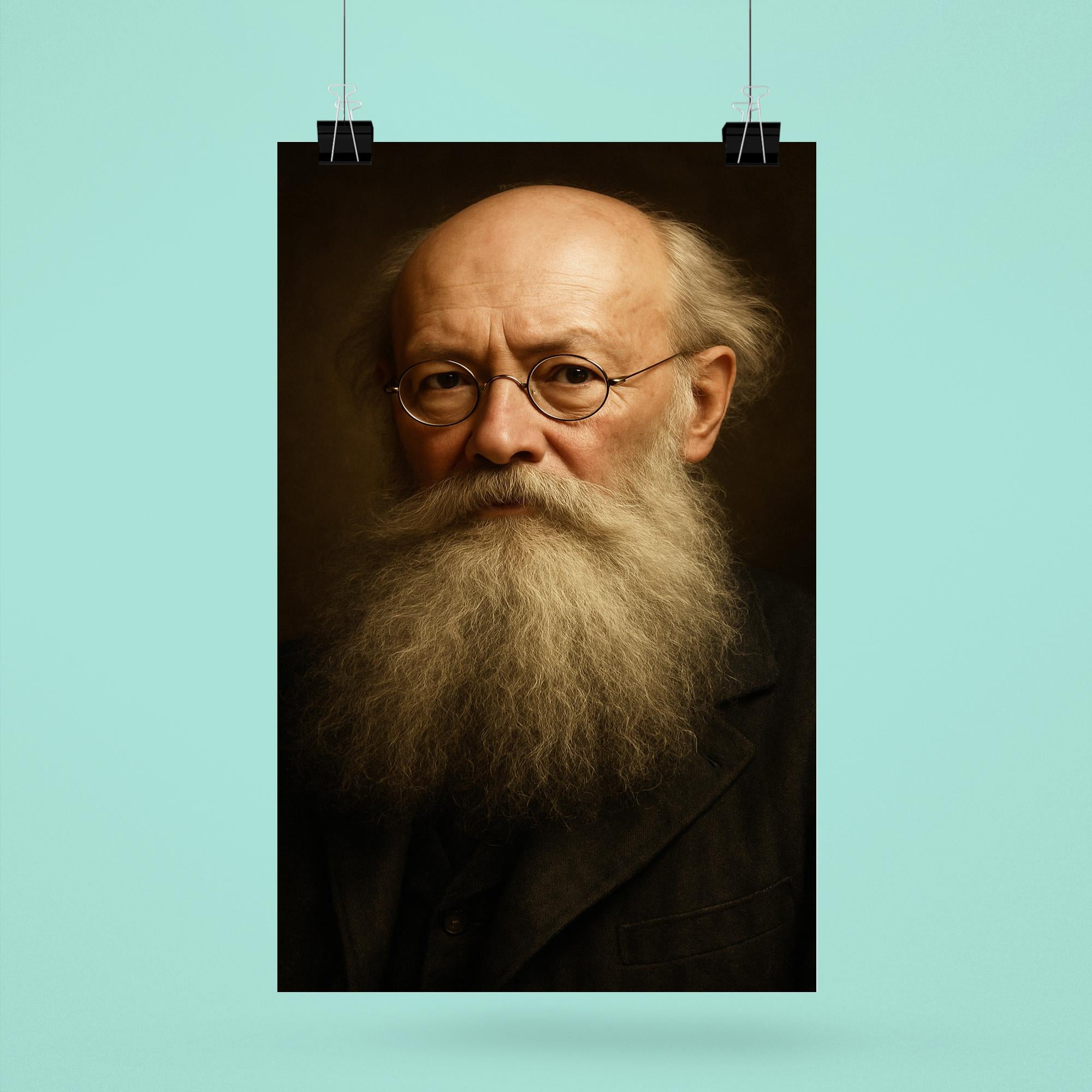
Peter Kropotkin
 Russia
Also known as: Pyotr Alekseyevich Kropotkin, Prince Kropotkin
Birthday
December 9, 1842
Birth Sign
Sagittarius
Birthplace
Moscow, Russia
Age
Died at 78
Height
5 ft 6 in (168 cm)
About
Peter Kropotkin was a Russian geographer, writer, and the foremost theorist of anarchist communism. Born into an aristocratic family in Moscow in 1842, he renounced his princely title and devoted his life to revolutionary ideas. He is best known for his scientific exploration of Siberia and his influential works on mutual aid and decentralized society.
Today, Kropotkin is remembered as a founding figure of anarchist thought, whose writings continue to inspire activists and scholars. His book Mutual Aid: A Factor of Evolution challenged Social Darwinism and argued that cooperation is a key driver of evolution. His ideas on voluntary association and free distribution of goods have left a lasting mark on political philosophy and social movements worldwide.
Early Life & Background
Kropotkin was born in the Konyushennaya district of Moscow, the youngest of four children. His father, Prince Aleksey Petrovich Kropotkin, was a royal officer who owned serfs in three provinces, and his mother, Ekaterina Nikolaevna Sulima, died of tuberculosis when Peter was just three. His stepmother, Yelizaveta Mar'kovna Korandino, was described as domineering and tried to erase traces of the children's mother. He was particularly close to his brother Alexander. His early education at the First Moscow Gymnasium left him unimpressed, as he felt that "all the subjects were taught in the most senseless manner," though he developed a strong interest in history and geography.
At age eight, he was selected by Tsar Nicholas I to attend the elite Corps of Pages in St. Petersburg. He entered the Corps at fifteen and became a personal page to Tsar Alexander II in 1861, the year serfs were emancipated. Despite his military path, his interests lay in geography and zoology. After graduating at nineteen, he accepted a commission in the Tsar's army but, to his father's disgust, requested an assignment in Siberia, where he knew he would likely be attached to geographical expeditions. From 1862 to 1867, he served as an army officer in Siberia, exploring the Amur River region and Manchuria, mapping uncharted territories and studying wildlife. In 1863, he led an expedition to the Amur River, making maps of territory never explored by Europeans. His observations of cooperation among animals and the harsh lives of peasants and workers shaped his later anarchist convictions. He later conducted geographic and geological surveys of Finland, and before he was thirty, he had gained an international reputation for his work. Returning to St. Petersburg, he joined the secret Circle of Tchaykovsky and formally embraced anarchism.
Career Growth
Kropotkin's revolutionary activities led to his imprisonment in 1874, but he escaped two years later and began 41 years of exile across Switzerland, France, and England. In Switzerland, he joined the Jura Federation and lectured, while working on his major historical work on the French Revolution. He was expelled from Switzerland and later imprisoned in France, before settling in England in 1886.
During his English exile, he wrote his most important works: The Conquest of Bread (1892), Fields, Factories, and Workshops (1899), and Mutual Aid: A Factor of Evolution (1902). These books laid out his vision of anarchist communism, arguing for a society based on voluntary cooperation and free distribution of goods. He also contributed the article on anarchism to the 1911 Encyclopædia Britannica. In 1917, he returned to Russia after the February Revolution, initially supporting the Bolsheviks but soon criticizing them as authoritarian. He died in 1921, leaving unfinished his work on anarchist ethics.
Career Timeline
Public Image & Style
Kropotkin's public image combines the paradox of an aristocrat who gave up privilege to become a revolutionary. He was known for his scholarly, scientific approach to anarchism, giving it a theoretical foundation. Media portrayals evolved over time: initially seen as a terrorist in the 1880s, later as a symbol of Russian cultural dignity, and finally as a figure of decay during the Russian Revolution. He is celebrated in anarchist circles and studied in academic contexts, with no official fandom name but a lasting influence on political thought.
Fame & Fandom
Peter Kropotkin stands as the 35th most famous person from Russia, a position he has held steady through the latest cycle of global attention. Within the broader cultural landscape, he ranks as the 78th most famous person in Art & Design. These placements reflect his enduring presence across media coverage, search activity, and consumption signals worldwide, as tracked by the iFANN Global Fame Rankings. While modern pop culture often focuses on living stars, Kropotkin maintains a unique standing among historical figures whose ideas continue to shape discourse.
Unlike contemporary celebrities, Peter Kropotkin does not have a formal fandom with a specific name or organized fan campaigns. His legacy is sustained by students, activists, and scholars who engage with his work rather than by crowds seeking autographs or participating in viral challenges. There are no documented rituals, hashtags, or charity drives funded by fans to keep his works in print, as his books remain standard texts in philosophy and history libraries globally. Instead of a fanbase in the traditional sense, his audience consists of self-identified anarchists, mutualists, and political theorists who view his writings as essential reading. The closest equivalents to fan interaction are found in academic curricula and ongoing debates regarding his theories on geography and economics.
Interesting Facts and Legends
Born a prince in Moscow, Kropotkin renounced his title and aristocratic privileges to dedicate his life to revolutionary ideals. At just eight years old, he was chosen by the tsar for the Corps of Pages, entering service during the very year his father's serfs were emancipated. His commitment to freedom led to a daring escape from a Russian prison in 1876, where he disguised himself as a woman to slip out of a window and evade extradition. Though initially supportive of the Bolshevik Revolution, he eventually became disillusioned with their methods. His scientific observations of animal life in Siberia formed the basis of his theory of mutual aid, which challenged the prevailing Darwinian narrative of competition.
A legendary story that fans still retell involves his dramatic 1876 escape, often cited as a feat of derring-do that cemented his reputation as an outwit of the state apparatus. Another pillar of his cultural mythology is his role as the "Prince of Mutual Aid," symbolizing the ultimate sacrifice of noble status for ideological purity. His book *Mutual Aid: A Factor of Evolution* remains a cornerstone of anarchist thought, with recent scholarship continuing to explore how his time among Swiss watchmakers influenced his understanding of labor. He left behind an unfinished work on anarchist ethical philosophy, adding to the intrigue of his intellectual journey.
Notable Quotes
“All the subjects were taught in the most senseless manner.”
“Mutual aid is as much a law of animal life as mutual struggle.”
Family & Personal Life
Kropotkin's father, Prince Aleksey Petrovich, was a typical royal officer, and his mother, Ekaterina, descended from a Zaporozhian Cossack leader. After her death, his stepmother Yelizaveta was harsh and domineering. He had two brothers, Nikolai and Alexander, the latter being a close companion in youth. In 1878, he married Sophie Ananiev, a woman of Jewish and Slav descent who had abandoned her family in Siberia over their treatment of workers. Their daughter, Alexandra, became a writer and translator. Kropotkin and Sophie remained married until his death.
Notable Connections
Kropotkin was associated with fellow Russian anarchist Michael Bakunin, though they differed in approach. He corresponded with Alexander Herzen and other revolutionary thinkers. He initially supported Vladimir Lenin's Bolshevik Revolution but later criticized it. His wife Sophie and daughter Alexandra were central to his personal life, and his ideas influenced many later anarchist and socialist movements.
Relationships & Dating History
Kropotkin married Sophie Ananiev in 1878, a woman of Jewish and Slav descent who had abandoned her family in Siberia due to their treatment of workers. They met among Russian émigrés in Switzerland and remained together until his death in 1921. Their daughter Alexandra became a writer and translator. No other romantic relationships are documented. At the time of his death, Kropotkin was married to Sophie.
- MarriedSophie Ananiev1878 - 1921Met among Russian émigrés in Switzerland; remained married until his death.
Death & Aftermath
Died
February 8, 1921 (aged 78)
Death Place
Dmitrov, Moscow Oblast, Russia
Cause of Death
natural causes associated with old age and long-standing health issues
Peter Kropotkin passed away on February 8, 1921, in his home located in Dmitrov, Moscow Oblast, Russia. The renowned geographer and anarchist theorist succumbed to natural causes linked to chronic heart and lung conditions that had weakened him for years, dying peacefully during the early years of the Soviet regime. Although the Soviet government initially celebrated him as a great scientist and contributor to geography, later policy shifted toward hostility regarding his anarchist ideology, yet he was widely eulogized by peers who honored his legacy as a champion of mutual aid. A large public gathering took place shortly after his death in Dmitrov, where workers, students, and fellow revolutionaries assembled to hear speeches emphasizing his contributions to social theory rather than purely political agitation.
His burial site has since become a location of pilgrimage for anarchists and leftists worldwide. Following his passing, his personal papers were preserved by family members and transferred to archives, allowing for extensive scholarly research into his life. His seminal works like Mutual Aid: A Factor of Evolution remained in print and were frequently reissued, influencing the development of anarchist thought throughout the twentieth century. Foundations and scholarships dedicated to his name have emerged within academic circles focusing on political philosophy and social justice, ensuring his ideas continue to be studied and debated.
Net Worth (Estate Value)
$1 Million
iFANN Editorial Team estimate
As a historical figure who passed away in 1921, Peter Kropotkin left no conventional estate in the modern sense. He lived frugally throughout his life, actively shunning material success and renouncing the wealth associated with his princely birth. His true fortune lies in his intellectual legacy, with seminal works like *The Conquest of Bread* and *Mutual Aid* continuing to be published and read around the globe. Posthumous earnings generated from royalties and reprints are modest and are managed by his descendants. Per iFANN's editorial analysis, the total value of his estate as of 2026 is estimated at $1 Million, reflecting the persistent commercial and scholarly interest in his contributions to political theory and science.
Awards & Accolades
View 3 records, honours and achievementsKnown For
Mutual Aid: A Factor of Evolution
1902 · Author
The Conquest of Bread
1892 · Author
Fields, Factories, and Workshops
1899 · Author
Anarchist communism
1870s · Theorist
Keywords
Sources
Quick Facts
- Profession
- geographer, writer, explorer
- Born
- December 9, 1842
- Birthplace
- Moscow, Russia
- Died
- February 8, 1921
- Death Place
- Dmitrov, Russia
- Gender
- Male
- Spouse
- Sophie Ananiev
- Birth Sign
- Sagittarius
- Height
- 5 ft 6 in (168 cm)
Personal Details
- Full Name
- Pyotr Alekseyevich Kropotkin
- Height
- 5 ft 6 in (168 cm)
- Spouse
- Sophie Ananiev
- Children
- Alexandra Petrovna Kropotkin
- Education
- Corps of Pages, St. Petersburg
Frequently Asked Questions
Was Peter Kropotkin a prince?
What is Kropotkin's theory of mutual aid?
Why was Kropotkin imprisoned?
Did Kropotkin support the Russian Revolution?
How did Kropotkin die?
Similar People
Join the community
fans discussing