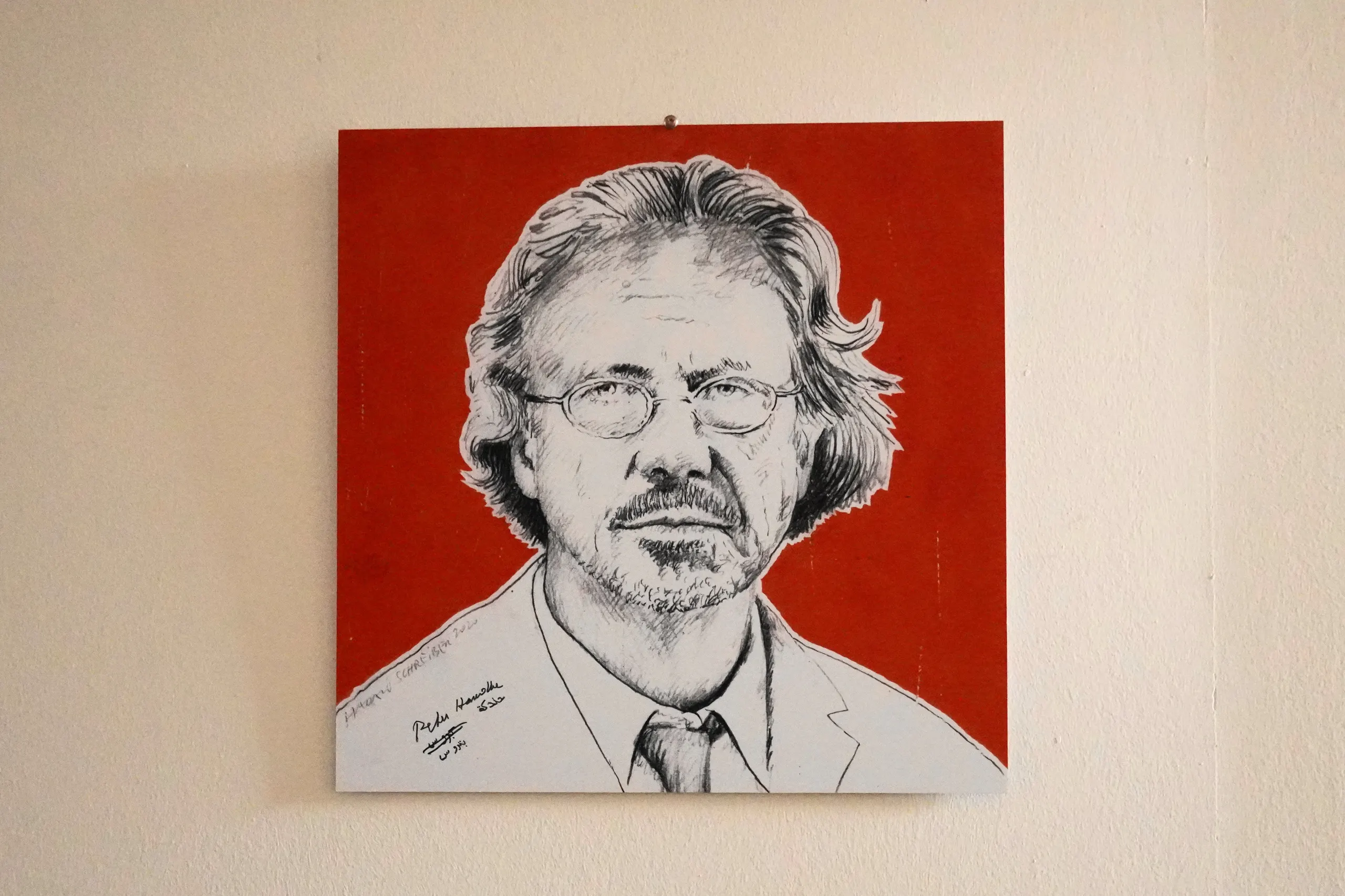
Peter Handke
 Austria
writer•playwright•poet•translator•film director
Also known as: Peter Handke, Péter Handke
Birthday
December 6, 1942
Birth Sign
Sagittarius
Birthplace
Griffen, Carinthia, Austria
Age
83 years old
Height
5 ft 10 in (178 cm)
About
Peter Handke is an Austrian writer whose restless imagination has produced novels, plays, poems, translations, and films. He won the 2019 Nobel Prize in Literature for "an influential work that with linguistic ingenuity has explored the periphery and the specificity of human experience." Over the decades, he has been hailed as one of the most original voices in German-language literature, a reputation built on works that question the very structures of language and perception.
Handke first gained attention in the late 1960s with avant-garde plays like Offending the Audience (1966), where actors dissect the nature of theater while alternately insulting and praising the audience, and Kaspar (1967), a meditation on language and identity. His novels, often stark and deadpan, capture characters in extreme psychological states. The Goalie's Anxiety at the Penalty Kick (1970) and The Left-Handed Woman (1976) stand out, as does A Sorrow Beyond Dreams (1972), a novella written after his mother's suicide. Beyond his own writing, he co-founded the Verlag der Autoren publishing house and collaborated with filmmaker Wim Wenders, penning screenplays for The Wrong Move and Wings of Desire.
His career spans more than fifty years, with over thirty works of fiction and drama, plus numerous essays and translations. Handke received the Georg Büchner Prize in 1973, German literature's highest honor. However, his public support for Serbian nationalism during the Yugoslav Wars sparked fierce criticism, and in 1999 he returned the prize money in protest against NATO's bombing of Yugoslavia. Despite the controversy, his influence on contemporary literature remains undeniable, a testament to his willingness to challenge both aesthetic and political norms.
Early Life & Background
Peter Handke was born in Griffen, a small town in the Sava Valley of Carinthia, Austria, on December 6, 1942. His father, Karl Handke, was a factory worker who died when Peter was young, leaving his mother, Hilda, to raise him alone. This early loss profoundly influenced his writing; his novella A Sorrow Beyond Dreams (1972) is a direct meditation on his mother's suicide and their difficult relationship. As a child, Handke was an avid reader and showed an early interest in literature and the arts. He attended high school in Klagenfurt, where he began writing poetry and plays.
His education continued at the University of Graz, where he studied law and philosophy but did not complete a degree, eventually dropping out to pursue writing full-time. Before achieving fame, Handke worked various jobs, including as a taxi driver and a laborer, experiences that informed his realistic and often gritty narrative style. His first major breakthrough came in the late 1960s with his participation in the Group 47, a prestigious association of German-speaking writers, which helped launch his career.
Career Growth
Handke's career is marked by a series of pivotal milestones that redefined German-language literature. In 1966, he published Offending the Audience, a radical anti-play that broke the fourth wall and challenged the nature of theater itself, establishing him as a leading figure of the avant-garde. The following year, Kaspar premiered, a play exploring the construction of identity through language, based on the true story of Kaspar Hauser. It became one of the most performed German plays of the century.
His novel The Goalie's Anxiety at the Penalty Kick (1970) gained international acclaim for its psychological depth and critique of social alienation. A Sorrow Beyond Dreams (1972), dedicated to his mother, solidified his reputation for raw emotional honesty. In 1973, he was awarded the Georg Büchner Prize, Germany's highest literary honor.
From the mid-1970s, Handke collaborated extensively with director Wim Wenders on screenplays for films such as The Wrong Move (1975), Wings of Desire (1987), and In Praise of Boredom (1990). These collaborations brought his philosophical and poetic sensibilities to cinema. In the 1990s, he shifted focus toward travelogues and political essays. His 1996 trip to Yugoslavia resulted in controversial writings supporting Serbia during the Balkan Wars, leading to significant public backlash and the return of his Georg Büchner Prize money in 1999.
In 2019, he was awarded the Nobel Prize in Literature, sparking both celebration and intense controversy due to his political stance. As of 2026, Handke remains active in literature. His novel The Ballad of the Last Guest was released in late 2025, continuing his exploration of memory and return. In March 2026, a National Review article discussed his "invisibility" in the public eye despite his literary output, noting that his latest work has been somewhat overshadowed by past controversies.
Career Timeline
Public Image & Style
Handke is viewed as a polarizing figure. To his admirers, he is a genius of language and a fearless explorer of human consciousness. To his critics, he is a dangerous apologist for nationalism and war crimes. His fanbase is largely academic and literary, rather than mass-market. There is no formal "fandom," but his works are studied in universities worldwide. His aesthetic is characterized by a stark, minimalist style in both writing and personal demeanor. He rarely gives interviews and avoids the public eye, which only adds to his mystique.
Fame & Fandom (iFAMOUS Rankings)
Peter Handke stands as the 15th most famous person from Austria, a position he has held steady across recent cycles according to the iFANN Global Fame Rankings. This placement reflects a unique trajectory where literary acclaim and political controversy intersect to create a global footprint that defies simple categorization. His fame is not built on mass-market adoration but on a polarizing intensity that keeps his name in headlines decades after his initial rise. While he commands respect within academic circles for works like *Offending the Audience* and *Kaspar*, his public image remains fractured by the shadow of his defense of Slobodan Milošević. The iFANN Global Fame Rankings track this complex attention across media coverage, search trends, and cultural consumption signals worldwide, capturing how a writer can be simultaneously revered and reviled. There is no formal fandom name or organized fanbase to rally behind him; instead, his audience consists of scholars, critics, and those drawn to the friction between art and morality. No fan rituals, birthday campaigns, or charity drives exist in his name. The only recurring narrative involves the annual re-evaluation of his Nobel Prize win and the enduring debate over whether his linguistic genius justifies his political stances. Stories of his isolation and refusal to apologize have become the central pillar of his mythology, replacing traditional celebrity lore with a cautionary tale of artistic integrity clashing with historical judgment.
Interesting Facts and Legends
Before achieving international renown, Peter Handke worked as a taxi driver in Vienna, a period that later informed his sharp observations of urban life. He is a devout Catholic whose faith often manifests through irony rather than dogma in his writing. A deep love for nature permeates his work, particularly his depictions of the Sava Valley and the Alps. Despite fierce political controversies, he has maintained friendships with numerous artists and writers who fundamentally disagree with his views. Handke is known for his reclusive demeanor, rarely granting interviews and maintaining a complete absence from social media platforms. The defining legend of his career centers on his attendance at the funeral of Serbian President Slobodan Milošević in Belgrade, where he delivered a eulogy defending Milošević, an act that branded him a war criminal apologist and exiled him from mainstream Western literary circles. Upon winning the 2019 Nobel Prize in Literature, he delivered a banquet speech defending the Serbs and attacking Western narratives of the Balkan wars, reigniting global condemnation. This event cemented his status as literature's most controversial laureate, transforming his legacy into a permanent flashpoint for debates regarding the separation of art and politics.
Notable Quotes
“I want to see the world with my own eyes, not through the eyes of others.”
“Language is not a tool, it is a house.”
“My wish, my greetings: they go to the WILD GEESE in Nils Holgerssons underbara resa genom Sverige and the wish is: that the geese should in...”
Family & Personal Life
Peter Handke was born to Karl Handke, a factory worker, and Hilda Handke. His father died when Peter was young, and his mother raised him alone. Hilda's suicide in 1971 deeply affected him, leading to the novella A Sorrow Beyond Dreams. Handke has two children from his first marriage: a son, Markus, and a daughter, Sophie. He has been in a long-term partnership with French actress Sophie Semin since the mid-1970s, though they never formally married. The couple lives in Austria, and Handke maintains a close connection to his children.
Notable Connections
Peter Handke has had significant associations with filmmaker Wim Wenders, with whom he collaborated on several films. His first wife, Libgart Schwarz, is a journalist and writer. His long-term partner, Sophie Semin, is a French actress and writer. He was also friends with actor Karlheinz Böhm and has expressed admiration for fellow writer Haruki Murakami.
Relationships & Dating History
Peter Handke married journalist Libgart Schwarz in 1966. They had two children together, Markus and Sophie, before divorcing in 1974. After his divorce, Handke entered a long-term partnership with French actress and writer Sophie Semin. They have been together since the mid-1970s, though they never formally married. Sophie Semin has been a constant presence in his life and has appeared in some of his film projects. As of 2026, Handke remains in a stable partnership with Semin.
- MarriedLibgart Schwarz1966 - 1974Married in 1966, divorced in 1974. They had two children together.
- In a RelationshipSophie Semin1975 - presentCurrentLong-term partner since the mid-1970s; they never married.
Salary, Net Worth In 2026
$3 Million
iFANN Editorial Team estimate
iFANN currently estimates Peter Handke's net worth at $3 Million as of 2026. The majority of this wealth accumulates through book royalties, translation rights, and the substantial prize money awarded with his 2019 Nobel Prize, which amounted to approximately $1 million that year. He holds real estate assets in Austria and potentially France, though specific details regarding these properties remain sparse. Handke does not engage in major business ventures or commercial endorsement deals. His extensive backlist continues to generate steady sales, buoyed significantly by the renewed interest following his Nobel victory. This financial stability reflects a career sustained by critical acclaim rather than commercial pop culture phenomena.
Awards Won (6)
Peter Handke has received numerous prestigious awards throughout his career, including the Georg Büchner Prize in 1973, the Kleist Prize in 1973, and the Nobel Prize in Literature in 2019. He has also been honored with the Austrian Decoration for Science and Art, the Herder Prize, and honorary doctorates from several universities.
2019 · Literature
Lifetime achievement
1973 · Literature
Lifetime achievement
Known For
Offending the Audience
1966 · Playwright
Kaspar
1967 · Playwright
The Goalie's Anxiety at the Penalty Kick
1970 · Author
A Sorrow Beyond Dreams
1972 · Author
Wings of Desire
1987 · Screenwriter
Keywords
Sources
Quick Facts
- Profession
- writer, playwright, poet, translator, film director
- Born
- December 6, 1942
- Birthplace
- Griffen, Carinthia, Austria
- Gender
- Male
- Spouse
- Libgart Schwarz (div. 1974), Sophie Semin (partner)
- Birth Sign
- Sagittarius
- Height
- 5 ft 10 in (178 cm)
- Education
- University of Graz (law and philosophy, no degree)
- Children
- Markus Handke, Sophie Handke
Personal Details
- Full Name
- Peter Handke
- Height
- 5 ft 10 in (178 cm)
- Spouse
- Libgart Schwarz (div. 1974), Sophie Semin (partner)
- Children
- Markus Handke, Sophie Handke
- Education
- University of Graz (law and philosophy, no degree)
Filmography
12
Total
10
Film
2
TV
Frequently Asked Questions
What is Peter Handke known for?
Why was Peter Handke controversial?
Is Peter Handke still alive in 2026?
Who are Peter Handke's partners?
What is Peter Handke's net worth?
Similar People
Join the community
fans discussing