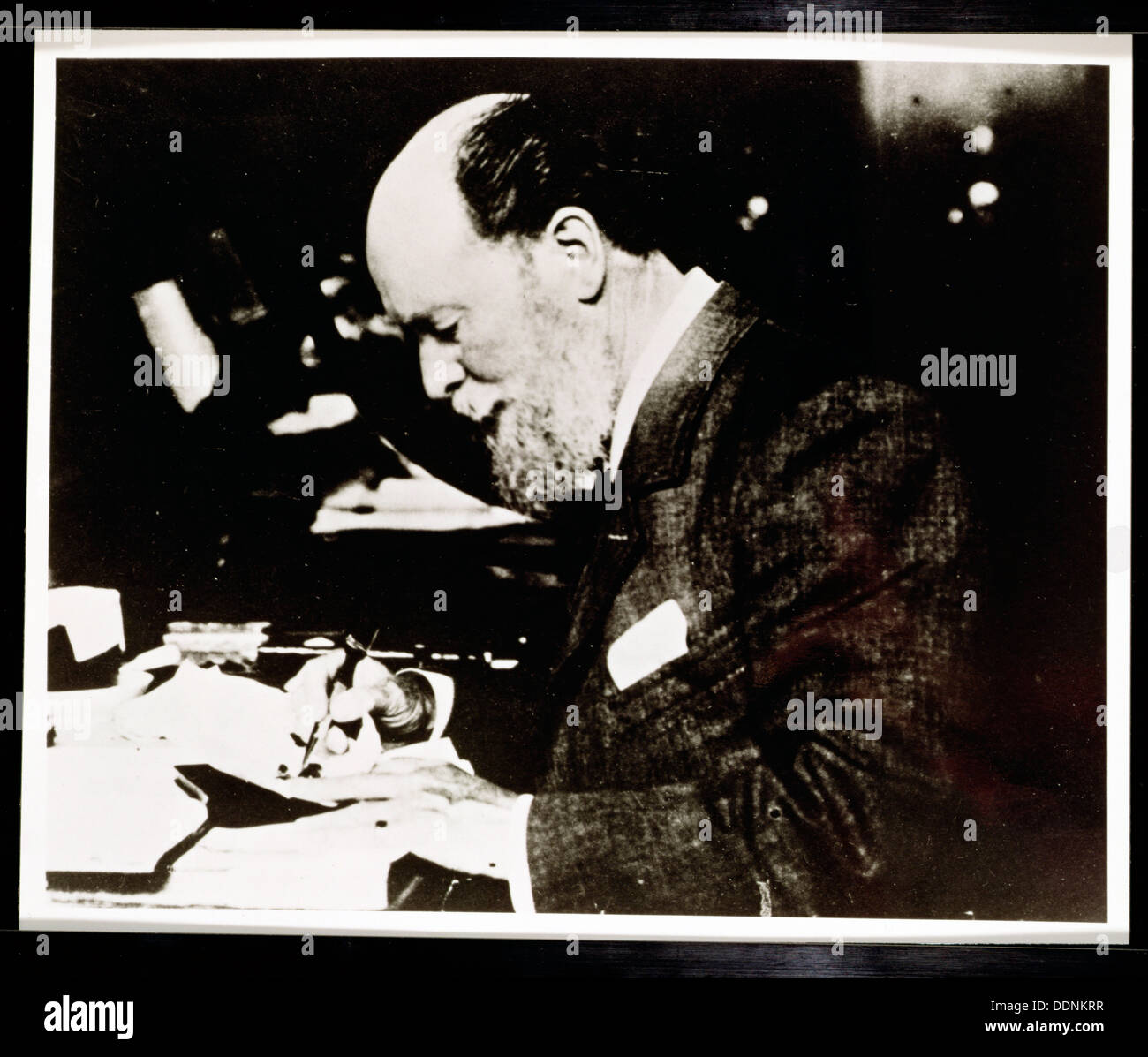
Peter Carl Fabergé
 Russia
Also known as: Charles Fabergé, Karl Gustavovich Fabergé
Birthday
May 30, 1846
Birth Sign
Gemini
Birthplace
Saint Petersburg, Russia
Age
Died at 74
About
Peter Carl Fabergé was a Russian goldsmith and jeweller, renowned worldwide as the creator of the exquisite Fabergé eggs, the jewelled Easter masterpieces made for the Russian Imperial family. Born in Saint Petersburg in 1846, he took over his father's business in 1872 and transformed it into the largest and most celebrated jewellery firm in Russia, defining the taste of an era with his innovative use of colour and enamel.
As jeweller to the Imperial Court, Fabergé produced a new, unique egg each year for Emperors Alexander III and Nicholas II, each a marvel of engineering and artistry. Beyond the eggs, his workshop crafted jewellery, objets d'art, and silverware that attracted clients including the kings of Sweden, Norway, and Great Britain. Today, his name remains synonymous with luxury and craftsmanship, and his works continue to fetch record sums at auction.
Early Life & Background
Peter Carl Fabergé was born on May 30, 1846, in Saint Petersburg, the elder son of Gustav Fabergé, a jeweller of Baltic German and Huguenot descent, and his wife Charlotte Maria Jungstedt, daughter of a Danish painter. The family's Huguenot ancestors had fled France after the revocation of the Edict of Nantes, settling in Estonia before moving to Russia. Carl spent his early years in Saint Petersburg, attending the Annenschule, and in the early 1860s the family moved to Dresden, where his younger brother Agathon was born in 1862.
In Dresden, Carl studied at the Handelsschule and frequently visited the Grünes Gewölbe, the museum of treasures founded by Augustus the Strong, which sparked his fascination with intricate craftsmanship. In 1865, he returned to Russia and refined his skills under the goldsmith Hiskiasa Pendina. In 1872, at age 26, he took over his father's business, setting the stage for his remarkable career.
Career Growth
Peter Carl Fabergé took over his father's jewellery business in 1872, and with his brother Agathon, he quickly turned it into an internationally recognised brand. Their success marked a shift in the jewellery world, moving away from a focus on diamonds and pearls toward design-driven pieces featuring natural coloured semi-precious stones and Fabergé's revived enamelling techniques. In 1885, he created the first Imperial Easter Egg for Tsar Alexander III, beginning a tradition that would produce about 50 eggs for the Russian Imperial family.
Appointed jeweller to the Imperial Court, Fabergé supplied not only the eggs but also a vast array of jewellery, objets d'art, and silverware to clients across Europe and Asia, including the kings of Sweden, Norway, and Great Britain, and the King of Siam. His firm grew to become the largest in Russia, and Saint Petersburg was considered one of the jewellery capitals of the world. Fabergé's success continued until the Russian Revolution, which devastated his business and led to his exile.
Career Timeline
Public Image & Style
Peter Carl Fabergé was seen in his time as the pinnacle of Russian craftsmanship, a master who elevated jewellery to an art form. His name became a byword for luxury, and his eggs, in particular, captured the imagination of the world. Today, he is remembered as a genius of design and innovation, with his works celebrated in museums and exhibitions globally. The Fabergé brand continues to evoke his legacy of exquisite artistry.
Fame & Fandom (iFAMOUS Rankings)
Peter Carl Fabergé remains a towering figure in the annals of decorative arts, his legacy measured not just by surviving masterpieces but by the enduring reverence for his craft. In the current landscape of global cultural attention, which tracks influence across media coverage and consumption signals worldwide, he holds a distinct position among historical creators. He is the 91st most famous person in Art & Design, a ranking that reflects the sustained fascination with his Imperial Easter eggs and the broader scope of his workshop's output. This standing within the iFANN Global Fame Rankings underscores how his name has transcended mere history to become a synonym for unparalleled luxury and engineering ingenuity.
While there is no organized fanbase that gathers for conventions or engages in real-time social campaigns, the community surrounding Fabergé is deeply devoted through the lens of collectors, art historians, and museum patrons. These admirers do not form a named fandom; instead, they unite through a shared appreciation for the rarity of his work and the tragic romance of his life story. The recent sale of the Winter Egg for a record-breaking $30.2 million in late 2025 served as a focal point for this collective interest, drawing global attention without the chaos of modern celebrity worship. Fans still retell the poignant narrative of his exile following the Russian Revolution, a tale of a "goldsmith to the gods" who died believing his world had crumbled. This legend, paired with the mystery of the missing Imperial Eggs, fuels a quiet but persistent search for lost treasures, keeping the spirit of Fabergé alive in the minds of those who value the intersection of art, tragedy, and history.
Interesting Facts and Legends
Peter Carl Fabergé's workshop operated as a prolific engine of creativity, producing over 150,000 objects beyond the famous eggs, including cigarette cases, picture frames, and miniature animals. He held a strict disdain for mass production, insisting that every single piece created under his watch be entirely unique. A charming anecdote from his personal life reveals he owned a pet parrot trained to squawk 'It's a fake' whenever presented with a counterfeit item. The workshop's crowning achievement, the Imperial Coronation Egg of 1897, housed a tiny replica of the coronation coach so intricate that its creation required more than a year of labor. Beyond these documented facts, the history of Fabergé is steeped in tragic legend. The narrative of his sudden exile following the Russian Revolution, which allegedly caused him to die of shock and depression believing his family had lost everything, remains a central pillar of his story. This tale is often paired with the enduring mystery of the missing Imperial Easter Eggs, a puzzle that has fueled speculation and search efforts for over a century. In modern times, this lore gained new weight when the Winter Egg sold for a record-breaking $30.2 million in late 2025, cementing the status of his works as the most valuable artifacts in jewelry history. Fans still retell the story of how he was known as a 'goldsmith to the gods,' a metaphorical title reflecting the divine quality of his craftsmanship that elevated ordinary materials into transcendent art.
Family & Personal Life
Peter Carl Fabergé married Augusta Julia Jacobs in 1872, and together they had five children, including Agathon, Alexander, and Eugène. Augusta was a supportive partner, and the family lived in a comfortable home in Saint Petersburg. After the Revolution, the family fled to Switzerland, where Carl died in 1920. Augusta passed away in 1925, and in 1929 their son Eugène moved Carl's ashes from Lausanne to rest beside her in the Cimetière du Grand Jas in Cannes, France.
Notable Connections
Peter Carl Fabergé worked closely with his brother Agathon, who joined the firm in the 1880s and contributed to its artistic direction. He also trained under the skilled goldsmith Hiskiasa Pendina. His father Gustav founded the House of Fabergé, and his sons Agathon and Alexander continued the family business after his death.
Relationships & Dating History
Peter Carl Fabergé married Augusta Julia Jacobs in 1872. Their marriage was a stable partnership that lasted until Fabergé's death in 1920. Augusta was a constant support throughout his career, and they had five children together. After Fabergé's death, Augusta lived until 1925, and the couple were reunited in death when their son moved Carl's ashes to Cannes to rest beside her.
- MarriedAugusta Julia Jacobs1872 - 1920Married for 48 years until Fabergé's death; they had five children together.
Death & Aftermath
Died
September 24, 1920 (aged 74)
Death Place
Lausanne, Vaud, Switzerland
Cause of Death
Unknown
The enduring legacy of Peter Carl Fabergé has since been cemented not by immediate public mourning, but by the soaring auction records of his creations and the global reverence for his artistry., his name remains synonymous with high jewelry, a status celebrated decades later when the House of Fabergé was revived as a luxury brand and his works like the Winter Egg fetched record sums at auction. He died on September 24, 1920, in Lausanne, Switzerland, following years of exile after fleeing Russia in 1918 due to the nationalization of his business assets by the Bolshevik regime. The historical record confirms he was 74 years old at the time, yet available biographical sources do not provide a detailed medical report, autopsy results, or an official coroner's ruling regarding his final days.
General references suggest declining health during his years in exile, though the exact nature of his last days and any specific medical intervention remain unconfirmed in standard documentation. His funeral was a private affair held in Lausanne within the Swiss expatriate community, far removed from the judicial systems of the Soviet Union or Western powers. Historical consensus indicates he was buried in the Flon Cemetery in Lausanne, though specific details regarding the date of burial or notable attendees remain obscure in biographical summaries.
Net Worth (Estate Value)
Peter Carl Fabergé died in 1920, and his estate has since become legendary. While no precise current estate value is available, the worth of his creations has soared. Individual Imperial eggs have sold for tens of millions of dollars at auction; for instance, the 1913 Winter Egg fetched $9.6 million in 2002, and the 1885 First Hen Egg is considered priceless as a Russian national treasure. The Fabergé brand itself, relaunched in 2009 by Pallinghurst Resources, continues to generate revenue through luxury goods licensing. The estate's financial trajectory is marked by record-breaking sales and enduring demand for his masterpieces.
Awards Won (4)
Peter Carl Fabergé received numerous honours during his lifetime, including the Russian Order of St. Stanislav and St. Anna, the Bulgarian Commander's Cross, and the French Legion of Honour. He also won gold medals at international exhibitions in Paris, Stockholm, and other cities, cementing his reputation as a master jeweller.
1889 · Imperial Award
1892 · Imperial Award
Known For
Fabergé Eggs
1885 · Creator
House of Fabergé
1872 · Head Jeweller
Keywords
Sources
Quick Facts
- Profession
- Goldsmith and Jeweller
- Born
- May 30, 1846
- Birthplace
- Saint Petersburg, Russia
- Died
- September 24, 1920
- Death Place
- Pully, Switzerland
- Gender
- Male
- Spouse
- Augusta Julia Jacobs
- Children
- Five, including Agathon, Alexander, Eugène
Personal Details
- Full Name
- Peter Carl Fabergé
- Spouse
- Augusta Julia Jacobs
- Children
- Agathon, Alexander, Eugène, and two other children
- Education
- Annenschule, St Petersburg; Handelsschule, Dresden
Frequently Asked Questions
How many Fabergé eggs were made?
What is a Fabergé egg worth?
Who owns the Fabergé brand today?
Where is Peter Carl Fabergé buried?
Did Fabergé only make eggs?
Join the community
fans discussing