 Japan
Japan“A chilling and brilliant descent into madness. Kon's film is as disturbing as it is beautiful, a rare combination in any medium.”
Maitland McDonagh
TV Guide
In 1997, a young pop idol named Mima Kirigoe stood at a crossroads. After years as the sweet-faced center of the J-pop trio CHAM!, she announced her retirement from music to pursue acting. Her fans were not pleased. One of them, a hulking obsessive who calls himself Me-Mania, began documenting her every move on a website called "Mima's Room," posting diary entries written from her perspective with unsettling accuracy.
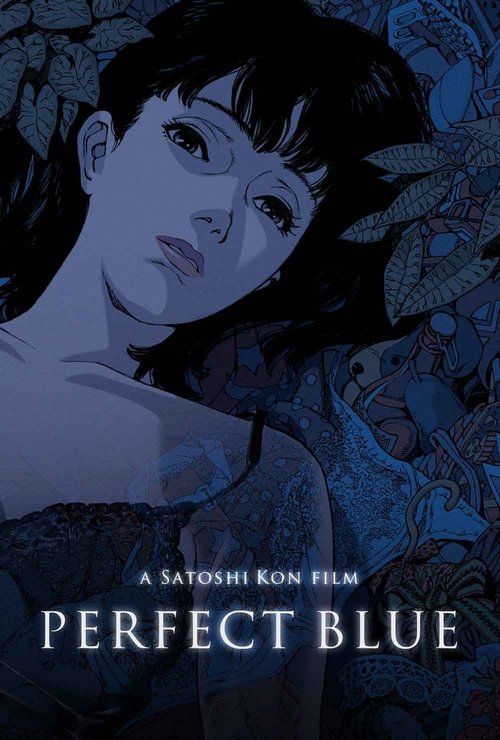
What follows is Satoshi Kon's directorial debut, a psychological horror film that refuses to let the audience settle into any single reality. As Mima takes a role in a gritty detective drama requiring nude scenes and a simulated rape, the line between her on-screen character and her own life begins to dissolve. People around her start dying. She finds bloodstained clothes in her own closet. And a ghostly version of her former idol self appears to mock her choices. Kon, working from a loose adaptation of Yoshikazu Takeuchi's novel, built the film on a modest budget of $830,442, with Madhouse handling the animation. The result, released in Japan on February 28, 1998, grossed $2.7 million worldwide and earned a cult following that has only grown in the decades since.
Perfect Blue is a film about the violence of fame, the fragmentation of identity, and the terror of being watched. It is also a masterclass in visual storytelling, using match cuts, mirrored reflections, and jarring shifts in color palette to mirror Mima's unraveling mind. The film holds an 87% Tomatometer score on Rotten Tomatoes and an 8.0 on IMDb, and its influence ripples through later works like Darren Aronofsky's Black Swan and Requiem for a Dream. Yet it remains, first and foremost, a singular, disturbing experience.
Stream
Availability and pricing can change. Confirm on the provider's site before purchasing.
Mima Kirigoe has spent her teenage years as the smiling face of CHAM!, a wildly popular J-pop trio. But Mima wants more. She announces her departure from the group to pursue acting full-time, a decision that shocks her fans and her manager, Rumi Hidaka, a former idol herself. The public reaction is mixed. Some fans are supportive; others feel betrayed. One fan in particular, a stocky, bespectacled man known only as Me-Mania, becomes obsessed. He creates a website, "Mima's Room," that chronicles Mima's daily activities in eerie detail, as if written by Mima herself.
Mima's first acting role is a small part in a detective drama called Double Bind. The part is minor at first, but the director, Tadokoro, decides to expand it. He rewrites the script to give Mima's character a traumatic backstory involving a rape, and Mima agrees to film a simulated rape scene. She also poses for a nude photo shoot under pressure from a sleazy photographer named Murano. These choices horrify her remaining fans, who see her as betraying her innocent idol image. The website posts about each decision before it even happens, as if someone is watching her every move.
As Mima immerses herself in the role, her mental state fractures. She begins seeing a translucent, grinning version of her old pop-idol self, who taunts her: "You're a fake!" Mima starts to confuse her own memories with scenes from the TV show. She cannot remember whether she actually attacked Murano after the photo shoot, or if that was a hallucination. When Murano is found murdered, stabbed with a screwdriver, Mima discovers a bloodstained screwdriver and clothes in her own apartment. She has no memory of committing the murder, but the evidence points to her.
The murders continue. The scriptwriter of Double Bind, who wrote the rape scene, is killed. Then a security guard who had harassed Mima is found dead. Each time, Mima finds herself near the crime scene with gaps in her memory. The police, led by Detective Shibuya, begin to suspect her. Meanwhile, Me-Mania escalates his stalking. He breaks into Mima's apartment and leaves a threatening note. Mima's grip on reality slips further. She starts to believe that the killer is her own "other self," the pop-idol version of her who wants to destroy the "fake" actress Mima.
Rumi, her manager, tries to protect her, but Mima grows paranoid of everyone. She sees Me-Mania following her, hears voices, and finds the website updating in real time with her private thoughts. The film constructs a labyrinth of mirrors, where every reflection might be a hallucination. Mima's performance as a character with dissociative identity disorder on Double Bind mirrors her own life so closely that she can no longer tell where the script ends and her reality begins. The plot hurtles toward a confrontation in a film studio, where the line between actress, stalker, and killer collapses entirely.
Remastered - Official 4K Trailer [Subtitled]
Original Japanese Trailer [Subtitled]
Official Trailer [Subtitled]
Critical Consensus
A groundbreaking animated psychological thriller, Perfect Blue masterfully blurs the lines between reality and delusion. Satoshi Kon's directorial debut is a visually stunning and deeply unsettling exploration of fame, identity, and obsession that remains a benchmark of the genre.
“A chilling and brilliant descent into madness. Kon's film is as disturbing as it is beautiful, a rare combination in any medium.”
Maitland McDonagh
TV Guide
“Visually stunning and psychologically complex, this is a masterpiece of animated horror that lingers long after the credits roll.”
David Cornelius
Film Threat
“Perfect Blue is a dizzying, disorienting and utterly unforgettable experience. Kon manipulates the audience with the same ease his characters manipulate each other.”
Andy Webb
The Movie Scene
“Satoshi Kon's debut is a landmark achievement in animation, a truly disturbing and thought-provoking film that redefines what the medium can achieve.”
Chris Tookey
The Daily Express
Junko Iwao
Mima Kirigoe (voice)
Rica Matsumoto
Rumi (voice)
Shiho Niiyama
Rei (voice)
Masaaki Okura
Mamoru Uchida / Me-Mania (voice)
Shinpachi Tsuji
Tadokoro (voice)
Emiko Furukawa
Yukiko (voice)
Yosuke Akimoto
Tejima (voice)
Yoku Shioya
Takao Shibuya (voice)
Hideyuki Hori
Sakuragi (voice)
Emi Shinohara
Eri Ochiai (voice)
Masashi Ebara
Murano (voice)
Kiyoyuki Yanada
Kantoku (voice)
Director
Satoshi Kon
Writers
Sadayuki Murai, Yoshikazu Takeuchi
Composer
Masahiro Ikumi
Cinematographer
Hisao Shirai
Producers
Hiroaki Inoue, Hitomi Nakagaki, Masao Maruyama, Yoshihisa Ishihara, Yutaka Togo
Fantasia Film Festival (1998)
Best Film: Won
Sitges Film Festival (1998)
Best Animated Feature: Won
Brussels International Festival of Fantasy, Science-Fiction and Thriller Films (1999)
Golden Raven: Won
Join the community
fans discussing